Home Blog Page 922

GPU Virtualization: The Next Step in Automotive Innovation

With the rapid adoption of automotive virtualization, manufacturers can now run multiple systems on a single computer, from highly reliable Linux software for mission-critical functions to highly customizable Android software for infotainment services. Although virtualization enables limitless opportunities to customize the driving experience, all these different virtual machines must still run their graphics processing requests through a single GPU.

In most vehicle architectures, the GPU is a separate co-processor with its own firmware. This means that each VM must send its commands and data to the GPU for processing and then receive the completed request from the GPU’s firmware. The problem with this setup is that if a VM sends an illegal command or bad data to the GPU and causes it to crash, no other VM can interact with the GPU until it is rebooted. Not only is this irritating, but it can affect the stability and security of any mission-critical vehicle software that is running on another VM.

Like everyone else, my company GlobalLogic struggled with a way to share a GPU between VMs without affecting the performance, stability, and security of those VMs. As part of our product development service offerings to automotive manufacturers, we utilize a virtualization platform called Nautilus to run multiple VMs on a single board computer. Although we had successfully sandboxed all automotive OSes leveraging a Xen Type 1 hypervisor, we were still dependent on the GPU hardware — and all its vulnerabilities.

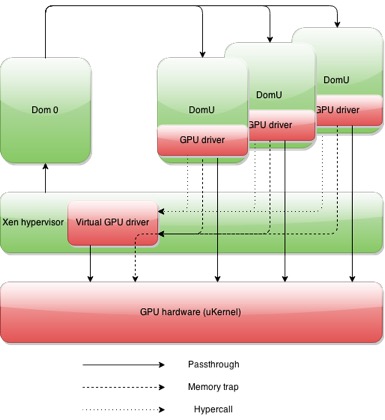
Then we realized that instead of using the GPU’s firmware for all VMs, we should instead flip the script and build an architecture that enables each VM to work with its own GPU firmware. For example, if VM1 needs to process a graphics request, it will upload its firmware to the GPU, execute the necessary commands, and then “log off” from the GPU. Once VM1 is no longer using the GPU, VM2 can begin to upload its firmware — and so on and so forth.

Behind the scenes, the platform stores all states of the GPU in a virtual GPU driver that sits on the Xen hypervisor. When VM1 initiates a request to access the GPU, the platform resets the GPU and uploads the VM’s firmware so that the VM is working with the GPU from its last previous status. This reset-upload-execute-reset process enables each VM and GPU to work in a siloed session and not affect any other VM-GPU sessions. If VM1 sends an illegal command to the GPU, it will only crash its own specific session instead of the entire GPU. This approach greatly improves the stability and security of GPU-sharing in a virtualized environment.

GPU sharing with mediated passthrough diagram.

Our GPU virtualization solution enables multiple domains to share the GPU hardware with no more than a 5 percent overall drop in performance. We are able to achieve this functionality by optimizing hardware resources across the native kernel module and carefully managing resources through a Xen mediator driver. With this architecture, no guest domain ever has access to any real hardware — everything is virtualized. 

We have thoroughly tested this approach and integrated it into our Nautilus platform with fantastic results. We are currently using this architecture with live customers, and we will be further demonstrating the solution at the GENIVI showcase at CES 2016 if you’re interested in learning more about GPU virtualization.

As automotive manufacturers come to rely more on software to operate their vehicles and engage with drivers, the graphics capabilities of vehicle dashboard displays and IVI systems will become increasingly important. With GPU virtualization, manufacturers can optimize graphics processing performance across multiple VMs while also ensuring the stability and security of those VMs.

Alex Agizim is VP, CTO of Embedded Systems at GlobalLogic Inc.

Top 5 Virtual Networking Predictions for 2016

laserNetworking is set to be one of the biggest growth industries for open source software development this year, and a key part of that is Network Functions Virtualization (NFV). Set to transform the way networks  are designed, NFV—an initiative to move to the cloud network services that have traditionally been carried out by proprietary, dedicated hardware—has seen explosive growth over the past few years, and that trajectory has only just begun. In fact, analyst firm Infonetics forecasts a fivefold increase in the NFV/SDN (Software-Defined Networking) market by 2019 with more than $11 billion in revenue. That’s huge.

The past year alone saw a tremendous NFV spike with more telecoms testing Proof-of-Concept (PoC) demonstrations to verify real-world applicability; more emerging use cases; and more interest and momentum outside the telecom space. NFV and SDN are on the precipice of reaching critical mass, set to change how networks are architected. Such a transformation is similar to the way in which server virtualization has changed how the internet is built. NFV is bringing the scale and elasticity of cloud architecture to networking.

The Linux Foundation-hosted Open Platform for NFV (OPNFV) Collaborative Project, which was created just over a year ago to help address the growing demand for NFV functionality, is at the forefront of this transformation. Tasked with creating a carrier-grade, integrated, open source platform to accelerate new NFV products and services, OPNFV boasts 56 member companies (including top mobile, wireline and cable operators, chip vendors, and startups), a forthcoming second release and a successful inaugural Summit held this past November. The project’s swelling community demonstrates the hunger for agile solutions that meet evolving network demands.

NFV is poised to move into deployment in 2016. Armed with increased functionality, testing and interoperability—propelled by OPNFV—the market is primed for some bold and innovative milestones over the next year. Here are my top five predictions for NFV this year.

Top 5 Predictions for NFV in 2016

1.  Containers will become a key technology component in any NFV platform. Containers are very hot right now, and the heat extends to NFV/SDN. With many network operators beginning to look at more efficient ways to introduce VNFs, containerization offers an alternative to using VMs running guest operating systems and instead uses applications inside “containers” on top of Linux.

2. “NFV” and “SDN” will be top skillsets among telecom job seekers. With the explosive growth of NFV and SDN, there is ample opportunity for developers looking to invest in long-term career growth and we expect to see “NFV” and “SDN” top job searches on recruiting sites like Linux.com and Dice.com. Growing projects like OPNFV and the need for NFV chops among a growing number of service providers and other IT sectors, signal an uptick in developer engagement across the board.

3. The first (limited) production deployments based on OPNFV technology will go live. 2015 saw an increase in NFV proofs-of-concept (there are currently 38 NFV PoCs according to the ESTI NFV Industry Standard Group), which will ultimately lead to more deployments. And as OPNFV releases its second and third iterations of the platform in 2016, the technology will become mature enough for early deployments to leave the lab and enter production. Similarly, I  expect more tier-2 telcos and others interested in deploying NFV will join the party based on the ROI and best practices learned from the early adopters.  

4. OPNFV will attract its first non-telecom end user member. Both SDN and NFV are expanding beyond just the telco space, with a broad range of implementations outside the traditional telecom space. Enterprise IT, academia, research and financial services are all experimenting with NFV and as use cases grow, it’s only a matter of time before OPNFV’s member roster reaches into other sectors.

5. Higher-profile NFV-related service outages will occur, signaling a turning point in adoption. I  expect to see issues with new NFV-based services/products as they begin roll-out, particularly regarding scale which could impact performance or accessibility. While service outages may be challenging, they are a natural, evolutionary step for any new technology. As NFV moves out of PoCs and into deployment, there will be growing pains along the way that the industry will learn from. The silver lining is that any large scale outage signals that the technology is maturing.

Mass adoption is still very much a journey. The acceleration we’ve made over the past year-plus is an indication that the industry is ripe and ready. We’ve reached the tipping point; the key pieces are in place and the time has come to begin to execute.

Heather Kirksey is Director of NFV for OPNFV, at The Linux Foundation.

Kali Linux NetHunter 3.0 Android Mobile Penetration Testing Platform Out Now

kali-linux-nethunter-3After being in development for over a year, the Kali Linux NetHunter 3.0 Android application has been released earlier today, January 6, 2016, by Offensive Security, the company behind Kali Linux, the successor of BackTrack.

Among the prominent features of Kali NetHunter 3.0, we mention a completely rewritten user interface, which has been made more application-centric, support for new attacks, even complex ones, support for managing your Kali chroot independently,

How OPNFV Operationalizes Network Functions Virtualization

Thanks to cloud computing, networks are experiencing an exponential growth in traffic. Service providers are under immense pressure to meet the demands of end-users and enterprises, and so not surprisingly they are looking towards technologies as software-defined networking (SDN) and network functions virtualization (NFV) to improve service agility and operational efficiency.

Open source software has become the key ingredient in addressing these challenges. In this article, we will focus on one such open source project, The Open Platform for NFV (OPNFV), which is a carrier-grade open source reference platform for NFV.

Read more at The New Stack

CES Brings the First Big Crop of AllJoyn IoT Products

More than a dozen smart-home products at the CES show this week can find and interact with each other through the AllJoyn software framework, one of the major platforms vying to connect the Internet of Things.

The devices include light bulbs, audio systems, an air humidifier and a security camera that can link up to other connected gear. They’re the first big batch of products to be certified for AllJoyn interoperability since the first were announced last October: Microsoft’s Windows 10 Professional and Surface Pro 3.

Read more at PCWorld

Server Monitoring with Munin and Monit on Ubuntu 14.04 LTS

This tutorial will show you how to monitor an Ubuntu 14.04 server with Munin and Monit. Munin produces nice graphs about nearly every aspect of your server, whereas Monit checks the availability of services like Apache, MySQL, Postfix and takes the appropriate action such as a restart if it finds a service is not behaving as expected. The combination of the two gives you full monitoring: graphics that let you recognize current or upcoming problems, and a watchdog that ensures the availability of the monitored services.

Read more at HowtoForge

Severe Silent Circle Blackphone Vulnerability Lets Hackers Take Over

screen-shot-2016The security-focused smartphone contained vulnerabilities which allow hackers to control the device’s modem and call functions.

Silent Circle’s Blackphone, born after former US National Security Agency (NSA) contractor Edward Snowden exposed the intelligence agency’s spying practices on the global stage, is a phone peddled to the privacy-conscious. The Blackphone grants users complete control of app permissions and includes encrypted services such as Silent Phone and Silent Text,…

Read more at ZDNet News

Internet of Things Growth to Drive U.S. Tech Market

The Internet of things (IoT) will help lead the U.S. consumer technology industry to record-setting revenues in 2016, according to a report from the Consumer Technology Association (CTA). 

CTA’s retail revenue projection for 2016 is $287 billion. Its wholesale revenue projection is $224 billion. In video, smart TVs are projected to sell 27 million units in 2016, a 13 percent increase over 2015.

Read more at eWeek

Amazon Makes EC2 Cloud Hosting Cheaper, Especially for Linux

Amazon has reduced EC2 cloud hosting on AWS for certain regions in the U.S., Europe, Asia-Pacific and South America. Linux hosting has seen the greatest price reduction.

Amazon EC2 cloud hosting has become cheaper than ever following a price reduction for certain services and regions, especially if you use Amazon’s Linux images. The pricing changes, which Amazon announced Tuesday, include 5% reductions in the cost of Linux cloud servers on the following configurations…

Read more at The VAR Guy

Microservices Are Not the Same Thing as Components

lego builders photo by simone mescoliniMention cloud, mention DevOps and it won’t be long before microservices enters the discussion. But what is, or are, microservices? The name implies something small – but what? Is it a part of a bigger thing or a piece of discrete functionality? And how are microservices different to application components? And why should we care?

An application component is a small part of an application, obviously. It is a function, a sub-element, sometimes an extension or a plug-in extra…

Read more at The Register