Home Blog Page 961

Systemd 228 Ships New Features

David Herrmann has announced the release of systemd 228…

Read more at Phoronix

Ubuntu Touch Could Get WiFi Display Support to Help Turn the Phone into a PC More Easily

One of the issues with the Ubuntu Convergence and the ability to use the phone as a PC is the fact that it requires dedicated hardware features on the device, but that might get solved in the future by the Ubuntu team.

Ubuntu Convergence refers, in the broadest sense, to the fact that both systems, for the phone and the desktop, share the same codebase. The fact that you can connect your phone to a TV and turn it into a PC experience is a result of that shared codebase. In … (read more)

Deis Aims to Extend Kubernetes into a Platform

In just a few short months, Google’s deft move to build an open consortium around its Kubernetes orchestrator has shifted the platform focus away from containers, and onto container orchestrators.

Perhaps the biggest indicator of that shift came last week at KubeCon in San Francisco, where Deis — now the brightly polished new division of Engine Yard — unveiled a package manager for workloads called Helm.

Helm will take a wholly new approach to deploying workloads in a PaaS-like manner, with Kubernetes — not Docker — as the objects of these deployments, according to principal architects Jason Hansen and Matt Butcher. The Deis team saw that no two data centers or cloud environments work alike, so no technique for deploying one type or even one identity of workload will translate perfectly between platforms, like a standardized template.

Read more at The New Stack

Release of UCS 4.1 with Docker, Single Sign-On + 2F Authentication

Univention published UCS 4.1 with important new features.

Most important innovations are:

  • Support of Docker-based apps in the Univention App Center
  • Single sign-on in the UCS management system via SAML technology
  • Even safer login process via optional two-factor authentication
  • User self-service for the password reset
  • Usability improvements and more transparent interface for the App Center
  • Technical basis: Linux longterm kernel 4.1.12, OpenLDAP version 2.4.42 and Samba 4.3.1

The new UCS version 4.1 is available online to download for free as VM or ISO image.

There is also an online demo available.

More about the new features in the Univention blog articles about Docker, Single Sign-On and Two-Factor Authentication.

Career Development Day: Build Your Career with Linux Foundation Training

logo lf newNovember 18 is National Career Development Day! In fact, the whole month of November is dedicated to career development and is sponsored by the National Career Development Association, which promotes and supports professional education, preparation, and credentialing for career development programs and services.

The Linux Foundation offers many career development resources for developers, users, and administrators of Linux systems. One of the most important offerings is its Linux Certification Program, which provides performance-based exams that are continuously updated using feedback from the community, so they are always up-to-date and relevant.

Whether you’re looking for your first job or just looking to upgrade your current position, a Linux Foundation certification will help you demonstrate your value and verify your skills. With a wide choice of online, classroom, and on-site Linux training offerings, Linux Foundation courses can help you stay ahead of the curve.

To celebrate Career Development Day, here are some of the ways that recent training participants, scholarship winners, and certified engineers and sys admins say the certifications will help them meet their career goals. What are your goals? How could training help you? Tell us in the comments, below, or weigh in with @LF_Training on Twitter.

Career Goal #1: Technical Leader in Linux Networking

diego BWDiego Xirinachs, who is a Linux Foundation Certified Engineer, says his career goals include becoming a technical leader on Linux networking technologies.

“Having a certification straight from the company that hosts Linux and even employs the Linux creator is a statement about my real Linux skills, and proves my skills are not tied to any distribution in particular,” says Diego.

Career Goal #2: Expert in Linux for the Enterprise

Sevillano BWEnrique Sevillano works as an IT manager at an energy utility company. He says Linux and open source have allowed him to deploy a high-availability virtualization infrastructure as well as affordable storage and cloud solutions.

”I am ensuring my career as an expert of deploying Linux for the enterprise as well as transitioning to Linux from another computing platform… I do see Linux Foundation courses as an essential part of my career,” Enrique says.

Career Goal #3: Linux Security Specialist

eva BWEva Tanaskoska is a university student in Macedonia who sees training as a way to enhance her education and build a specialized skill set. She is currently forming a CERT team, where she mentors students on using Linux to perform penetration tests, forensic investigations, and incident response.

She is taking the Linux Security course, because, she says, “I want to learn as much as I can about Linux’s security mechanisms. My graduation thesis will also be Linux security oriented. Therefore, I’m certain the course will help me greatly with it and possibly with my postgraduate studies, too.”

Career Goal #4: OpenStack Expert

thumb ivanIvan Melia took the OpenStack Cloud Architecture and Deployment course as a way to rapidly gain expertise with OpenStack. He says, “Training helps me have a real skill set and background that puts me in better position to talk about technology and have credibility. Training for me is an acceleration in the ramp up in building a technology skill set.”

“I was expecting that the training would be in-depth and it was.  It was the perfect amount of theory and practice. I wanted to be able to deploy OpenStack in data centers, and consult on Open Cloud deployment, and the training was a great value add. I wouldn’t have felt comfortable doing that without the training,” Ivan says.  

Career Goal #5: Differentiating Job Skills

NamPho BWNam Pho, a recently certified system administrator, works in the research computing group at Harvard Medical School. He sees training and certification as a way to differentiate yourself from others when applying for a job.

He says, “Having been on both sides of the process, I’ll say that hiring is tough. There are so many applicants for jobs these days that say they know this or that and without talking to them it’s tough to really know the depth or quality of that experience. I like to think that having certifications is a rough proxy for some competency and will increase the odds that you get a response.”

Attempt to set up HAProxy/Keepalived 3 Node Controller on RDO Liberty per Javier Pena

Actually, setup bellow follows closely https://github.com/beekhof/osp-ha-deploy/blob/master/HA-keepalived.md
As far as to my knowledge Cisco’s schema has been implemented :-
Keepalived, HAProxy,Galera for MySQL Manual install, at least 3 controller nodes. I just highlighted several steps  which as I believe allowed me to bring this work to success.

Complete text may be seen here

The Essential Sphinx Markup Cheatsheet for Faster Documentation

Sphinx markup examples

Last week, in Write Documentation Once, Output Multiple Formats with Sphinx we learned how to install the Sphinx documentation generator, and how to build HTML, PDF, Epub, and other documents from a new Sphinx installation. Today we’re going to create a small test project with some original content, and mark it up using RST, the native Sphinx markup language. Then you can build multiple output formats from your single source. All you need is your favorite text editor and a working Sphinx installation.

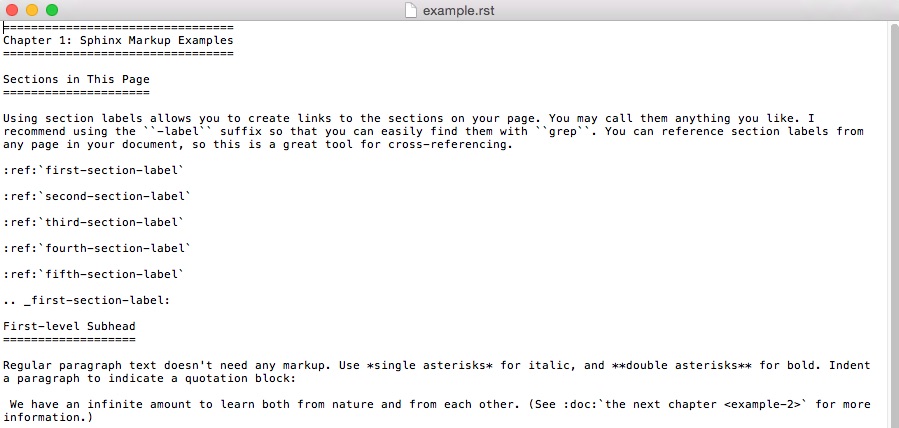
The example project for this article is simple and demonstrates the essentials. Start by downloading the main example page, example.rst, the screenshot of the rendered HTML page, sphinx-html-page.png, and the other project files from Google driveexample.rst is a Sphinx source file, and sphinx-html-page.png shows what it looks like after running the make html command.

Sanity Tips
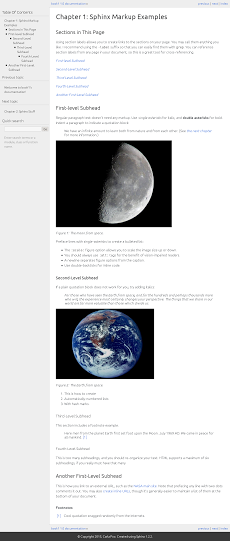
sphinx html pageWhen you need help always refer to the Sphinx reference manual, rather than wasting time on Web searches full of wrong answers.

Sphinx is written in Python, so whitespace matters. Run frequent builds, as this is the fastest way to find markup errors. This example from running make html finds an error and tells us exactly where it is:

book1$ make html
[...]
/home/carla/book1/content/example.rst:23: WARNING: Title underline too short.
First-level Subhead
=================

Documentation Structure

In the example project for this article, the project file structure looks like this:

book1
|--_build
|-- conf.py
|-- content
   |-- example-2.rst
   |-- example.rst
|-- images
   |-- blue-marble.jpg
   |-- moon-from-space.jpg
|-- index.rst
|-- Makefile
|-- _static
|-- _templates

book1 is the project’s root directory. When you run your build commands, the output goes into the _build directory. All of the files were created by the sphinx-quickstart script (see part 1) except the content and images directories. Those are my example content files, and index.rst was modified to include the content files.

Your source files should have the .rst file extension. (This is configurable in conf.py with the source_suffix parameter.) When you reference your .rst files in internal links and the table of contents use only the filename and omit the extension. For image files you must specify the full filename, including the extension.

Titles and subheadings are marked-up with a variety of punctuation marks. You may use whatever punctuation marks you like, or adornments as the Sphinx manual calls them; the order on your page determines how they render. Your adornments must be the same length as your headings. If they are not you’ll see warnings in your build output.

Your table of contents page is defined in conf.py with the master_doc parameter. For this project the TOC source file is index.rst. The example project is simple, containing only two pages, so the TOC is simple:

.. index.rst
=================
Table of Contents
=================
.. toctree::
    :maxdepth: 2
    
    content/example
    content/example-2

maxdepth controls how many levels of subheadings your TOC displays, so :maxdepth: 2 displays the page title and the second-level headings. You don’t have to call it “Table of Contents”, but can name it whatever you like. Prefacing any line with two dots and a space prevents it from appearing in the final output, so you can use this for comments as well as formatting directives. In the TOC example .. index.rst is a comment and .. toctree:: is a formatting directive.

Remember that all filepaths (in your TOC, cross references, and image links) are relative to your project root.

Building Your Project

In part 1 we learned how to list and run our available build commands. When you re-run a build command, for example make html, remember to always run make clean first. When you run multiple different builds in succession, do not run make clean because this deletes the contents of your build directory. Instead run them in succession so that they will all appear in your _build directory:

$ make latexpdf
$ make man
$ make epub
$ make text
$ ls _build
doctrees  
latex
man
epub  
text

Now you should have your original source files in four different nicely-formatted outputs. What do you do now? Check out the Sphinx documentation for more features and advanced functionality, starting with how to use conf.py for advanced project control.

Public domain photos of Moon and Earth courtesy Earth Science and Remote Sensing Unit, NASA Johnson Space Center

Google Open-Sourcing TensorFlow Shows AI’s Future Is Data

In open sourcing the TensorFlow AI engine, Lukas Biewald says, Google showed that, when it comes to AI, the real value lies not so much in the software or the algorithms as in the data needed to make it all smarter. Google is giving away the other stuff, but keeping the data.

“As companies become more data-driven, they feel more comfortable open sourcing lots of [software]. They know they’re sitting on lots of proprietary data that nobody else has access to,†says Biewald, who also worked at Yahoo as a search engineer and helped bootstrap a notable search startup called Powerset, now owned by Microsoft. “What they’re not opening up is their data. They would never do that.â€

Read more at Wired.

Freescale Makes Significant Investment in Real Time Linux

freescale logoFreescale has just announced they are joining the Real Time Linux (RTL) Collaborative Project as a Gold Member.  Freescale joins Google, National Instruments, OSADL, and TI with a significant investment because they value the strategic importance of this open source project and the benefits it creates for their customers.

For years, Freescale has offered full Linux board support packages to their customers which represent a broad range of industries including robotics, telecom, manufacturing, aviation and medical.

Linux adoption for embedded applications is following a similar path to what we saw in mobile, where smartphones and their apps drove new experiences and even further commercial success of Linux (via Android) in the marketplace. In the case of embedded systems, advances in artificial intelligence, image and voice recognition are sparking massive innovations based on the power, flexibility and cost advantages of embedded Linux systems. For example, in drones and cars we are seeing a convergence of advanced image recognition and artificial intelligence giving way to pilotless and driverless navigation.  From robotics, to drones, to cars, a real time Linux kernel is key to the foundation of these soon-to-be commercially available solutions.

With increased deployment of these devices in the field, support requirements escalate and mainline code gets costlier to maintain.  Companies spend more and more development time maintaining patches instead of innovating.  These costs and delayed innovation ultimately hurt the consumer.

The Linux Foundation helps companies solve this dilemma by helping them leverage open source to share the cost of R&D and build open source platforms that allow them to innovate faster.

The research and development required to implement full real time support in the Linux kernel mainline is substantial.   The RTL Collaborative Project supports Preempt-RT maintainer, Thomas Gleixner and his team of RT experts to do this R&D and push critical code upstream to be reviewed and eventually merged into the mainline Linux kernel where it will receive ongoing support. This will save the industry millions of dollars in development and will focus their efforts on innovation instead of patching kernels.    

As a Gold member, Freescale will lead at the Gold level and have voting rights on resource allocations while also participating in the quarterly code plan review, and the twice yearly face-to-face at the Embedded Linux Conference. In addition, Freescale will have the option of sending an engineer for one month to work alongside Gleixner and his team.

I applaud Freescale, a long time member of The Linux Foundation and advisory board member of the Yocto Project, for joining this important project and reinforcing their long standing commitment to the Linux and open source community.

Docker Debuts Universal Control Plane Management Service

The new technology, unveiled DockerCon EU, provides enterprise deployment and management capabilities.

Read more at eWeek