The Linux-dominated home automation business is still a fragmented free-for-all, but it’s also beginning to consolidate, with far fewer startups in 2015 compared to recent years. This month we saw several major product announcements from established players related to Linux.
First, Google’s Nest Labs announced the first device partners for its Weave home automation protocol using the Thread networking standard. Now Samsung, which began shipping its first Linux-based SmartThings hub last month, released a $249 sensor kit built around the hub. Meanwhile, in the larger Internet of Things world that includes industrial, as well as home automation, the Linux Foundation’s AllSeen Alliance announced a new certification program and security stack. In addition, Amazon unveiled an AWS IoT cloud platform available with starter kits based on Linux hacker boards (see below).
SmartThings Home Monitoring Kit
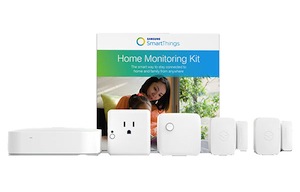 After Samsung acquired home automation vendor SmartThings in Aug. 2014, the company accelerated the development of a second-generation hub that moved to a more advanced processor running embedded Linux. Samsung unveiled the new SmartThings Hub this January at CES, and the hub finally shipped in September, along with a new line of smaller, sleeker sensors, and an improved mobile app.
With about 200 compatible devices that work with the SmartThings hub, new customers can get easily overwhelmed. The new Samsung SmartThings Home Monitoring Kit aims to get them started by offering the new hub with a discounted selection of ZigBee-connected smart sensors. The kit provides a motion sensor, a smart electrical outlet for controlling lights and other gizmos, and two multipurpose sensors. The latter can do things like checking whether doors, windows, or garage doors are open or closed.
The new hub has a faster processor, as well as battery backup that lasts up to 10 hours. Some basic functions are now available locally without Internet access. As before, the hub supports ZigBee, Z-Wave, and IP-devices connected via WiFi. Two new USB ports and a Bluetooth radio will support future expansion.
The improved Android and iOS mobile app, which will soon run on the Apple Watch and Samsung’s Tizen-based Gear S smartwatches, lets users organize and control connected devices by room, as well as view live streaming from cameras. A new Smart Home Monitor feature can send alerts and take rule-triggered action linked to unwanted entry or motion, smoke or fire, or leaks. A premium service lets you capture and upload video clips during such events.
Last January, Samsung said it was planning to move to Tizen over time, although no firm plans have been announced. In any case, SmartThings will likely play a central role in Samsung’s vision for Internet of Things in the home, connecting Samsung devices ranging from Smart TVs to phones to refrigerators.
A Forbes analysis earlier this month identified Samsung as one of six major companies expected to lead the Internet of Things industry, which spans home and industrial automation. The sextet, which also includes ARM, Cisco, Honeywell, IBM, and Intel, have vowed support for an expanding array of IoT alliances, ranging from interoperability organizations like the Allseen Alliance and the Intel- and Samsung-backed Open Interconnect Consortium, to wireless standards groups like ZigBee, Z-Wave, and Thread.
On the home front, Samsung, Google (Nest Labs), and Apple (HomeKit) are generally considered to be the leaders. Others include smart device vendors like Honeywell, GE Digital, and Belkin (WeMo), and perhaps home improvement store efforts such as Lowe’s Iris and the Home Depot and GE-supported Wink.
Yet, a larger, more established smart HVAC industry, spanning home surveillance, building management, and smart grid technology, is also getting into the market for wireless, smartphone-accessible devices. An Oct. 20 study from Transparency Market Research, which projects that the global home automation market will grow from $4.41 billion in 2014 to $21.6 billion by 2020, lists a much different set of players. According to the study, the leaders are Crestron Electronics, Control4 AMX, ADT, 2GIG Technologies, Siemens, Johnson Controls, Honeywell, iControl Networks, Vantage Controls, and Schneider Electric.
Nest Labs Reveals Weave Partners
The fact that few can agree who’s leading the automation market points to its continuing volatility. Yet consolidation has already begun, including Samsung’s SmartThings acquisition, Belkin’s pickup of WeMo, and iControl’s acquisition of Piper. Google’s Nest Labs has gone on to acquire companies — and more Linux-based smart-devices — including DropCam and Revolv.
Earlier this month, Nest Labs announced its first partners for its Weave home automation protocol. Weave is initially designed to work with the Google-backed Thread peer-to-peer wireless mesh networking standard, an IPv6-oriented, 6LoWPAN-based alternative to ZigBee and Z-Wave.
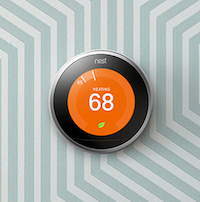 Using Weave with Thread enables a direct, low latency (100ms) connection from smart devices to Nest devices like the Nest Learning Thermostat without a live Internet connection. The mesh networking capability lets you connect devices in large houses that are beyond WiFi range.
Weave’s security stack includes application-specific encryption keys, making it harder for malicious hackers who break into one device to gain access to others, such as a door lock. Home automation devices are increasingly seen as a vulnerable point of entry for malicious hackers and identity thieves. Earlier this year, Qwirky’s Wink subsidiary was forced to recall its Linux-based Wink hubs because the company forgot to update the security software.
Nest Labs has also launched a Weave certification program. Weave-compatible products in the “Works with Nest” ecosystem will start with a Yale smart lock due in early 2016 called Linus. (It’s named after company founder Linus Yale, not Mr. Torvalds.) Other Weave partners include Big Ass Solutions, Daikin, GE, Hunter Douglas, iHome, Legrand, LIFX, Lutron Electronics, P&G, Philips hue, Rachio, Somfy, SkyBell, Tyco, and WeMo.
AllSeen Boosts AllJoyn Certification and Security
Certifications and security are growing points of focus for other automation platforms, such as the increasingly popular, open source Allseen/AllJoyn. Last week, the Linux Foundation’s AllSeen Alliance announced 13 new members including Buffalo and Midea. On Oct. 19, the Alliance announced an AllJoyn Certified program based on conformance and interoperability tests for the Qualcomm-supplied AllJoyn open source framework.
AllSeen also announced new security features for AllJoyn. The authentication and device authorization updates go beyond the existing data encryption and message-based security to add “rich semantics that extend familiar security models from the cloud and app domain to the devices that make up the IoT,” says the organization. The new security manager service architecture is said to manage key management, permission rules, and certificates in IoT connected devices.
Amazon Launches Ambitious IoT Platform
Earlier this month, Amazon made its big play in the industrial IoT market, which AllSeen/AllJoyn also supports. The company announced an AWS IoT managed cloud platform built around Amazon Web Services (AWS). Designed for aggregating input from sensor devices and other IoT endpoints, the platform includes an AWS IoT Device Gateway featuring AWS Identity and Access Management (IAM) software that lets customers manage individual or groups of devices.
Other components include a web-based AWS IoT Management Console, a cloud-oriented AWS SDK, and an AWS IoT Device SDK. The latter is available on 10 AWS IoT Starter Kits, three of which run Linux, and the rest on Arduino or various RTOSes on microcontroller-based boards. The Linux-based kits are built-around the BeagleBone Green, DragonBoard 410c, and Intel Edison with Arduino hacker SBCs.

 Ubuntu 15.10 (Wily Werewolf) has finally arrived in its stable form, but don’t expect to see too much on the desktop side. This new release of Ubuntu has a lot more changes and features on the cloud and server side of things.
 System 76 has announced its latest desktop release, Wild Dog Pro, with a range of high-end customizable configurations to enhance video editing and media creation, software engineering, CAD, and high-end performance for demanding games.
 Valve didn’t want to share the details about the hardware and software solutions used in the Steam Link, but it looks like the community has been quick to dismantle and share with everyone all there is to know about it.
 Liquid Lemur Linux offers a new twist on the usual Linux desktop environment experience. Developer Edward Snyder recently released the second alpha version of Liquid Lemur Linux 2.0. It offers a hybrid desktop experience that combines the Window Maker window manager with elements of the Xfce desktop. Liquid Lemur has been around for a few years, but it has gone through several directional changes. Its start-and-stop development saga included earlier releases based on non-Debian repositories and full use of the Xfce or KDE desktops.