Home Blog Page 1000

Review: Silent Circle Blackphone 2

So, so many of the phones we review here at WIRED are boring. There’s really nothing special to tell you about most of them. We can talk about processors or fun camera tricks, but like the paintings of Thomas Kinkade, every phone is just a variation on a common theme.

The Blackphone 2, the second device from the Swiss company Silent Circle, is unique. It promises a fully private experience, with advanced security features, deep permissions management, and encrypted voice, text, and video chat built in.

Read more at Wired

Google and NASA Are Getting a New Quantum Computer

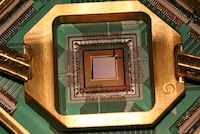
WashingtonC16-3.0.0The famous Quantum Artificial Intelligence Lab is getting some powerful new hardware. A joint project between Google, NASA, and the Universities Space Research Association, the Quantum AI Lab today announced a multiyear agreement to install a D-Wave 2X, a state-of-the-art quantum processor released earlier this year. With over 1,000 qubits, the machine is the most powerful computer of its kind, and will be put to work tackling difficult optimization problems for both Google and NASA.

The fragility of the qubits also means the computer’s processor can only operate at extremely cold temperatures. The 2X’s standard operating temperature is less than 15 millikelvin, a temperature far colder than outer space.

Read more at The Verge

Orange Pi PC Is An Open-Source Single-Board Computer That Runs Android and Ubuntu

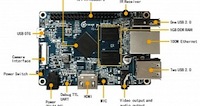
orange-pi-pcThe guys over Orange Pi have announced a new, cheaper version of their well-known Orange Pi 2 SBC (Single-Board Computer), which is dubbed Orange Pi PC, it’s open source, and it’s available for only $15 (€13).

Boasting an AllWinner H3 Quad-core Cortex-A7 H.265/HEVC 4K CPU, Orange Pi PC ships with a Mali400MP2 GPU that runs a 600MHz and supports OpenGL ES 2.0, 1GB DDR3 that is shared with the GPU, an 10/100M Ethernet RJ45, a TF card, and a MMC card slot. Best of all, Orange Pi PC comes with support for running the Ubuntu and Debian GNU/Linux distributions, Google’s Android…

Read more at Softpedia Linux News

Ubuntu Snappy Core 15.04 Has a New and Improved Raspberry Pi 2 Image

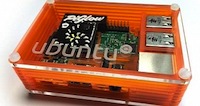
ubuntu-snappy-core-15-04Canonical’s Oliver Grawert had the great pleasure of announcing the general availability of the new and improved Raspberry Pi 2 image of the Ubuntu Snappy Core 15.04 operating system.

Being based on the latest Linux 4.2 kernel, the Ubuntu Snappy Core 15.04 Raspberry Pi 2 image is fully working, all of its device parts received internal modifications in order to work perfectly with Linux kernel 4.2, and it uses the linux-raspi2 package that was shipped by the Ubuntu Kernel team…

The 6 Best Natural Language Processing Tools in the World Today

In our formative years, we master the basics of spoken and written language. However, the vast majority of us do not progress past some basic processing rules when we learn how to handle text in our applications. Yet unstructured software comprises the majority of the data we see. NLP is the technology for dealing with our all-pervasive product: human language, as it appears in social media, emails, web pages, tweets, product descriptions, newspaper stories, and scientific articles, in thousands of languages and variants.

Many challenges in NLP involve natural language understanding. In other words, computers learn how to determine meaning from human or natural language input, and others involve natural language generation.

<A HREF=”http://www.linuxlinks.com/article/20150926105743917/NaturalLanguageProcessing.html“>Full story</A>

Apache Big Data Preview: Q&A with Pivotal’s Roman Shaposhnik

Pivotal WhiteOnTealSpun off from VMware and EMC in 2013, Pivotal Software, Inc. “represents the nexus between next-generation data-driven application architecture and approaches to transforming the enterprises into modern software companies,” says Roman Shaposhnik, Director of Open Source at Pivotal. “Work there feels like a unique opportunity, like, when I was at Sun Microsystems, I felt the creation of Java was a new way to develop software for the Internet.”

Shaposhnik will be participating in the keynote panel “ODP: Advancing Open Data for the Enterprise” at the upcoming Apache Big Data conference. As a preview to the event, we spoke with Shaposhnik about some of Pivotal’s products and the company’s support of open source.  

Companies like EMC and VMware tend to buy companies. Yet here, they spun one out. Why do you feel that was the right way to go?

For a company addressing next-generation data-driven application development, it has to be a standalone company.

Having Pivotal as an independent legal entity means we can have a very different relationship with open source software, and allows us to pursue our vision of a platform. For example, Cloud Foundry, which was developed originally at VMware is one of the cornerstone technologies of Pivotal. VMware’s focus is on virtualization technology. EMC’s is on storage. So it works out very well.

Do Cloud Foundry and VMware’s products co-exist?

Yes. They’re very complementary.

Pivotal offers a PaaS solution that delivers a set of services. These services need to run on a server-side infrastructure, like VMware, OpenStack, etc… although we prefer VMware. And data needs to be stored somewhere — like on EMC, although we can run on general-purpose storage.

What does Pivotal offer?

Pivotal Cloud Foundry, Pivotal Big Data Suite, and Pivotal Labs.

Pivotal Cloud Foundry is a comprehensive cloud-native platform, on which you can develop and run the kind of user-facing, big data apps that many companies are moving to — and lets you develop and iterate fast, deploying new features, versions and apps hourly if you want to, not just only once per month or quarter.

Pivotal Cloud Foundry is a product, including support, based on the Cloud Foundry open source project from the Cloud Foundry Foundation. Pivotal is one of the Foundation’s Platinum members, along with IBM, HP, and others.

Pivotal Labs helps companies move from traditional large, slow develop, test, deploy cycles to a new Agile model, to take advantage of a platform like Pivotal Cloud Foundry.

And Pivotal Big Data Suite lets companies handle and work with “big data,” in quantities and ways that legacy, silo’d, expensive tools couldn’t — or not affordably, or not fast enough.

Who’s using these products and services, and why?

Companies like Uber, Netflix, and many “business-model-disruptive” startups are succeeding by creating user-facing apps that be iterated from development to deployment quickly and frequently, can handle lots of users, and quickly extract information from large amounts of data. Large, established, traditional businesses like the Walmarts, Targets, taxi companies, and others are having to respond to this disruption be changing how they make and use IT — like the disruptive startups, transforming themselves into software-defined companies.”

Cloud Foundry is a tool for doing this, and Pivotal Labs helps companies change so they can take full advantage of these new tools and methods.

Pivotal-Roman Shaposhnik-2

Can you tell us about Pivotal’s support of open source?

Almost all of what we have and do is open source. A few pieces are still proprietary — mostly where the software comes from partnerships and relationships, areas where there are patent implications, and other things we have no control over. We are trying to rectify this, and push everything we can into open source. But the core tech is all OSS.

Tell us about Pivotal’s HAWQ technology. What does HAWQ stand for?

It stands for real SQL is finally Hadoop-native (laughs). Or, you could say it stands for Hadoop with Query. That’s my opinion at least.

What is HAWQ?

Pivotal HAWQ is essentially is a Hadoop-native advanced SQL analytics database.

“Hadoop-native” means that it is native to how Hadoop manages data… HAWQ is integrated with the Hadoop Distributed File System (HDFS)… and also with all other members of the Hadoop ecosystem, any way of representing data on Hadoop.

Being native means that HAWQ is well integrated with Hadoop’s resource management: YARN… YARN is how HADOOP partitions resources between different analytics frameworks, let them co-exist on the same compute cluster, and access data locked within the same cluster. HAWQ is fully YARN-aware.

Advanced SQL means we are fully SQL compliant. As a result, for example, HAWQ lets you hook up TABLEAU, which is the one of the most popular Business Intelligence tools available today… this means we can help BI users migrate to from their legacy systems to cloud-native environments.

Unlike other tools used by BI analysts, HAWQ is also useful for data scientists. HAWQ supports MADLIB, so they can do things like run linear regressions on the data, do feature extraction on unstructured data, etc… with an environment that’s familiar not just to BI users but also to data scientists. This makes it easier to bring (sell) HAD into the enterprise, because the APIs stay familiar.

To whom is HAWQ useful and where?

HAWQ is good for anyone trying to expand a traditional massively-parallel processing (MPP) database — verticals like financial, oil and gas, big retail, telco. Anybody who needs MPP power combined with Hadoop ecosystem. And anybody already using Hadoop should be trying HAWQ on the same cluster, if analytics rather than transactions are your priority.

Tell us more about the Open Data Platform.

ODP is an exciting initiative, letting different players in Hadoop space advance the state of Hadoop as a holistic platform.

It’s exciting because it allows vendors to solve a very important problem: make sure that Hadoop wins in the enterprise. Think back to the “Unix wars,” where the only winner was Microsoft.

ODP is a non-profit collaborative project so vendors can work together on the core platform, getting it to the level of enterprise readiness, so Hadoop can “leap the chasm” to be useful and ubiquitous in data centers, like Oracle is today. ODP invites all the vendors to grow the market, and then see who owns shares of that much bigger marketplace.

What’s your favorite open source tool?

I still play with the Plan9 operating system that came from Bell Labs. I love it because it’s small and agile enough to fit into weird how like my Raspberry Pi. It’s a tool for all the weird things I do in my spare time.

I use Mutt, which is one of the first OSS projects I contributed to, back at Sun.

Vi or Emacs?

Vi. But on Plan9, I’d rather use Acme.

Real-Time E-Book Editing With Calibre

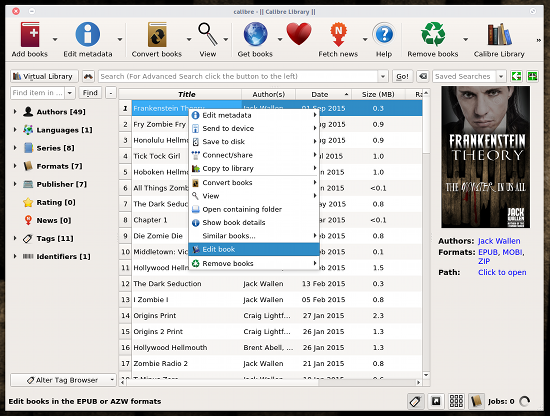
jack-calibre-1If you’ve worked with e-books, you know that editing them can be a work-flow nightmare. You format the book, save it, convert it, and check it out. When you find issues, you then must reformat, save again, reconvert, and recheck. This can become quite tedious when you run into stubborn or numerous formatting errors that slip through the cracks.
However, that time-consuming process doesn’t have to be so frustrating… at least not when you have Calibre at hand. With this outstanding, open source e-book management software, there’s a lesser-known feature that allows you to edit your e-book, in real time, to remove those formatting (and other) mistakes with ease. You can even do the entire formatting within Calibre and bypass any errors introduced by a middle man.

The only caveat to this process is that it requires you have at least a basic understanding of HTML and CSS (as the editing pane works with both). In other words, you’re not going to be editing a LibreOffice .odt file in a WYSIWYG editor. Also, you must have converted your e-book to either .epub or .azw3 formats (the Calibre editor cannot work with .mobi files).

I won’t go through the Calibre conversion process, so these steps assume you already have your book converted into the necessary format. With that said, let’s walk through the editing process of your book.

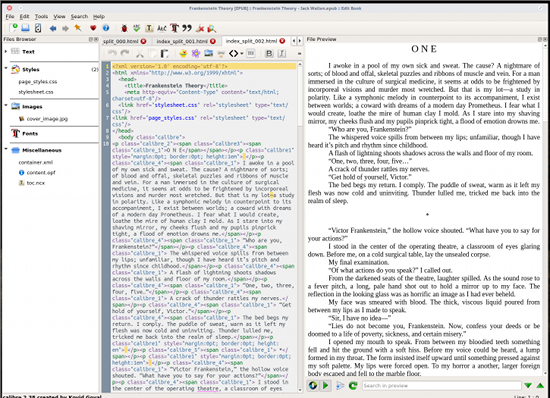
The Editing Window

To get to the editing window, right-click on the book you want to work with (from within Calibre’s main window—see Figure 1 above) and select Edit book.

Once opened, you’ll find three panes:

  • Book navigation (far left) is where you select what you want to view (chapters, styles, images, fonts, etc)

  • Work pane (center) is where you do the editing of the book

  • Preview pane (right) displays the contents of the book

What’s important to note is, from within in the navigation pane, you can expand each tree to view individual entries. When you expand the text tree, you will see each chapter of your book (depending upon how you’ve handled the conversion). For example: When I convert books, I always change the conversion wizard to search for the HTML <h3> tag to use as chapter headings. I also instruct Calibre to start a new page with every <h3> tag. Figure 2 illustrates each new chapter of a book.

jack-calibre-2When you double-click on a chapter in the left navigation, it will open up in a new tab in the editing pane. You can also open up the document style sheet. This makes for a handy reference point as you work through the files (or should you need to make changes to one or more of the styles). As you make changes (to either a chapter or to the style sheet), they will appear in the live preview window. As you switch tabs in the editor window, the preview window will automatically switch to preview what is being edited.

At the bottom of the preview pane, you will notice a toolbar with a few buttons and a search bar (Figure 3). The buttons are (from left to right):

  • Disable/enable auto-reload of preview

  • Disable/enable syncing of preview position to editor position

  • Split file at specified location

  • Reload preview

  • Find next

  • Find previous

jack-calibre-3The editor pane also has several buttons (Figure 4) that allow you to easily insert tags, images, hyperlinks, formatting, colors, and even a button for beautifying the current working file.jack-calibre-4

Working with the Editor

Now that you are familiar with the editor layout, let’s take a look at the heart of the tool. As long as you are familiar with HTML and CSS, getting up to speed with the editor should be quite simple. Open up a chapter (or style sheet) and start editing.

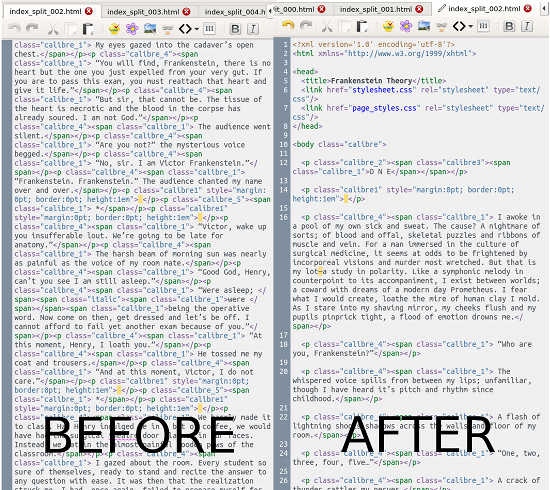
If you open a file and find the HTML to be hard to read (some applications like MS Word are very bad at creating HTML), you can click the Beautify button to clean up the code. This will auto-indent and color code the HTML of the file. Figure 5 illustrates how well the Beautify tool works to make your job much easier.

jack-calibre-5When you complete the editing (and beautifying), I highly recommend you run the Check Book tool. In the main toolbar you’ll see the ladybug icon—click it to run the checker. If it reports errors, address them and rerun the checker. You can also run the built-in spell checker from the Calibre main toolbar (Figure 6). 

jack-calibre-6Once you’ve completed the entire editing process, all you have to do is click the Save button (or Ctrl+S) and the epub (or azw3) file will automatically reflect your changes.
Creating Checkpoints

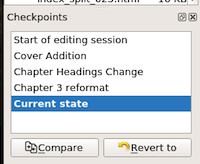
This is an important feature—one you should not overlook. As you work on your book, you can create checkpoints. These checkpoints are restore points that you can revert to, should something go awry in your editing (which could save you a lot of work).

calibre 7To create a Checkpoint, simply click the thumbtack icon in the toolbar and give the Checkpoint a name. If you find yourself in a situation where you need to revert, click on the Edit menu and you should see the last Checkpoint created. If you’ve created more than one Checkpoint, you can click the View menu and check the box for Checkpoints. This will add an additional preview pane (in the bottom of the left navigation—Figure 7) so you can jump to whatever Checkpoint you need.

Creating and editing e-books doesn’t have to be a struggle. If you’re looking for a way to make this process far more efficient, you should dive into Calibre’s e-book editor and you’ll save time and frustration alike.

Exclusive Interview: HydroXphere’s Charlie Houchin

charlie-houchinIt’s not often we have an Olympic gold medalist speaking at one of our technical conferences, but that’s exactly what’s happening at the AllSeen Alliance Summit 2015.

As an avid swimmer growing up in North Carolina, Charlie Houchin spent his summers participating in many volunteer-run community swim meets. After he graduated from the University of Michigan, Houchin qualified for the 2012 London Olympics, where he won a gold medal in the 4×200 freestyle relay. At the 2013 World Championships in Barcelona, he won another gold medal in the same event.

For one of his college classes, Houchin developed a business plan for improving summer swim meets. That plan became the foundation for HydroXphere, which later developed Meet Central — a swim meet operating and timing system for volunteers, parents, and swimmers. Houchin prototyped the Meet Central app on AllJoyn — a software framework developed by Qualcomm that lets compatible devices and applications find each other, communicate, and collaborate.

As a preview to the upcoming AllSeen Alliance Summit, we spoke with Houchin about his background, his passion for swimming, and how collaborative technologies can bring value to a community.

We don’t often have Olympic gold medalists keynote our technical conferences. Can you tell us a little about your background and how you combined your sport with technology?

My background from an athletic standpoint involved playing multiple sports into middle school. Swimming was always my favorite, and I opted to just swim by 7th grade.

Swimming went from something I was good at to a serious focus after my freshman year of high school. I began competing for the U.S. National Jr. Team and, later, the U.S. National Team. I swam on scholarship at the University of Michigan and then for four professional years (two in Southern California and two in Jacksonville, Florida).

I credit a professor at UM for encouraging me to be passionate about business — and taking ownership of my own idea. Until that point, I had not considered my path as a businessman. My journey as an athlete was always a bit off the beaten path — I think the professor “gave me permission” to think the same way about business.

Anecdotally, it’s fun to joke that, because of my intense focus on swimming as an athlete, I didn’t have any choice but to come up with a business plan for swimming. While that’s true, the reality is I’ve always been most passionate about the great relationships via the sport — that’s the underlying passion. Although not a commercialized sport, at the grassroots level, swimming’s greatest strength is in its participation — by communities all over the country. I knew there were ways to champion that participation in swimming, ways to connect those communities of participants. The use of the technology manifested itself once the problem was clear.

How did you become interested in collaborative technologies and applications?

The use case above. Participating in swimming is already something being done by millions of youth and their parents domestically. Summer swim meets are, by nature, community events that require cooperation between neighbors. The fundamental interaction is already there, but it is severely fragmented and unstructured. Everyone’s participation is very “silo’d”. We want to empower and equip the market to communicate that participation! (And we want to do this because they told us!)

Here’s an example to illustrate the point: I was speaking at a K-12 campus after the Olympics. The Kindergarten classes couldn’t come to the assembly so afterwards, I traveled around to each class to share my gold medal and answer questions. You can imagine the questions from boys and girls of this age! As I passed around the medal, one boy looked at the medal, looked back and me, his face lit up, and proceeded to tell me about the medal HE won at HIS last swim meet!

It’s a cute story, but our market doesn’t have that outlet by which they can communicate their participation. Folks in swimming value their participation. They want, and deserve, a way to shout about it from the rooftops. This drives us daily at HydroXphere.

Why did you choose AllJoyn when developing the Meet Central app?

AllJoyn seemed like the most appropriate option. We have a great relationship with some folks at Qualcomm, so we had learned a lot about the technology before the handoff happened. The ability to include users from multiple OS’s in the same experience is obviously very compelling. The international part of our market leans Android as you might expect.

Why is open source and the Internet of Things important to you? What interesting trends or innovations are you seeing?

Regarding IoT — I see the ability to heighten the value of a community’s experience. I’m excited for those guys and gals who are passionate about their respective verticals — those folks remaining narrow and deep in their ventures.

AllJoyn is great because it is the vehicle by which we can get narrow and deep with our community — we’re meeting them at a UX place we simply could not reach prior to AllJoyn. But we’re not wowing anyone with the technology in and of itself — we’re just meeting our users at that place where they already operate and exist. While the technology has to be killer, the real fun is marrying the fundamental human behavior with the tech and seeing how the people respond. At HydroXphere, we’re always amazed at how often we are discussing human behavior!

I think the space becomes more clearly defined when there is a departure from the notion that every idea has to be something that immediately impacts a billion people. Because of the ability of technology today to provide deeper user value and additional ways to monetize, we feel freed up to focus on the human element. The more we’ve done that, the more we see the true size of our market. It’s very energizing.

This type of application is ripe in so many verticals, and again, it’s going to take the guy or gal willing to throw their hat in the ring — to stay narrow and deep — to bring the opportunity to fruition. To own the data, you have to create the data, that’s the challenge.

Product positioning is one thing that IoT tech helps enable — certainly AllJoyn has for us — the idea of capturing data at the point of origin — for us, that had been a powerful concept we’ve applied.

What’s next for HydroXphere and for you?

The more specific we get in our market focus, the more opportunity there seems to be. We have a great Summer 2016 on the horizon — all about supporting our community!

What can we look forward to during your keynote?

A genuine conversation with a use case that, I hope, gets anyone there thinking about what it is they can bring to life. At the very least, 30 entertaining minutes after everyone has had their morning coffee!

What advice do have for other entrepreneurs?

Know what you have to hold onto when things are moving at 120mph.

Super-threaded computing with GSequencer

Super-threaded computing with GSequencer

Multi-threaded computing become common, nowadays. Normally you process a tree with on single thread and maybe update another one asynchronously. But what if you compute the tree in parallel? There comes the term super-threaded in. Basically anything could be super-threaded using a FIFO. But as sharing memory and protecting it by mutices you might encounter a dead-lock.

After reading following article you might think it would be ease. But you’re definitely wrong without limiting parallelism you even have a need for the nested tree:

super-threaded computing

The following article gives you a deeper insight how it is solved:

the only way

GSequencer has a solution, the nested recycling tree. It defines by the recycling context how audio data is accessed. Every recycling has its own thread and the iterator thread brings order into the chaos.

Recycling life-cycle

I’ve just created those meaningful float-charts with Dia to show you how the basic life-cycle goes. The first belongs to iterating the tree and locking the FIFO. The second is about processing audio data.


iterator thread

Like every thread in GSequencer the iterator thread is synchronized every run. There currently three playback modes and all of them form the playback domain. The iterator thread exists only for the domain and FIFO is unique within parent recycling.


recycling thread

The recycling thread exists three times one for each playback mode. All those threads wake-up at the very same time. They get signaled by the iterator thread and then process the audio data.

Interested in participating

http://gsequencer.org
https://github.com/gsequencer/gsequencer/wiki/super-threaded-computing


Dronecode Hosts Workshop As Open Source Drones Proliferate

logo-dronecodeThe Linux Foundation’s Dronecode Project is hosting a workshop in Dublin, Ireland on Oct. 5, as well as a  Flight Day event at a nearby airport on Oct. 8, to showcase open source Unmanned Aerial Vehicle (UAV) technology. These events bookend LinuxCon + CloudOpen + Embedded Linux Conference Europe, which is being held Oct. 5-7 at Conference Centre Dublin.

The workshop will be led by Lorenz Meier, PX4 Project lead, and Tully Foote Platform Manager for ROS (Robot Operating System). Meier will demonstrate a PX4 Flight Dronecode stack running on Linux in simulation. The hands-on workshop ​will ​also cover ​toolchain ​setup using a supplied ​VM​/​docker ​image, as well as driving ​an ​electric ​servo ​motor with a PX4/Pixhawk autopilot. ​Foote, meanwhile, will show how Dronecode can interface with ROS.

At the Flight Day event, participants are invited to bring their own UAVs and apply the knowledge learned from the workshop. Prizes will be awarded for various flight challenges, and academic research groups will showcase their projects alongside companies like 3D Robotics’ (3DR) and Parrot.

The Dronecode Project was launched in Oct. 2014 with the goal of uniting open source drone projects and assets and providing a common codebase to help accelerate software development. The project spans from microcontroller-based drones running real-time operating systems like Nuttx to new Linux-driven hybrid designs run that also incorporate RTOSes.

The project, which is governed by the Dronecode Foundation, has made substantial progress in standardizing foundational stacks, and several, mostly Linux-based, UAVs aligned with Dronecode have reached market. New members, such as Parrot, Walkera, and Erle Robotics, have brought the membership to 44, comprising 1,300 active developers.

QR X350PROThe new companies join Platinum members 3DR and Yuneec, Gold members Intel and Baidu, and Silver members including Qualcomm, Box, ProDrone, Falcon Unmanned, and others. Earlier this year, Erle Robotics launched a Dronecode-aligned Erle-Copter in Ubuntu and Ubuntu Snappy flavors, and Walkera launched the 2015 QR X350 Pro, which features a Linux-driven Dronecode flight controller.

The Dronecode Project builds upon two closely related open source drone autopilot platforms, APM/ArduPilot UAV platform, and the PX4 project based at the Swiss Federal Institute of Technology, Zurich.

According to workshop leader Lorenz Meier, the core developer and maintainer of the Pixhawk PX4 Flight Stack software, as well as a Ph.D student at the Computer Vision and Geometry Group in the Department of Computer Science at ETH Zurich, the Dronecode Project is moving from developing basic autopilot flight stacks to addressing higher end functions.

“So far, we have focused on getting the Dronecode flight stacks into industry-ready shape,” says Meier. “While GPS-based flight is in a pretty good shape now, we have set out to tackle the next challenges like obstacle detection and avoidance and tighter integration into the cloud, which would allow dynamic no fly zones. The goal is to make flying easier and safer at the same time.”

“Mid-2016 will be a good time to look at Dronecode and Linux adoption, as companies will have had the opportunity to phase in new technology,” says Meier.

I asked Meier about the rapid transition toward Linux, and whether Linux will soon be able run a drone on its own without a companion microcontroller/RTOS control system.

“Hard-realtime Linux is still a specialized solution, making RT-Linux somewhat hard to integrate based on standard distributions,” says Meier. “We opted instead for a hybrid solution running standard Ubuntu / Debian Linux and a dedicated RTOS side-by-side. The PX4 flight stack that runs on Snapdragon Flight uses Linux for higher end functions, but uses Qualcomm’s QuRT for all safety-critical parts running on the Snapdragon 801’s Hexagon DSP. Similarly, the APM-based 3DR Solo runs Yocto based Linux image, but also runs all safety-critical software on a co-located Pixhawk running NuttX and the PX4 middleware for sensor interfacing.”

I also asked Meier about the integration of Dronecode technology with ROS, which was designed for terrestrial robots, but is increasingly being used on drones such as the Erle-Copter.

“ROS is a great rapid prototyping environment and ROS 2.0 is moving in the right direction to become more of a drone platform,” says Meier. “However, right now neither we nor Qualcomm or other industry adopters base the PX4 stack on it. In addition to offering ROS, we have a DSP-to-Linux IPC mechanism called muORB for messaging as a lightweight alternative. However, the PX4 middleware has a transparent adapter layer for ROS, though, so people can run our apps in a native ROS environment. Dronecode also has a MAVLink to ROS bridge called mavros.”

Irish Drone Community Gains Spotlight

A major goal of the workshop and Flight Day is to support the emerging UAV industry in Ireland, a country whose rugged coastline and castle-dotted hills have attracted filmmakers using drones. Both events are sponsored by Atlantic Bridge, IDA Ireland, and Startup Ireland, in addition to 3DR and the Dronecode Foundation.

Ireland has taken an early lead in establishing regulations that legalize safe drone usage. A hobbyist drone community is emerging around organizations like Copter Shop Ireland and the iFly Technology training center. UAV-related companies based in Ireland include Green Aviation, Verifly, and SkyTec Ireland.

“Dronecode provides an ideal collaborative technology platform to foster rapid adoption and growth for the drone industry in Ireland,” says Trishan de Lanerolle, Program Manager for the Dronecode Foundation, as part of the Linux Foundation’s Collaborative Projects team.

At the Flight Day event, several University research groups will be showcasing their projects alongside companies like 3DR and Parrot. De Lanerolle says, “From a regulation point of view the Irish Aviation authority has a progressive approach and wants to promote innovation in this space.”

In the U.S., meanwhile, there’s a growing campaign for self regulation by vendors and users as a means to forestall potentially more restrictive FAA regulations. In a recent Hackaday post, 3DR CEO Chris Anderson notes safety-oriented Dronecode projects including Dronecode No Fly Zones and a related Safe Flight API.

As drone vendors and users come under fire for unsafe flying practices and invasions of privacy, it’s important to note the many benefits of UAV technology, from improved agricultural practices to search and rescue and disaster relief. The Dronecode events will highlight the increasing number of humanitarian projects involving drones, including Uplift Aeronautics and OpenRelief. Other efforts include UAViators, which helps aid organizations safely use drones for relief efforts. Drones are also used by the World Wildlife Foundation to track wildlife and poachers in Africa.

The Drone Developer Workshop ($10) will be held Oct. 5, 2-6pm at the Spencer Hotel in Dublin, Ireland. (bring your own laptop). Flight Day ($10) is scheduled, weather permitting, for Oct. 8, 9am to 4:30pm, with transportation provided to an airfield near Dublin. More information and registration may be found here.