Home Blog Page 1079

Learn Cloud Administration With Linux Foundation Instructor Michael Clarkson

Michael ClarksonLinux Foundation Instructor Michael Clarkson started his IT career on the front lines as a Level I tech, and slowly worked his way up to senior architect through years of trial by fire. When the boss asked him to get some new piece of technology working, he turned to man pages, documentation, and IRC for an education.

“Much of what I’ve learned in IT has come from being thrown into the fray and having to find the solutions,” Clarkson said. “I’ve always been the guy they call when the situation is really broken.”

Clarkson began teaching in 2011 for Red Hat, but his experience with Linux administration goes back to the mid 90s. He is a Red Hat Certified Architect, Level II and a Cloudera Certified Administrator in Apache Hadoop. He’s also a content creator for O’Reilly Media, president of his own training and consulting firm, Flakjacket Inc., a regular contributor to the Enterprise Linux on Ravello blog series for Ravello Systems, and a professional public speaker on Linux, IT Security, OpenStack, and Cloud technologies.

Here, Clarkson tells us more about how he learned Linux and software development, his career path to becoming an expert on hypervisors, and his hobby as a stand-up comedian.

What courses do you teach at The Linux Foundation?

I teach mainly cloud and operations courses. Lately course topics have focused on OpenStack and enterprise automation tools.

How long have you been teaching?

I started instructing for Red Hat in 2011, Cloudera in 2012, and The Linux Foundation just this year.

How did you get started with Linux?

In 1993-94 I was up at Texas A&M – Corpus Christi with my father helping him with his Structures and Abstractions class. I was 15 at the time and the CS lab team took me under their wing as one of their own. One of guys handed me a floppy disk of one of the early iterations of Linux, either Slack or Debian, and I was hooked. In 1996 I moved over to Red Hat and have been predominantly a Red Hat/Fedora admin ever since.

How did you learn?

Beating my head against the wall. In all honesty I learned through years of trial by fire. New tech is adopted, boss buys it, you have to make it work, so you pray for a solid man page or docs and an active IRC channel for the product.

I think my favorite part about Linux and the broader Open Source community is there is no end to the learning and growth. Even when I teach intro classes I find myself learning new things and connecting new concepts just from a student asking something in a new way.

What is your area of expertise now?

Right now my primary areas of focus are the emerging cloud technologies such as OpenStack, Docker, and the various types of virtualization as well as enterprise operations management, which is where I’ve spent most of my career.

How did you develop that? What has your career path been?

It is a jagged road that brought me here. Much of what I’ve learned in IT has come from being thrown into the fray and having to find the solutions. I’ve always been the guy they call when the situation is really broken. Google, IRC, and a network of fellow professionals have fed my growth and kept me going.

What projects are you involved in currently? What are you working on?

Right now OpenStack is seeing most of my time, with Hadoop and CentOS rounding out my top three.

What are the hot button issues or latest trends in your area?

The biggest ones I see come from people trying to shoehorn the latest thing, whether that be Docker, OpenStack, etc., into problems they weren’t meant to solve.

What technologies and skills do you see coming down the pike that Linux professionals should be prepared for?

Containers are the hottest thing I’m seeing right now. They have so many features and so much versatility I see them completely changing how we do things.

How do you address these in the courses you teach?

I find the best solution is education via example. Give students use cases for the product and a good list of things the product does not solve.

Anything else you’d like us to know about you?

When I’m not teaching I enjoy performing stand up comedy. This lends itself to teaching as some topics in Linux are admittedly dry.  

Meet more Linux Foundation instructors:

Learn OpenStack with Linux Foundation Instructor Tim Serewicz

Learn KVM and Linux App Development with Linux Foundation Instructor Mike Day

Learn Linux Performance and Scripting with Linux Foundation Instructor Frank Edwards

From Linux User, to Electrical Engineer, to Linux Foundation Instructor: Jan-Simon Möller
Linux 4.1 Release Has Record Developer Participation

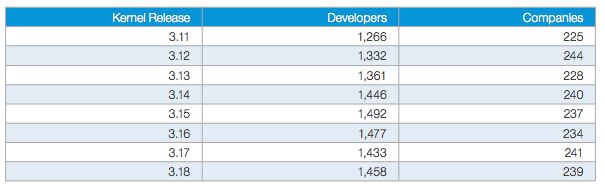
Linus Torvalds this week announced the release of the Linux kernel version 4.1, which will also form the basis of the next long term stable (LTS) kernel release. Linux 4.1 was also the first kernel release to include contributions from more than 1,500 developers (1,539 to be exact) — with about 270 submitting their first ever patch, according to LWN Editor Jonathan Corbet. The previous record for the most developer participation on a release was set last June with Linux 3.15, which boasted 1,492 developers submitting patches. (See his full 4.1 release report.)

Despite the record level of participation, Torvalds had a “quiet” week after the final release candidate, rc8.

“I’m not sure if it was quiet because there really were no problems (knock wood), or if people decided to be considerate of my vacation, but whatever the reason, I appreciate it. It’s not like the 4.1 release cycle was particularly painful, and let’s hope that the extra week of letting it sit makes for a great release. Which wouldn’t be a bad thing, considering that 4.1 will also be a LTS release,” Torvalds wrote on the Linux kernel mailing list.

“Anyway, since rc8 we’ve had truly small changes, mainly some final driver fixups (HDA sound, drm, scsi target, crypto) and a couple of small misc fixes. The appended shortlog is probably one of the shortest ones ever. I’m not complaining.”

This release comes with significant improvements. Here is a selection of improvements which affect the enterprise as well as consumer space.

who writes linux developers

Improvements for Chromebooks

Linus is a Chromebook user, as we know from his Google+ posts, and so am I. For those Chromebook users who install their own distros on these devices, there are massive improvements with this release. Patches submitted by Dmitry Torokhov improve the support for touchpads and touchscreen on Google’s Chromebook Pixel 2, when running a Linux distro instead of Chrome OS.

Talking about laptops, the 4.1 release also brings improvements for Dell and Toshiba laptops. Thanks to the patches by Darren Hart from Intel, the release will enable users of the supported Dell laptops to use keyboard back-lighting. Toshiba laptop users will also notice many improvements including USB sleep charging support and improved back-lighting.

Improved Btrfs support

Btrfs is the future of the Linux file system and it’s already the default FS on many distros including openSUSE. It continues to get better with each release. Chris Mason, the principal author of Btrfs, who now works for Facebook, sent patches which fixes a regression from 4.0 “where conversion between different raid levels would sometimes bail out without converting.” Thanks to his patches, 4.1 improves performance on massive Btrfs file systems of about 20 terabytes or more. It also fixes ENOSPC aborts when deleting huge files (3 TB or more).

From Android with Love: ext4 encryption

Google is among the leading contributors to the Linux kernel and they have Theodore Ts’o, the former CTO of the Linux Foundation, and the creator of ext4 file system, which is used heavily at Google. Google finally implemented ext4 encryption in Android, which is aimed at the upcoming release of Android M. It has now made its way to the mainline Linux kernel. Ts’o sent pull requests for 4.1 which brings file system encryption to ext4 on Linux.

Graphical improvements and Intel chips

Linux 4.1 brings out-of-the-box acceleration for Nvidia’s GTX 570 series graphic cards. In addition, it brings significant performance improvements for Intel’s low powered Atom chips.

The release has reportedly improved battery life and performance on select Intel chips. These can be attributed to the tweaks made to the drivers for Atom chips – more specifically Bay Trail, Cherry Trail and Skylake SoCs.

Bits and bytes

Customers using software RAID on Linux will notice improvement thanks to the patches submitted by Neil Brown. In his pull request Brown explained, “A few have performance impacts which should mostly be positive, but RAID5 (in particular) can be very workload sensitive …. we’ll have to wait and see.”

Much awaited full ACPI support for 64bit ARM is also heading to Linux, thanks to a lot of work done by Linaro teams.

I have only skimmed the cream of what’s exciting in the latest Linux kernel. I would advise keeping a eye on the Kernel Newbies page as they add more info to the 4.1 page.

Google Solidifies Container Story With An Updated Kubernetes, Container Engine, and Private Registry

When it comes to managing containers, everyone including the competition agrees that Google is the leader, which was evident from the way Kubernetes was received by the community. Google is leaving no stone unturned to make its cloud the best platform for running the containerized workloads and microservices. From orchestration to cluster management to private registry, Google Cloud Platform has all it takes to run complex distributed containerized applications.

Kubernetes, the popular open source cluster management, and orchestration tool hits a significant milestone with V1. On 21st June, the community celebrated the launch at the Oregon Convention Center. During the last one year of its availability, Kubernetes gained the support of the biggies including IBM, HP, Red Hat, Mesosphere, Microsoft, CoreOS, VMware and Intel. Though Docker, Inc. is busy acquiring companies to become a full stack container management company, the ecosystem is moving fast in building tools for solving the problems of container scheduling, cluster management, service discovery, and health monitoring. Kubernetes is on its way to become the de facto container management tool preferred by cloud service providers and enterprises.

Read more at Forbes.

How to configure status pages using cachet

Cachet is a single-site, alternative to statuspage.io written in PHP with the Laravel project, supporting both SQLite and MySQL databases.


Read More at https://miteshshah.github.io/linux/centos/how-to-configure-status-pages-using-cachet/

Docker Rivals Join Together in Open Container Effort

The Linux Foundation is now home to new Open Container Project, bringing Docker, CoreOS and others together to advance open-source containers for all.

Read more at eWeek

New Open Container Project Helps Define the Future Data Center


We at The Linux Foundation witness first-hand every day the impact of open source, collaboration and neutral governance on the most promising technologies of our time. It is how most software today is built. Containers are one of the most important innovations in software development and today, with the introduction of the Open Container Project , The Linux Foundation will become the home of this essential infrastructure. This project will prevent fragmentation and enable application portability among platforms, which are the ingredients developers require in order to build and deploy everything from retail and banking applications to streaming media services.

Containers make it easier than ever for developers to build applications quickly right on their laptop and to reach Internet scale on any combination of public and private cloud technologies. Millions of individual developers have found containers are the best way to create and share development environments. And, even more powerful is that those environments can seamlessly be used in production as well, enabling the development Holy Grail of dev/prod parity.

That’s why we applaud Microsoft, Amazon Web Services, Google, Docker and CoreOS, among the other founding members of the Open Container Project, for taking the important steps to build a neutral and collaborative environment where everyone can work together to bring a portable container standard to the cloud.

logo containercon w1I am extraordinarily excited to be working with nearly every technology company on this project, which I think could be as important to the future of the Internet as intermodal containers have been to globalization. We expect to see a lot of the Open Container Project contributors at ContainerCon in August and look forward to the work ahead of us.

Three Projects Funded by CII

The Linux Foundation’s Core Infrastructure Initiative has announced the funding of three projects to the tune of “nearly $500,000.” “CII’s funds will support a new open source automated testing project, the Reproducible Builds initiative from Debian, and IT security researcher Hanno Boeck’s Fuzzing Project. Additionally, The Linux Foundation is announcing Emily Ratliff is joining The Linux Foundation as senior director of infrastructure security for CII. Ratliff is a Linux, system and cloud security expert with more than 20 years’ experience. Most recently she worked as a security engineer for AMD and logged nearly 15 years at IBM.

Read more at LWN

Shuttleworth: Introducing the Fan

Mark Shuttleworth announces “the Fan”, a new mechanism for directing communications between containers. “We recognised that container networking is unusual, and quite unlike true software-defined networking, in that the number of containers you want on each host is probably roughly the same. You want to run a couple hundred containers on each VM. You also don’t (in the docker case) want to live migrate them around, you just kill them and start them again elsewhere. Essentially, what you need is an address multiplier – anywhere you have one interface, it would be handy to have 250 of them instead.” See this pagefor details on how it works.

Read more at LWN

Queue Spinlocks Coming For Linux 4.2 Kernel

Waiman Long of HP has been spearheading qspinlocks now for the past several months and with Linux 4.2 the queue spinlocks support will be merged…

Read more at Phoronix

Entroware’s Apollo Is a Superb White Laptop Powered by Ubuntu and Ubuntu MATE

Entroware has recently forged a partnership with the Ubuntu MATE project to help them ship laptops powered by this operating system and the laptop called Apollo that will definitely turn some heads.

Entroware has already presented a new Linux mini-PC powered by Ubuntu 15.04 and Ubuntu MATE 15.04 read more)