
Planning to launch a new web application? Are you sure it works well enough and loads on time, even when the traffic reaches a breaking point? If you are not sure, here is something that requires your immediate attention.
A surefire way of being certain that the performance of your application maintained is by monitoring it regularly. For this, use of novel testing tools is highly suggested. Out of all the superb testing software and tools available over the Internet these days, choosing the best one can often be a tricky task. So, enlisted below are 3 most convenient open source load testing tools that you can use for your application. Of course, you can avail customized and premium ones such as PeopleSoft Application Load Testing tools also, but it is suggested that you must run the first test on an open source one.
Given below are three superb tools which you can bring into use for testing your application of errors and bugs:
- 1.The Grinder: This is a free Java-based load testing platform, licensed by the BSD-style open source tool, which was developed by Paco Gomez and maintained by Philip Aston. The contribution of the company with many enhancements, translations, and fixes. Making the Grinder valiant, it features with the two main parts:
- ØGrinder Agents: Having a number of workers to create the load, Grinder agents are the headless load generators.
- ØGrinder Console: It controls the number of Grinder agents that monitors the results through the various applications. It is used for editing or developing test suites.
This is how the Grinder can be proved affluent to your website. Here are some of its key features:
- Strewn testing balances the number of agent instances
- Flexible specification that includes the generating test data on-the-fly has the capability to use external data sources like databases, files, and many more.
- Supportive to multi-protocols
- Network Activity is recorded by the Grinder test script
- 2.Tsung: Known as IDX-Tsunami, it is the only java based open source performance testing tool. It is simple to install as like “apt-get install erlang” (Tsung relies on Erlang).
In 2001, Nicolas Niclausse developed the Tsung. Also, he had originally implemented a distributed load testing solution for Jabber (XMPP). This success followed in 2003, where he productively performed the HTTP protocol load Testing.
In present times, it functions fully on testing solution with the support of modern protocols like databases, web socket, and more.
Therefore, TSung have many features to explore:
- Enables the replication of thousands of virtual users on mid-end developer machines
- Supportive to multiple protocols, it has dynamic scenarios and mixed behaviors by allowing the load patterns to be combined in a single test.
- Embeds easy-readable load reports
- 3.Apache JMeter: The only desktop application in present times, Apache JMeter is a user-friendly GUI. Through this, the test development and debugging processes becomes easier. Since 2009, Apache JMeter is now a popular source to remedy solution like Silk Performer. JMeter is widely adopted and has the modular structure extended by the plugins. This implies that the features developed by the Apache Software Foundation or online contributors implements the protocols through the plugins. Here are few of them:
- JMeter is a platform that is suitable to any operating system with java.
- Scalable in nature, JMeter executes various distribution modes i.e. it can control a number of remote hosts.
- Multi-featured that visualize and analyze performance test results
These tools are flexible enough to correlation, assertions and distributed testing capabilities.
 Peter Robinson has announced that Fedora 22 for AArch64, a community-driven and -built operating system, has been released and is now available for download.
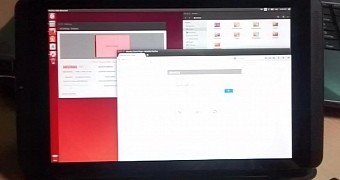 The NVIDIA Shield Tablet is a gaming device built by Nvidia that has very specific user niche, but a user of this tablet managed to run Ubuntu on it; not the mobile version, but the desktop one.
 An estimated 45,000 students from a province in Indonesia have enhanced their education and computer-usage knowledge through a pilot program using