
X.Org Server 1.17 has made it into Ubuntu 15.04…
Read more at Phoronix
 Oracle, through Michele Casey, had the pleasure of announcing today, March 13, the general availability of Oracle EnterpriseLinux 7.1, a computer operating system designed for enterprise environments and based on the Linux kernel.
Highlights of Oracle Enterprise Linux 7.1 include a 64-bit unbreakable enterprise Linux 3.8.13 kernel, a Red Hat Enterprise Linux compatible 3.10.0 kernel, also for x86_64, Linux container support via Docker or LXC (Linux Contai… (read more)

Google is closing its programming project hosting service, Google Code, after nine years of operations. Google stopped users from creating new projects yesterday and will make existing project read-only this August, ahead of a complete closure scheduled for January 25th, 2016. The search giant says it started Google Code when project hosting options were limited, but since launch in 2006, it’s seen a “wide variety of better project hosting services” such as GitHub and Bitbucket rise to the forefront.
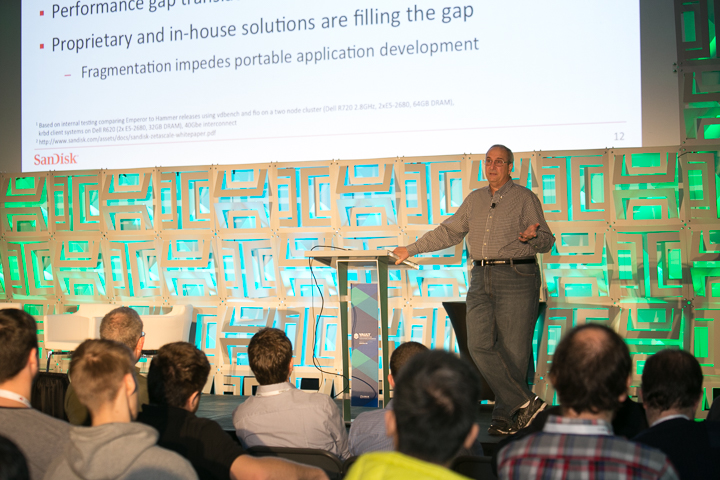
SanDisk, in a joint venture with Toshiba, sells almost half of the world’s flash technology but enterprise storage users can be forgiven if they don’t associate SanDisk with flash storage systems. Most of what SanDisk sells goes into mobile devices. You probably have flash memory in your smartphone and don’t even realize it, or at least don’t think about it. Going forward, SanDisk is determined to enter the systems business too, noted Allen Samuels, chief software architect of SanDisk’s emerging storage solutions, in his keynote at the Linux Foundation’s Vault storage conference this week in Boston.
Attracting the company to storage are a number of factors starting with the explosion of data. Everybody knows the volume of data is expanding. But what many don’t realize is that it, in part, is changing the way enterprises build data centers and deploy servers, storage, and software.
Data center planners no longer view this expanding volume as a data processing, computational problem as they did in the past. Rather, it has become a “problem of moving data through the data center,” said Samuels. How quickly you can capture it, get it to the systems that need it, and protect the data has become the mission of today’s data center. The computational part turns out to be easy by comparison. As a result, scalability has become today’s byword, and the key to scalability is parallelism, he continued.
The explosion of data also is driving data center planners to rethink the essential components of the data center itself. “You need to rethink how you build servers. Think rack scale,” he advised. And not just the usual rack; he suggested a simplified disaggregated rack characterized by shared I/O and clustered systems.
And while you are at it also rethink the fabric that connects the various pieces. The goal, according to Samuels, should be the independent scaling of compute, memory, storage, and networking.
For storage you will need to shift your thinking to object stores, scale-out block storage, NoSQL/KV store, and the Hadoop file system. Certainly don’t count on conventional hard drives.
“The performance-oriented hard drive is vanishing,” he noted. Those are the costly 15K RPM devices aggregated in the hundreds or thousands to bring more spindles to the IOPS challenge, or the degradation of hard drive efficiency that comes with increasing I/O. Instead, capacity optimized hard disk drives (HDD) (shingled magnetic recording, Cloud drives) will move to the fore where you still need HDD.
Flash, however, will drive storage architectures as flash cost reductions continue and performance, reliability, and durability continuously improve. It easily overcomes the IOPS challenge. Expect flash also to cannibalize primary storage to take over enterprise storage. HDD will be relegated to data retention and data protection. The big challenge will revolve around balancing and orchestrating it all.
Samuels then turned his attention to new caching and tiering solutions. Heterogeneous replication, for example, leaves one copy on flash for fast computation (computation isn’t being completely overlooked). Additional copies will reside on low-cost HDD for protection, both local and remote. Similarly flash erasure coding can substantially reduce storage overhead compared to HDD RAID.
In the end organizations want open source scalable software storage solutions but current scale-out OSS software is cost-inefficient on flash. This results in a performance gap, which translates into significant expense at data center scale. For now proprietary and in-house solutions are filling the gap, Samuels noted. SanDisk, he added, is bringing its own newly announced Ceph-based solution that can achieve a 7-10x improvement for block reads, according to internal testing.
The flash-HDD cost comparisons are past. Nobody is focusing on cost per gigabyte when performance and IOPS are what counts. Concluded Samuels: “Flash is primary storage today.” And it is unlikely to change in the foreseeable future.
Summary:
When the TN11SCC board is in V100R004C01 or an earlier version, the lifecycle of the CF card on the board may be shorter than expected.
[Problem Description]
Trigger condition:
Periodical database and log backup, and upgrade in package loading mode on the Huawei dwdm board TN11SCC are properly implemented.
Symptom:
An SWDL_NEPKGCHECK alarm is reported.
Identification method:
The CF card is faulty when all the following conditions are met:
1. The TN11SCC board is in V100R004C01 or an earlier version.
2. The CF card has been used for more than five years.
3. An SWDL_NEPKGCHECK alarm is reported.
4. The access to the cfs1 area of the board fails using a command on the Navigator. For example, a board in slot 18 reports an SWDL_NEPKGCHECK alarm as shown in the following figure..

A command on the Navigator is delivered as shown in the following figure.

However, a failure message is returned. When this occurs, the CF card has been faulty.
[Root Cause]
As confirmed by the CF card supplier WD, the CF card will become faulty upon multiple times of rewrite operations and cannot be read or write any longer. Since there are frequent
database and log backup operations for Huawei OptiX OSN 6800 V100R004C01 and earlier versions, the CF card can be used for five years at most. The card lifecycle is closely related to the size of the NE database and logs. In versions later than V100R004C01, the backup frequency and method are modified. After the modification, the CF card can be used for at least 100 years as estimated.
[Impact and Risk]
Upgrade in package loading mode and software synchronization will be affected, but services are not affected.
[Measures and Solutions]
Recovery measures:
Replace the TN11SCC board when the CF card of the board becomes faulty.
Workarounds:
Before the CF card becomes faulty, upgrade the TN11SCC board to V100R004C04SPC800 or
a later version.
Preventive measures:
1. If the CF card on a TN11SCC board has been faulty, replace the board. For more Huawei transmission board please have reference on www.thunder-link.com
2. If the CF card has not been faulty, upgrade the TN11SCC board to V100R004C04SPC800 or a later version.
Material handling after replacement:
Return the TN11SCC board for repair.
 Much to the delight of Apple fanbots everywhere, Apple has now fully unveiled the Apple Watch. The watch, which was previewed in September, will go on sale April 10 and ship on the 24th. Based on its brand name, styling, accessories, and battery life claims, it will likely be a big hit — at least as far as smartwatches go.
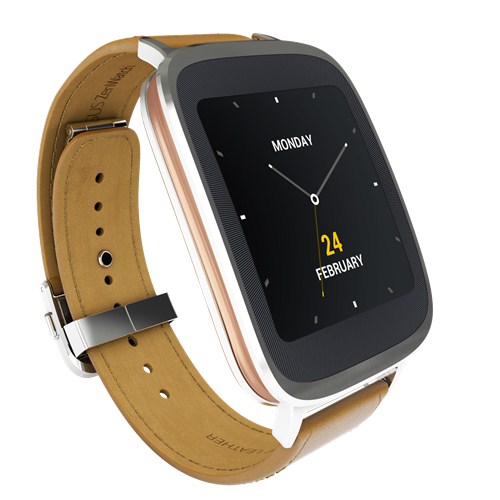
According to Canalys, only 720,000 Android Wear smartwatches shipped in 2014 from about a half dozen manufacturers, out of a total of 4.6 million “smart wearable bands.” Yet, the first models shipped in the summer, and several second-generation models didn’t make it until later in the year or 2015. There are also a few new contenders. Our slide show of seven compelling Android- and Linux-based smartwatches features five Android Wear models, plus Tizen and WebOS-based watches (click on the Gallery link below).
Android Wear software features have improved somewhat since the launch, and the hardware specs have begun to creep upwards too, although Google’s guidelines somewhat limit innovation. Most of the watches follow the same script: a dual-core, 1.2GHz Qualcomm Snapdragon 400 with 512MB RAM and 4GB of eMMC flash, and a 1.63-inch, 320 x 320 AMOLED touchscreen. Most integrate Bluetooth 4.0, a micro-USB port, a microphone, various sensors, and voice control.
Such low-end specs limit the Wow factor, but Google realizes that on a tiny device like a smartwatch, a feature war could make the devices more expensive and harder to use. More features also leads to greater size and weight, potentially reversing recent style gains.
Some Android- and Linux-based watches outside of the Android Wear program push the envelope on more autonomous features rather than simply acting as a smartphone notification companion. This typically results in larger, clunkier designs that might look out of place in the boardroom or country club. On the other hand, they provide interesting functionality aside from health monitoring and the convenience of not having to reach into your pocket for your phone.
 While most of the early full-featured wrist smartphones, such as the Android-based Neptune Pine and the Omate TrueSmart, suffered in reviews, newer models such as LG’s Urbane Watch LTE seem more promising. The 4G-ready phone watch offers an innovative GUI that runs on a version of the Linux-based WebOS. Meanwhile, Neptune is expected to unveil a new wearable within the week.
Android Wear may not be setting the world on fire, but it still has a shot against the much vaunted Apple Watch. Unlike the original iPhone or iPad, the Apple Watch breaks little new ground. Or rather, it doesn’t add many more innovations than have any of the second- or third-generation Android Wear models. With most of these devices moving to round-faced screens and thinner watch-faces, the Apple Watch seems a bit pedestrian.
Round displays are more appealing to consumers, suggests Canalys. Its smartwatch study calls out the first round-faced Android Wear watch — the Moto 360 — as “the clear leader” among Android Wear watches, and notes that LG’s second-generation, round-faced LG G Watch R sold much better than the original G Watch.
Not surprisingly, Apple is pricing its watch on the high end. The Apple Watch starts at $349 for the sports model, but many of Apple’s typically well-heeled customers will likely choose the stainless steel options that bring the price up to $550 or more. There’s even a gold, luxury model that costs as much as $17,000, even though it is functionally the same as the sports model.
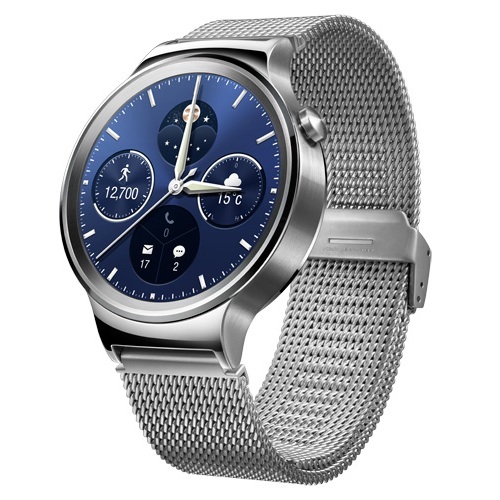
The Huawei Watch, which was widely considered the most attractive new watch unveiled at Mobile World Congress earlier this month, is also aiming high. The watch will likely start at around 349 Euros ($370 at the moment), according to some pre-order retail listings, although some models could cost as much as $1,000.
Most of the Android Wear watches cost much less at between $200 to $300, which could be seen either as an advantage or a disadvantage. Over the last two decades as wristwatches have gradually faded away as a mainstream fashion accessory, the market has been split into high-end luxury watches costing over $1,000 and low-end fitness watches under $100. There’s a danger that Android Wear might be stuck in a dead zone between the Apple Watch and other luxury smartwatches on the high end and the $99 and up Pebble and other basic notification and fitness watches.
The Pebble alone has sold over one million units since it launched in 2013, or about a fifth of all smart wearables, according to Canalys. A small army of 25,000 developers has developed some 6,000 apps and watch-faces for the fitness oriented Pebble. The fairly open SDK provides access to a firmware stack built on the open source FreeRTOS combined with proprietary code.
Our slide show is limited to watches that have been fully announced and are expected to ship by summer. Some watches that are farther off on the horizon show promise, however, like the Tizen- and Intel Edison-based Blocks watch, which brings some of the modular upgrade concepts used by the Project Ara phone to a smartwatch. Due to ship in late 2015, Blocks uses the links of the watch wristband to house modular components, which also helps reduce the size of the watch-face.
Some are calling Monohm’s large, disc-shaped Runcible a watch, even though it mimics smartphone features and is designed more for the pocket than the wrist. The autonomous, phone-like device, which runs on Firefox OS, is due in Japan by year’s end.
Then there are the leaked watches such as a round-faced, Tizen-based Samsung Orbis, which would replace the Samsung Gear S. A no-show at MWC, the Orbis is said to feature both a crown-shaped power button and a rotating bezel ring on top, somewhat like the Apple Watch.
HTC was also expected to unveil a smartwatch at MWC, but like Samsung, the company may have decided to wait for the Apple Watch instead. Well, time’s up!