
The open-source collaboration project leverages embedded Linux in a bid to open up unmanned aerial vehicles to development.
Read more at eWeek
Pat Riehecky has announced the release of Scientific Linux 7.0, a distribution compiled from the source code for Red Hat Enterprise Linux 7: “Scientific Linux 7.0 x86_64 released.” Scientific Linux differs from Red Hat Enterprise Linux and CentOS in that the project enhances the system with extra software…”
In 2006, Amazon was an e-commerce site building out its own IT infrastructure in order to sell more books. Now, AWS and EC2 are well-known acronyms to system administrators and developers across the globe looking to the public cloud to build and deploy web-scale applications. But how exactly did a book seller become a large cloud vendor?
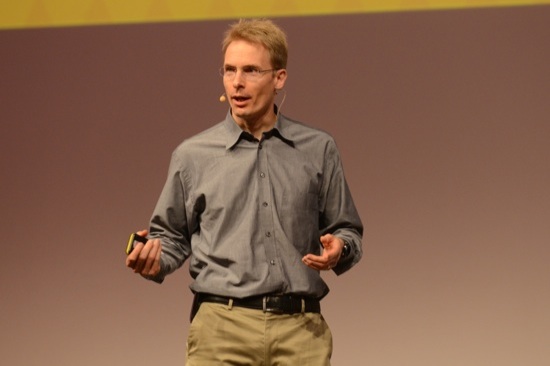
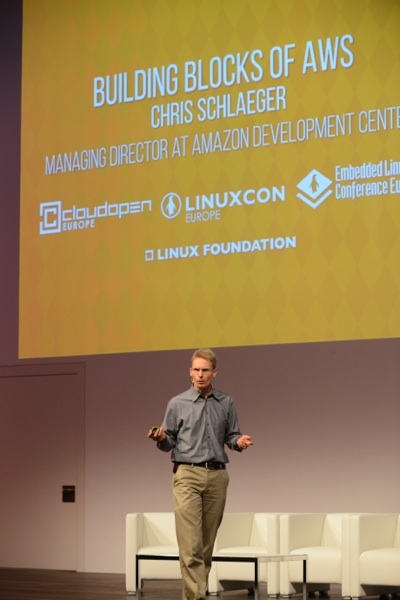
Amazon’s web services business was devised in order to cut data center costs – a feat accomplished largely through the use of Linux and open source software, said Chris Schlaeger, director of kernel and operating systems at Amazon Web Services in his keynote talk at LinuxCon and CloudOpen Europe today in Dusseldorf.
Founder Jeff Bezos “quickly realized that in order to be successful in the online business, he needed a sophisticated IT infrastructure,” Schlaeger said. But that required expensive proprietary infrastructure with enough capacity to handle peak holiday demand. Meanwhile, most of the time the machines were idle
By building their infrastructure with open source software and charging other sellers to use their unused infrastructure, Amazon could cover the up front cost of data center development.
“That was our first service model,” said Schlaeger, who is also managing director of Amazon Development Center in Germany.
It built a foundation of infrastructure and services including storage, security and access, followed by compute and networking and content delivery. Then, on top it built a range of platform services such as databases, analytics, app services, deployment and management services, and services for mobile devices.
“It allows customers to focus their attention on their business rather than become IT experts,” Schlaeger said. “This is a sophisticated view of clouds, because it’s not just foundation services. You need to offer more.”
By 2008 AWS offered 24 features and services, roughly doubling the pace of development every year since. Last year the company offered 280 different services. And AWS is on track for the same accelerated development pattern again this year, Schlaeger said.
 At the same time AWS has cut prices 45 times – the result of what Schlaeger calls, “The AWS Innovation Flywheel.” New features and services lead to more AWS users, which requires more infrastructure which leads to greater economies of scale and greater innovation, which leads to reduced costs – a continuous cycle.
Behind all of these new services and infrastructure innovations lies Amazon Linux, the company’s custom operating system. Used internally and also available to AWS customers, it provides a stable and secure base on which customers can build and run their own applications and services.
“In order to innovate, the ability to modify every parameter of your system is key and Linux and open source is a good basis for that,” Schlaeger said.
Amazon has created a custom operating system that requires minimal overhead and has key security features such as automatic updates of critical packages at launch, no root login by default, regular updates, and new AMIs (Amazon Machine Images) twice a year.
As new technologies come along, Amazon can incorporate them to the benefit of their own services as well as their customers. The speed with which AWS has incorporated Docker, a relatively new and fast-growing project, is indicative of Amazon’s increased participation in the open source community over the past year. Docker has already been incorporated with Amazon EC2, AWS Elastic Beanstalk and AWS OpsWorks, Schlaeger said.
“We’re really serious about getting engaged with the open source community and gaining more visibility,” Schlaeger said.
 A few months ago, I met Chris Anderson and Andy Jensen, CEO and COO of 3D Robotics, one of the leading manufacturers of commercial drones. They were interested in creating a software foundation for their open source drone projects and wanted to pattern it after the Linux Foundation. We quickly realized we could provide the collaborative and participatory infrastructure needed to advance the ecosystem, and Dronecode was born.
The potential for drones to have an impact on our lives is just now hitting the mainstream. While makers and hobbyists have been in from the ground floor, applications such as search and rescue, agriculture, mapping and surveying, photography and film and ecological study have real potential to save lives, save money and improve efficiency. Chris was on the forefront of this movement with his bestselling book Makers: The New Industrial Revolution and his creation of DIYdrones.com.
Today we launch Dronecode with industry leaders who are shaping the coming Drone revolution. Joining 3D Robotics as founding members of Dronecode are BaiDu, Box, DroneDeploy, Intel, jDrones, Laser Navigation, Qualcomm, SkyWard, Squadrone System, Walkera and Yuneec.
The Dronecode story is very unique, with three impressive elements:
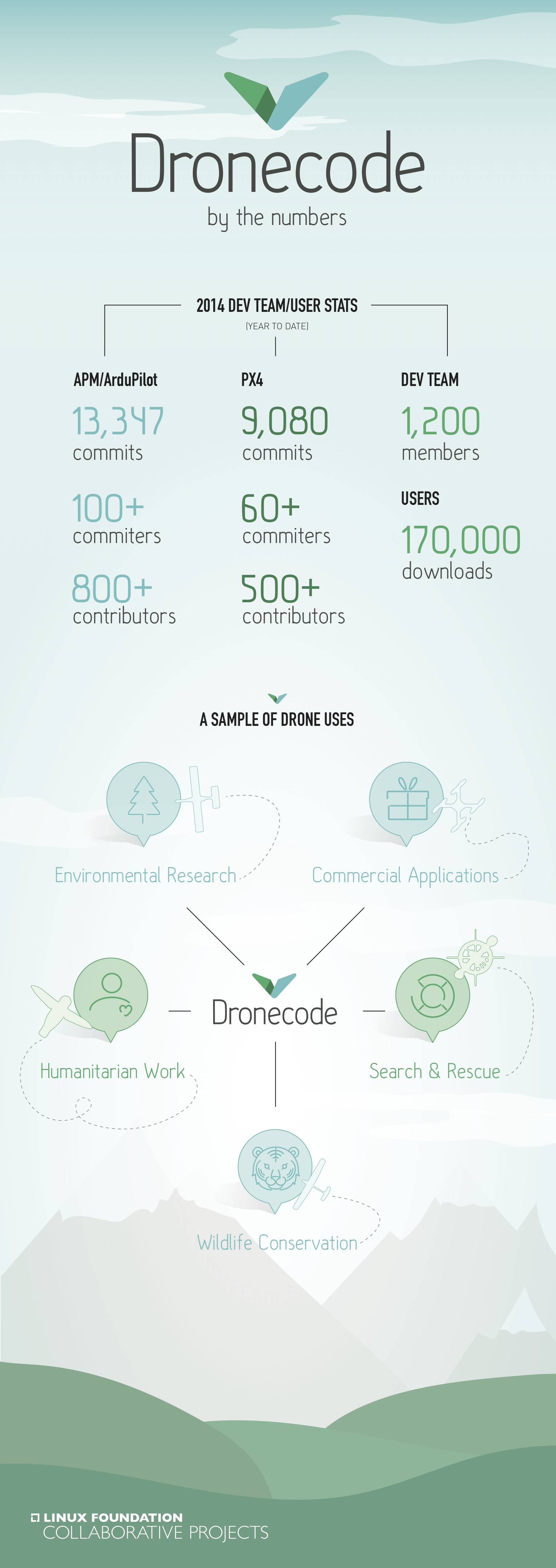
Today more than 1,200 developers are working on Dronecode projects with more than 150 code commits a day on some projects.
The code forms the basis of many of the commercial drones available in the market.
Andrew Tridgell (“Tridge”) will become the chair of the Dronecode Project’s Technical Steering Committee (TSC) and have a seat on the board. He is a lead maintainer in the development of APM and is well recognized for his contributions to the open source software community, including his work as the author of the Samba file server. He is open source royalty so we were even more excited to work on this project.
The software projects that make up Dronecode have been open source since the beginning and currently have an active and growing developer community, so why create Dronecode with the Linux Foundation?
According to Chris, “As the APM/ArduPilot and PX4 project matured and were more widely adopted as part of the drone revolution, it became clear that the kind of professional management and governance that the Linux Foundation provides for other leading open source projects would help them reach the next level of participation, performance and innovation. The combination of independence and a clear path for corporate participation and adoption while protecting open source ideals is something these projects have always been built on, and the experience and reputation of the Linux Foundation ensures that these will be embraced and preserved as the industry around them grows.”
A drone platform is an interesting project for us because it is built on many of the advances of technology we have been involved in for some time (things like Arduino, BeagleBones and embedded Linux) and has great collaboration potential for newer projects like our AllSeen IoT platform (imagine all of the sensors and data connected to other devices). It’s amazing to see the tangible result that cheap and powerful software and hardware components — built from open platforms — can create.
By partnering with 3D Robotics and the other founding members we hope to help extend the “architecture of participation” to other developers and companies who wish to establish and grow an ecosystem around this project. More than just code, we help companies collaborate together to create ecosystems by delivering the technical, marketing and educational resources needed, and most importantly providing the right frameworks for that participation. We are at a crucial step in the democratization of drone technology where people can purchase or make their own drone, and through Dronecode they can also fully participate in the foundational platform for unmanned aerial vehicles. Join us by becoming a member of Dronecode or participate in the code (or just make cool stuff). We also plan to expand drone related content at our Embedded Linux Conferences in the US and Europe. I’m excited to see what’s next.