Linux creator Linus Torvalds is well-known for his strong opinions on many technical things. But when it comes to systemd, the init system that has caused a fair degree of angst in the Linux world, Torvalds is neutral.
“When it comes to systemd, you may expect me to have lots of colourful opinions, and I just don’t,” Torvalds told iTWire in an interview. “I don’t personally mind systemd, and in fact my main desktop and laptop both run it.
A question I get a lot is, “What makes an open source software project successful?” This isn’t a simple question, as every project is really different. But certainly there are some common characteristics: a vibrant and open community and ecosystem of contributors, an innovative goal or technology and investments from a diverse set of stakeholders are just a few.
Business benchmarks and market share help measure the success of a project over time. A blockbuster like Linux can tout nine code changes per hour, $10.8 billion in shared R&D investment and millions of developers. It runs 65 percent of smart mobile devices, 95 percent of high performance computing market, 55 percent of the embedded systems market, and most of world’s stock exchanges.
But there is another measure of success that is extremely powerful: inspiring someone to think, to question, to imagine. When we do this we help build a new generation of inquisitive, smart technologists who will surprise us with their innovation and invention in the years to come. The next great technological innovation won’t be built by a single company but seeded by an inspired, passionate individual. People, not companies, make the difference.
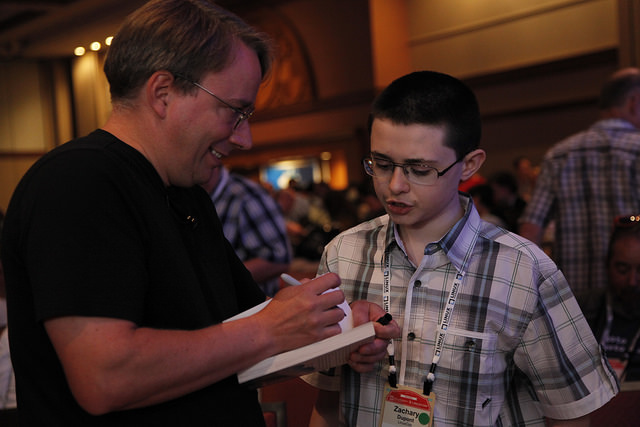
I met a young man a few weeks ago that embodies this ideal. Seventh-grader Zachary DuPont joined us at LinuxConin Chicago after writing a letter to his hero, Linux creator Linus Torvalds, that arrived in the Linux Foundation mailbox. The letter (handwritten, not by email) was part of a school project and the assignment was to reach out to someone who inspired you. When we received the letter we invited Zach to meet his hero in Chicago, which he did on opening morning of the event. That night when I was talking to Zach and his parents he told me that day was the “best day of my life.”
This is the sign of a truly successful project. Inspiring people and engaging them so they can build with us. We’re excited to follow Zachas he gets to know the community and determines how he will make a difference, too.
At LinuxCon we welcomed famous people like the CEO of Local Motors and the founders of Docker and the Open Prosthetics Project, among others, but the highlight of our event was welcoming Zach. You can meet him and hear his story in this short video:
The fifth 3.17 prepatch is out. “So I should probably have delayed this until Wednesday for sentimental reasons: that will be 23 years since I uploaded the 0.01 source tree. But I’m not an overly sentimental person, so screw that. I’m doing my normal Sunday release.” Linus noted that this is a relatively large set of changes, so any thoughts of doing an early 3.17 release (to avoid conflicts between the merge window and his travel plans) have to be put aside.
Going back two years has been an initiative to build the Debian package base with LLVM/Clang rather than GCC — for much the same reasons as building the Linux kernel with Clang. Thanks to Google’s Summer of Code, there’s been more progress on building out Debian using the latest Clang compiler…
Apache Mesos is a cluster manager that provides efficient resource isolation and sharing across distributed applications or frameworks. Mesos is a open source software originally developed at the University of California at Berkeley. It sits between the application layer and the operating system and makes it easier to deploy and manage applications in large-scale clustered environments more efficiently. It can run many applications on a dynamically shared pool of nodes. Prominent users of Mesos include Twitter, Airbnb, MediaCrossing, Xogito and Categorize.
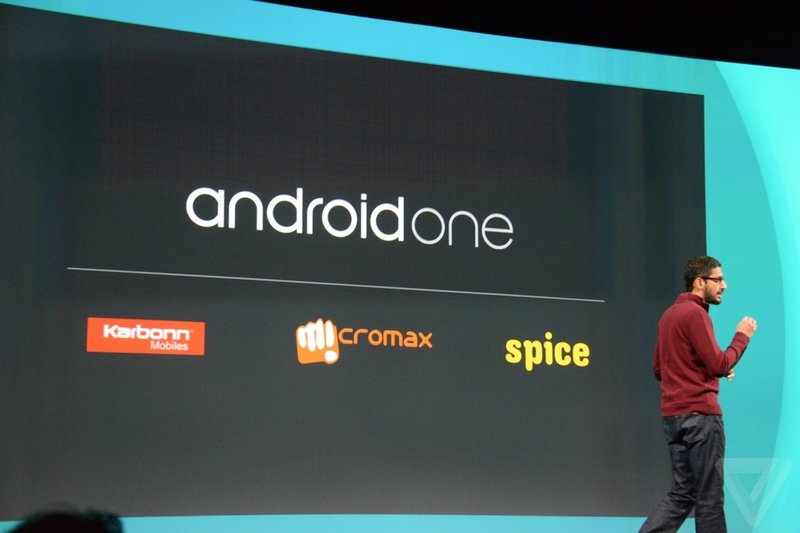
Google has unveiled the first smartphones to run on its Android One platform, a standard designed to help push affordable smartphones in the developing world. The initiative kicks off in India, where Micromax, Spice, and Karbonn are all selling phones said to have 4.5-inch screens, 1GB of RAM, 1.3GHz quad-core processors, dual-SIM slots, microSD expandable storage, and FM radios. Android One devices will also ship with support for more languages, including Hindi. The first phones are expected to retail for 6399 rupees ($105).
Similarly inexpensive smartphones have been around for a while, but Android One represents a concerted effort from Google to put its stamp on the user experience. These phones will all run stock Android…
Anyone who does a bit of online shopping knows that one of the most important rules to get the best deal possible is to look for the product you want on multiple shopping platforms. For example, buying a used book on Amazon is easy, and buying the same on eBay might be cheaper. You also […]
Chinese networking giant’s new research site in the Sophia Antipolis technology hub is its 17th in Europe and will focus on chipset design and embedded technology.