

I am very proud to belong to a generation of professionals who has seen the emergence of free and open software and the revolution it is today.
Read more at OpenSource.com
I am very proud to belong to a generation of professionals who has seen the emergence of free and open software and the revolution it is today.

Roku just hit a milestone: over 10 million of its streaming players have been sold to this point, stretching from the company’s original set-top box — which debuted in 2008 — through today. It’s a big number, and it establishes Roku as one of the leading players in the living room, at least when it comes to streaming boxes. Game consoles obviously sell many more units than that, but Roku has carved out a nice audience by pricing its products aggressively and constantly expanding the ecosystem of apps that run on those boxes. And the products themselves keep getting better.
All told, Roku says it’s now amassed a list of 1,800 channels; the company says that’s 1,000 more than any other streaming player offers. And people really love…
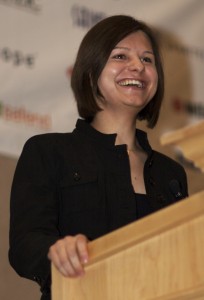 No matter how good the code review process is, or how high the standards for acceptance, applications will always have bugs, says Joanna Rutkowska, founder and CEO of Invisible Things Lab. So will drivers. And filesystems.
“Nobody, not even Google Security Team, can find and patch all those bugs in all the desktop apps we all use,” Rutkowska says in the Q&A interview, below.
This is why she and her team built Qubes OS, a security-focused open source operating system based on Fedora that, in essence, assumes that bugs are everywhere. Instead of running one kernel, Qubes isolates all functions into separate virtual machines using the Xen hypervisor. Each function may only access what it needs to run, thus limiting an exploit’s potential damage.
Rutkowska will give a keynote talk about Linux security and Qubes OS at LinuxCon and CloudOpen Europe, Oct. 13-15 in Dusseldorf, Germany. Here she gives an overview of the project, how it uses Xen, and how it addresses common security issues.
Linux.com: What is Qubes OS?
Joanna Rutkowska: Qubes OS is an open-source operating system designed to provide strong security for desktop computing. Qubes OS implements security by a compartmentalization approach. It’s based on Xen and Linux, but also has support for Windows-based AppVMs.
How does it use the Xen hypervisor and Linux?
Qubes uses Xen as a “compartmentalization provider.” We believe Xen is very powerful for this role. The Xen hypervisor is (still) relatively bloatware-free and had a decent architecture that allows us to keep it reasonably secure (e.g. it allows to keep qemu outside the TCB). It also offers support for so-called driver domains, which Qubes utilizes to sandbox networking and USB stacks.
Having said that, it is important to remember that Qubes is largely independent of the underlying hypervisor. In the next release (R3) we’re even introducing a Hypervisor Abstraction Layer to allow for (relatively) easy swapping of Xen for other VMMs. So, in the future we might see e.g. a KVM-based variant of Qubes OS, for better hardware compatibility.
Qubes uses Linux (here I mean both the kernel and the platform) mostly as an… “API provider” for apps and drivers. We don’t utilize the security mechanisms Linux provides, and instead we rely on Xen isolation for that.
This statement might sound like downplaying the importance of Linux, which, however is not my intention. There would be no Qubes OS without the flexibility of Linux. Even though we now also have support for Windows-based AppVMs, Linux is still unbeatable when it comes to making lightweight user AppVMs and sophisticated service VMs, or fueling Dom0 — the admin domain of Qubes OS.
What are the main security issues that you’re trying to address?
That desktop applications do have, and always will have, bugs and we need to accept the fact that nobody, not even Google Security Team, can find and patch all those bugs in all the desktop apps we all use.
That desktop drivers for various devices (WiFi, USB, etc) do have, and always will have bugs. That various more or less exotic filesystem implementations do, and always will have bugs. Etc.
How does Qubes address those issues?
Unlike other approaches which try to add security mechanisms to the already bloated kernels or systems, Qubes takes a different approach: it starts with a bunch of well-isolated compartments (Xen VMs), which represent various user security domains and system service VMs, and then, very carefully, builds bridges across those isolated compartments.
These “bridges” are essential to make Qubes actually usable as a desktop system, and include things such as seamless desktop GUI virtualization, secure copy-and-paste and file copy between different domains, and many other services. Clever use of these inter-VM bridges allows, in some cases, to actually achieve better overall security than in case one used multiple physically separated computers — you can read more on this surprising effect in this recent paper:
Can you tell us more about what you plan to talk about at LinuxCon and CloudOpen Europe?
I will have a short keynote about why we do Qubes OS and what does our upcoming roadmap looks like, and then we plan to have a more in-depth two-hour session on Qubes for more power users and developers.

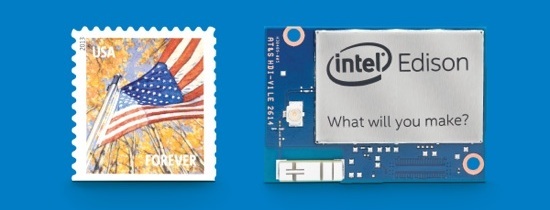
The smartwatch market is hardly a surefire bet, despite hopes that the Apple Watch will spur the market. However, the larger market for wearables, which includes smartwatches, eyewear, and smart clothing and accessories seem destined for greatness.
Linux-based platforms for wearables include Android Wear, Samsung’s Tizen SDK for Wearables, and now Intel’s Edison computing module, built on Yocto-based Linux and the Intel Atom processor. The Edison was released last week in conjunction with the Intel Developer Forum. Prior to the formal launch, some 70 Intel Edison beta units have been seeded, forming the basis for about 40 Edison-based projects, says Intel.
In the Intel view, the smartwatch is only the highest profile member of a booming ecosystem of wearables and other Internet of Things devices that can run on the common, Arduino-compatible Edison platform. Intel is definitely interested in watches, however. Earlier this year, the chipmaker acquired a watch company called Basic, and at IDF, former Apple exec Mike Bell, now VP of Intel’s New Devices Group, teased a new Basic Peak model due to ship by year’s end that appears to run on the Edison. Intel is also collaborating with watchmaker Fossil on another project, and with Barney’s and Opening Ceremony on a luxury Mica fitness watch.
At IDF, many more Edison-based projects were demonstrated. Chris Anderson, CEO of 3D Robotics, showed an Edison-based quad-copter drone, and Meridian Audio announced wireless speaker endpoints. There was also a Trossen Robotics robot, a Braille printer, and a fitness shirt. Intel even showed a Connected Wheelchair Project announced with physicist Stephen Hawking.
The $50 Edison module has changed from the original plan. Back in April, Intel announced that instead of using a new dual-core version of its Pentium-compatible, low-power Quark, it would first ship a dual-core Atom version, and would follow up later with a Quark model. As it turns out, both the Atom and Quark are integrated on the same Atom Z34xx (“Merrifield”) based system-on-chip called the Tangiers.
The Tangiers SoC clocks down its Atom cores to a 500MHz, and strips out the some advanced smartphone focused features. In the first generation, the Quark will be inactive, but when it is eventually switched on, it will be clocked down to 100MHz and act primarily like a microcontroller companion chip. The Quark will not run Linux, as it does on Intel’s Galileo hacker boards, but rather a new “ViperOS” real-time operating system derived from the VxWorks RTOS platform provided by Intel subsidiary Wind River.
Like Wind River Linux, the stack running on the Atom part of the Tangiers is based on Yocto-based Linux 1.6. Among other development tools, Intel is launching an Analytics for Wearables (A-Wear) developer program with Cloudera to offer Hadoop-based cloud services to Edison projects.
Two maker-focused development boards are provided for the board: a simple Edison Breakout Board and a more extensive Arduino-enabled version. SparkFun, which resells the boards along with Mouser and Maker Shed, offers over a dozen of its own SparkFun Blocks add-ons, which can stack on the module to add displays, batteries, industrial interfaces, and motor control.
It remains to be seen whether the Edison is picked up by big-name consumer electronics companies, which have largely adopted Android Wear or are selling “dumber” smartwatches without formal OSes. Yet, with the open source Yocto Project community behind it, we should see plenty of innovation in wearables and other IoT devices from smaller companies.
Editor’s Note: This is a guest blog contributed by the Samsung Open Source Group.
This year’s LinuxCon & Kernel Summit North America were notable for several reasons, not the least of which included being able to see the scenic views of downtown Chicago through the hotel lobby windows!
Below, the Samsung Open Source Group will share our top highlights of the conferences, as well as look forward to what we can expect from LinuxCon Europe next month in Germany.
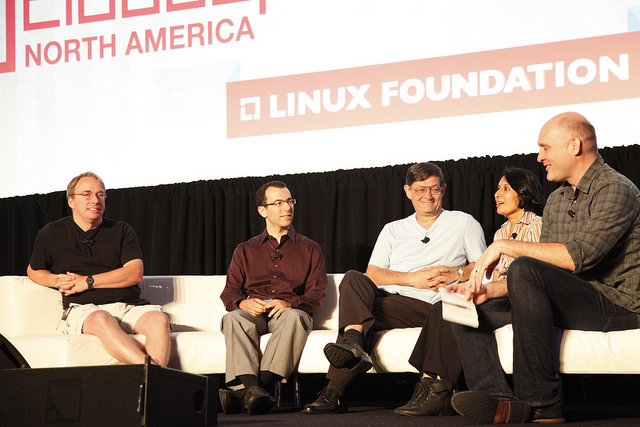
There were a lot of kernel topics discussed (to be expected). One that came to the forefront in both the kernel summit as well as the LinuxCon Kernel Panel discussion was the kselftest effort that Shuah Khan, Senior Kernel Developer with Samsung’s Open Source Group, has put forth and is now leading as the maintainer.
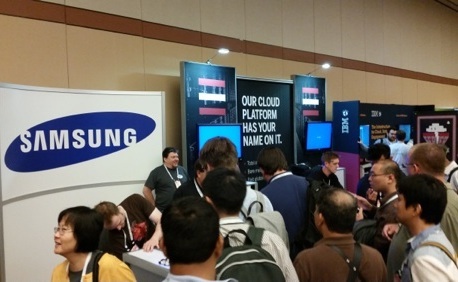
The goal of the kselftest effort is to improve initial Kernel bring-up testing. To do this, the community believes tests need to run quickly, to serve as a basic sanity check, instead of a full-scale stress test.
Media was also a big kernel topic, including a presentation by Mauro Chehab, multimedia maintainer and kernel developer from Samsung’s Open Source Group. He talked about the Kernel and userspace challenges related to build Linux support for wordwide digital TV support, showing the differences between the several standards.
The Kernel tinification project also generated a lot of discussion. The goal is to reduce the Kernel footprint, in order to allow it to run on really small devices. One of the issues was a question of what was actually driving this, because there is no clear hardware actually demanding it (yet).
Morten Rasmussen from ARM presented a report from the Energy-Aware Scheduling session and highlighted next steps. This work has been in progress for two years and is addressing concerns from the Linux kernel community. At the 2013 kernel summit, the need for a set of metrics and benchmarks to evaluate the energy-aware scheduler was identified. This year, two tools developed by Linaro are used to measure and evaluate the scheduler work. These tools are a good start and community feedback will determine how useful they are.
The Linux Foundation introduced certification for System Administrators and Engineers. The certification tests are available online for anyone to take anywhere, and are designed to evaluate the ability to solve real problems as opposed to testing an individual’s theoretical knowledge of the subject matter. Beware, there are no multiple choice questions on these to allow for guess work. Staying true to the Linux ecosystem’s choice and flexibility, these certifications provide choice of CentOS, openSUSE, or Ubuntu. This new certification program will enable employers to assess Linux talent when hiring or promoting their own engineers.
A talk by Keith Packard detailed the ways in which Valve had managed to utilize the Xorg display server for commercialization on their SteamOS gaming platform. The points that he showed proved that there are still companies interested in both leveraging and giving back to FOSS, and that gaming on Linux has never been in a better state than it is today as a direct result of the existing software stack.
A presentation co-delivered by Lars Bergstrom from Mozilla and Mike Blumenkrantz from Samsung’s Open Source Group described the Servo parallel browser engine and its underlying programming language, Rust. The engine has been developed from scratch over the past several years with a focus on memory usage and adherence to existing web specifications. It’s even more unique due to the project’s decision to reuse an existing and much-used API for 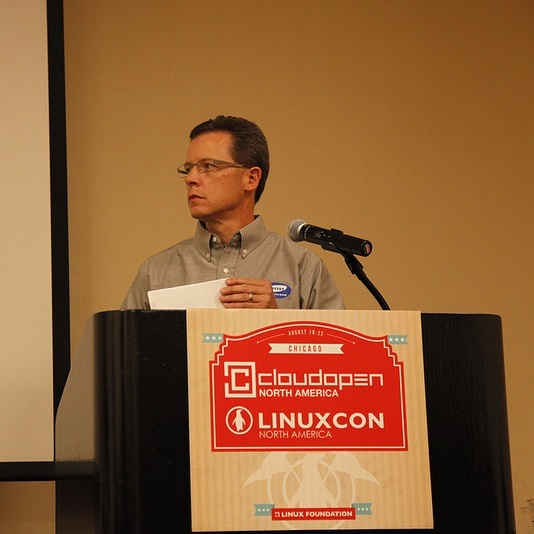 application embedding instead of attempting to create a new one.
Even in a highly technical conference environment, sessions on how to utilize the Open Source Way, ethos and development processes attracted a good audience. Guy Martin, Senior Strategist from the Samsung Open Source Group moderated a successful & well-attended panel with open source community luminaries Jono Bacon, Karl Fogel, Leslie Hawthorn and Karsten Wade. The panel (Empowering Corporate Open Source Developers) proved entertaining for the variety of opinions presented, and had a large amount of audience participation as well.
Guy also presented a shortened version of his ‘Developing OSS Leadership’ training course, which he also gave at LinuxCon Japan. This was in the last time slot of the conference, and though he expected to be talking to himself and a few diehard Samsung team members, the talk was well attended, with an engaged audience that asked good questions and kept him after his presentation for almost 30 minutes to ask more detailed questions.
As always, some of the most useful interactions happened as part of the ‘Hallway Track’ – colleagues and friends finding a quiet corner to catch up, discuss the latest things they were working on, or just hang out.
Also, the event at the Museum of Science & Industry was a great time for everyone who attended. The exhibits were fun and educational, the food was delicious, and the indoor quadcopter flying around didn’t result in any injuries or damages. 🙂
There are already some great sessions lined up for LinuxCon Europe in Germany, and the Samsung Open Source Group is excited to be a part of this, with Mike Blumenkrantz and Guy Martin reprising their sessions at this edition of the event.
Additionally, Dr. Ibrahim Haddad, Head of the Samsung Open Source Group, is planning an entertaining talk on open source compliance (yes, it can be entertaining!) and the Enlightenment for Linux (EFL) team will be well represented with numerous technical presentations, as well as their developer day co-located with the event.
Of course, it’s Germany, so we hope our friends at the Linux Foundation are planning a special beer-themed social event… 🙂