Home Blog Page 1578

Docker Gets a New Release and a New Nod of Approval

Since we first wrote about Docker last August, the open source container project has advanced in numerous ways. Not only did the company behind it officially shed its original dotCloud name and put Docker at the forefront of its focus, but it also raised $15 million in funding and announced partnerships with the likes of Rackspace, OpenStack, Red Hat and Fedora.

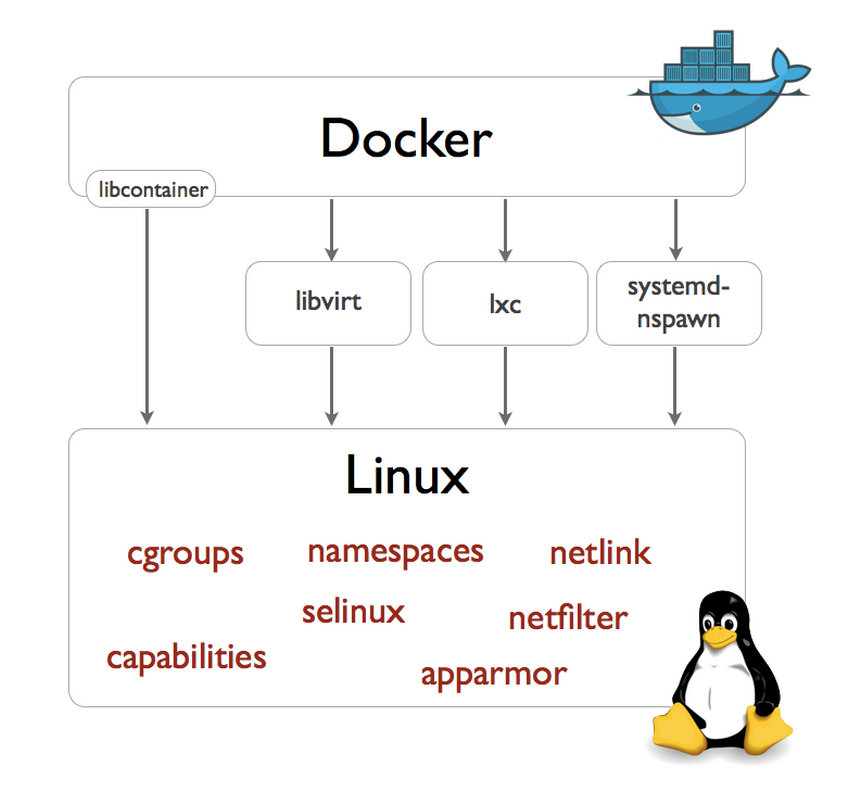
Docker diagramMore recently, Docker added another two milestones to its list of accomplishments. First, it released version 0.9, which is particularly notable for two major improvements: execution driversand libcontainer. Second, it got a major boost when Red Hat announced the extension of its application certification program to include containerized applications.

‘First-Class Support’

Docker 0.9 includes numerous bug fixes and continues the project’s focus on “quality over features, shrinking and stabilizing the core, and providing first-class support for all major operating systems,” in the team’s own words.

It’s also a major step towards a stable, production-ready 1.0 release, they note. In fact, the next release — version 0.10 — will be considered the first release candidate for 1.0.

In the meantime, the new version 0.9 introduces an execution driver API that can be used to customize the execution environment surrounding each container, making it possible for Docker to take advantage of isolation tools including OpenVZ, systemd-nspawn, libvirt-lxc, libvirt-sandbox, qemu/kvm, BSD Jails, Solaris Zones and even “good old chroot,” the project team says.

LXC will continue to be available as a driver in its own right as well.

A New Default

Also new in Docker 0.9 is a built-in execution driver based on libcontainer, a pure Go library developed to access the kernel’s container APIs directly, without any other dependencies.

“Thanks to libcontainer, Docker out of the box can now manipulate namespaces, control groups, capabilities, apparmor profiles, network interfaces and firewalling rules -– all in a consistent and predictable way, and without depending on LXC or any other userland package,” the project team explains. “This drastically reduces the number of moving parts, and insulates Docker from the side-effects introduced across versions and distributions of LXC.”

Libcontainer improves stability so much, in fact, that it’s now the default, while LXC is now optional.

‘A Win/Win for Users’

As for Red Hat’s new certification for containerized applications, the rationale was to ensure that application containers built using Red Hat Enterprise Linux will operate seamlessly across certified container hosts, Red Hat explained.

The upcoming release of RHEL 7 and Red Hat’s OpenShift Platform-as-a-Service (PaaS) offering will both be certified container hosts, with Docker as a primary supported container format.

“This announcement is a win/win for users,” Stephen O’Grady, cofounder and principal analyst at RedMonk, told Linux.com. “For Docker users, officially sanctioned access to Red Hat platforms gives that project the ability to target an enormous number of enterprise Linux users and the potentially lucrative market they represent. And for Red Hat, the certification means that for the dramatically expanding Docker community, RHEL is a first-class citizen.”

Red Hat is now offering early access to its partner program whereby ecosystem partners can participate in early testing, integration and feedback of the tools and resources required for containerization prior to the official launch of the certification and partner program later this year. The Partner Early Access Program will run through late spring.

“As the de facto standard in open source container technology, we are pleased to see Red Hat embracing the container movement as a means of application efficiency and consistency across computing footprints,” said Docker CEO Ben Golub.By offering a container certification on Red Hat Enterprise Linux and Docker, Red Hat is providing the industry’s only standardized, stable platform for commercial container workloads, providing a safe, reliable way to deliver the enterprise applications of the future.”

Qualcomm’s Liat Ben-Zur: Open Source Collaboration Works

Liat Ben-Zur QualcommEarlier this year, Qualcomm wowed technology industry executives and analysts with a tour of its smart connected home at the Consumer Electronics Show in Las Vegas. The tour demonstrated how the Linux-based home automation platform AllJoyn connects all of the various in-home devices from appliances and lighting to TVs and talking teddy bears.

“As they walked through the home, you could see the executives truly understand the power of various devices across brands and verticals and visualize the potential for collaboration,” says Liat Ben-Zur, senior director at Qualcomm Connected Experiences and chairperson of the AllSeen Alliance, in the interview below.

What the tour didn’t show, however, was what it takes to build the open source software platform that allows all of those devices to talk to each other. It is an impressive undertaking, with companies such as LG, Panasonic, Haier, Sharp and Silicon Image working together to build the AllJoyn platform alongside Qualcomm as part of the AllSeen Alliance, a Linux Foundation collaborative project.

In her keynote next week at Collaboration Summit in Napa, Calif., Ben-Zur will share the AllJoyn community’s experiences using collaboration to advance software development and the Internet of Things. 

Linux.com: You recently wrote that “The Internet of Everything does not require that everything needs to be connected to the internet.” What’s your vision for how devices will interconnect? 

Liat Ben-Zur: We imagine a different topology where every device in our home is interoperable and connected to a private internet, as opposed to having every device connecting out to the public internet. And then I, as a home owner, can decide which of my many connected devices should share data publicly versus privately. For example, I may choose not to expose when my toilet is flushed or when my garage door opens, however I may want to allow public cloud access to IP cameras so I can securely monitor my home when I am away. The idea is to provide consumers with more control of their data, choosing which data is to be exposed externally outside of the home and what is not.  

What is the role of open source software in enabling that?

Ben-Zur: We believe that the AllJoyn vision can make a significant impact on shaping the future of the Internet of Things.  To realize this vision, we need the expertise and creativity from all corners of the world, across many different disciplines and across many different verticals.  Specifically, we want companies with HVAC systems experts to help define the standardized interfaces and automotive experts to help expand the AllJoyn open source project with standardized  services for the automotive vertical. We truly believe that it will take a collaborative village to grow this project to become the de facto standard language for all connected things.

How will industry collaboration through the AllSeen Alliance contribute to this effort?

Ben-Zur: Some of the world’s leading consumer electronics and home appliances manufacturers, service providers, retailers, enterprise technology companies, innovative startups and chipset manufacturers have already joined the AllSeen Alliance.  All of these companies have unique insights into the needs of their products, customers and businesses.  By collaborating with all of these companies across an array of verticals, we are already starting to see how the existing AllJoyn open source project can benefit.  For example, Technicolor recently joined the Alliance and they are already enabling a more data-centric publish and subscribe set of application programming interfaces (API). By combining Qeo’s APIs and secure architecture with AllJoyn’s software and services framework, developers and device makers will have more options and greater flexibility in how they implement a fully distributed Internet of Everything.

What has been the highlight, so far, of your experience with AllSeen?

Ben-Zur: Seeing executives from around the world having an “ah ha” moment at our Connected Home demos at MWC and CES.  As they walked through the home, you could see the executives truly understand the power of various devices across brands and verticals and visualize the potential for collaboration.  These moments have reaffirmed our strategic decisions and furthered our belief that we are, in fact, solving an important problem for the industry.

Why is Qualcomm invested in this collaborative approach?

Ben-Zur: The AllSeen Alliance is all about enabling an ecosystem and forming an industry standard that allows for the growth of the Internet of Everything across all verticals. Our homes, our cars, and the things around us are getting smarter every day. Why not give manufacturers and developers the tools they need to invent new ways for these smarter things to work together?

https://www.youtube.com/watch?v=F1cKCgJ56r0″ frameborder=”0

Recapping The Top Changes Of The Linux 3.14 Kernel

With development of the Linux 3.14 kernel coming to an end and its official release potentially coming in a few days, here’s a recap of some of the top features and changes for this next major kernel version…

Read more at Phoronix

Tizen Wearable SDK Released, Google’s Android Wear Coming Soon

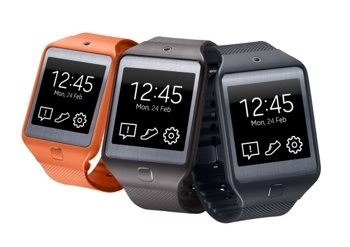
Samsung-Neo-2-2Like most smartwatches, Samsung’s Tizen Linux-based Gear 2 and Gear 2 Neo are primarily companion devices to Bluetooth connected smartphones rather than full-fledged wrist computers. Yet,the Tizen SDK for Wearablereleased by Samsung yesterday enables a variety of modes on the Gear watches for both standalone and companion scenarios.

The open source Tizen software development kit includes a Tizen Wearable IDE for Ubuntu, Mac OS X and Windows desktops, as well as an emulator and tool-chain. Samsung also released a certification process for testing Gear apps, and a scheme for secure code signing.

The release arrived the day before Google announced its Android Wear wearable platform. This lightweight version of Android is now available as a developer’s preview, and will first appear in the G Watch, which LG briefly announced along with an image, but few details.

Due in the second quarter, the G Watch will be followed by a Motorola watch running Android Wear called the Moto 360. Expected this coming summer, the watch features an innovative — and yet retro – round watch face. According to Google, consumer electronics companies including Asus, HTC, and Samsung will also participate in the project, although it’s unclear whether Samsung, for example, would actually create an Android Wear smartwatch or instead add support for the platform in its industry-leading Samsung Galaxy phones and tablets. Google, also cited chipmakers Broadcom, Imagination, Intel, Mediatek, and Qualcomm as participants, as well as “fashion brands like the Fossil Group,” all of which will help “bring you watches powered by Android Wear later this year.”

The key enhancement in Android Wear is the integration of Google Now, letting users vocally query one’s smartwatch in natural language, starting with “Ok Google.” The “contextually aware” platform also extends Android’s notification system, with features such as stacked notifications, and adds support for various sensors. In addition, it offers more controls over your presumably Android-powered, Bluetooth connected phone.

It’s unclear how much control Google will extend over the hardware design; most likely. It will most likely follow the fairly loose requirements of an Android phone or tablet rather than the more strict guidelines it has used with Chrome OS and Google TV devices.

In the meantime, Samsung will have a several month head start on app development and the devices itself, now that it has released the Tizen SDK. Samsung’s Gear 2 and similar, but plastic-fabricated, Gear 2 Neo, will ship in April at an undisclosed price with 100 Tizen-based Gear apps (see farther below). The most stylish model, the swatch-like Gear Fit, runs a real-time operating system (RTOS) instead of Tizen, and will ship with a much smaller number of apps.

Wearable SDK details

The Tizen SDK for Wearable provides three app modes: one for simple, standalone Tizen widgets that don’t require Internet access, and two for linking Tizen widget apps with host apps running on the smartphone. In the future, the host could conceivably include mobile devices running Tizen, generic Android, or perhaps other OSes, but for now, it’s limited to Samsung devices running Android 4.3 or higher.

In the “Integrated” mode, an Android app and host-side Tizen app are packaged together in the host-side APK — the latter installs the widget on the smartwatch. In the “Master-Follower” mode, the Android host app and host-side Tizen Gear app are installed separately. This would presumably be used to add Gear connectivity to pre-existing Android apps.

The Gear apps make use of Tizen’s HTML5-based Web Runtime (WRT). The runtime communicates with the mobile device with the help of a Wearable Manager Service located on the watch and a Gear Manager on the mobile device. The Bluetooth, Bluetooth Lower Energy (BLE), or WiFi communications are brokered via a Samsung Accessory Protocol (SAP) service based on Samsung Mobile SDK 1.5. The 1.5 version, currently in beta, includes a new Accessory package that supports Gear connectivity for things like notifications and controlling music playback.
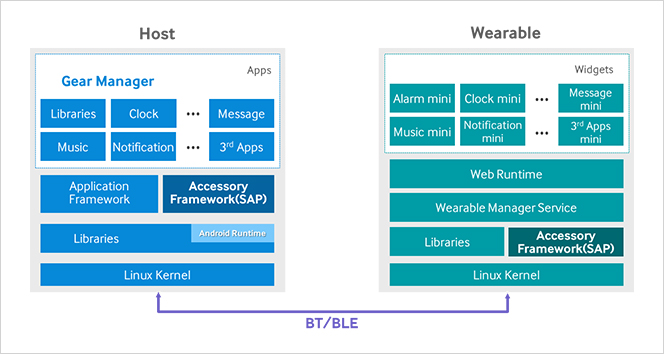
The architecture of the Samsung Gear host and wearable device software including the Gear Manager.

Accessory lets developers define services between a wearable and a smart device. Currently, the new Gear smartwatches are the only devices to support Accessory. However, Samsung envisions Accessory will not only run on future wearables, such as a health-related wearables or a potential Tizen-based eyewear device, but also for a variety of smart “Internet of Things” devices including automotive computers, gaming consoles, wireless speakers, or printers. It’s unclear whether these devices would similarly need to run Tizen or might also include Android devices. The Accessory page makes no mention of the Linux-based OS.

Like the original, Android-based Galaxy Gear smartwatch, the Gear 2 and Gear 2 Neo are equipped with a 1.63-inch Super AMOLED screen with 320 x 320-pixel resolution. Yet, they have a faster 1GHz, dual-core processor, backed up with 512MB RAM and 4GB flash. The watches include Bluetooth 4.0, as well as a 2-megapixel camera capable of 720p video.

Fitness features include a heart rate sensor, pedometer, accelerometer, gyroscope, and apps for running, walking, cycling, hiking, sleep, and stress monitoring. The devices add IP67 water and dust protection, and the 300mAh battery is said to last 2-3 days under typical usage.

23 apps, on the road to 100

Since the watches were announced in late February, the Gear now has 23 apps, a number that Samsung says should reach 100 by the April launch. In addition to apps for well-known brands like CNN, Conde Nast, eBay, and Expedia, Samsung announced music apps like MyMusicCloud and iHeartRadio, and a variety of health and fitness apps. The latter include Dacadoo, MapMyFitness, Strava, Runtastic, and Focus Trainr.

Social networking and location-related apps include Banjo, Glympse, Iwunta, and Life360. The remaining apps are a hodgepodge of productivity and media management apps such as Atooma, EasilyDo, Feedly, Spritz, Flick Dat, and News Republic. There’s even a wine-lover’s app (Vivino) and a Sleep Genius app for tracking and treating sleep disorders.

One would imagine that the other 70 or so apps that will be announced in late April will include some bigger names. Most likely, many of these will be Master-Follower apps that add Gear connectivity to an existing Android app.

Most app developers already know Android, so Samsung’s hybrid approach to Tizen app development shouldn’t be too large of a hurdle. The bigger question is whether developers will see a large enough market to justify the extra time and expense, especially for a platform that is limited by a requirement for connected Samsung smartphones and tablets. Although that encompasses most Android consumers, it’s still an extra limitation that won’t be an issue with most other smartwatch platforms, including Google’s.

Samsung will not only require a major marketing effort behind the Gear 2 watches, but will need to announce plans for future Tizen wearables that would expand the scope of the ecosystem to make it more appealing to developers and consumers. It also needs to attract more developers, something it has begun to do by recently by announcing 54 winners of over $4 million in Tizen App Challenge prizes.

The problem is that these apps were designed for Tizen smartphones, which appear to be delayed at least until the fall. Some of these apps might be converted to the Gear 2, but for the most part, entirely new apps will need to be developed.

In the meantime, however, developers have a flexible, open source SDK to help them get started. It’s unlikely that any other smartwatch will come along soon that will blow the Gear 2 out of the water. According to the current rumors, Google’s Nexus Watch will be very similar to the Gear 2 and most other smartwatches – i.e., a squarish device that most fashion-conscious types would never dream of wearing.

Within a year or two, however, further miniaturization and design efficiencies should enable a cool-looking bendable screen device like the Gear Fit that can run an advanced OS like Tizen or Android. Apple may have the design chops necessary to offer such a device this year, but if so, it’s likely to be initially priced beyond the scope of most consumers.

Meanwhile, Samsung has been doing its part to steer consumers toward wearables. For years it has been increasing the size of Galaxy smartphones to the point that people can no longer easily extract them from their pockets. Smartwatches to the rescue.



Catalyst 14.3 Beta Linux Driver Fixes OpenGL Performance Issues

AMD has released a new Windows and Linux Catalyst proprietary graphics driver. The Catalyst 14.3 Beta for Linux doesn’t advertise any new features, but it comes with some bug-fixes…

Read more at Phoronix

GOG.com Will Begin Offering Linux Games

The GOG.com online game store that offers various DRM-free game titles will finally begin shipping Linux games…

Read more at Phoronix

How to Make a Successful Gadget, the Fitbit Way

How do you make a successful gadget? In our online, mobile, cloud-connected world it’s not enough to build a better mousetrap. At the first Wearable Technology Show Fitbit has laid out its principles, providing a handy guide to success for the modern gadget.

Gareth Jones, Fitbit’s vice-president for Europe, Africa and the Middle East, laid down the commandments of the modern gadget at the Wearable Technology Show in London on Tuesday, highlighting the importance of ecosystems, openness, and fitting seamlessly into a person’s life. Read on for Fitbit’s rules of success…

It’s got to be more than hardware

Read more at CNET News

Hands-on: My New Laptop and Two More Linux Flavours

Two more Linux distributions, and a solution to the wi-fi problem.

GNU Guile 2.0.10 released

Version 2.0.10 of the GNU Guile language, an implementation of the “Scheme” Lisp dialect, is out. New features include better GDB integration, HTTP proxy support, better runtime error reporting, a new vector operations library, and a lot of changes to support the upcoming “R7RS” version of the Scheme language (information about which can be found on scheme-reports.org).

Read more at LWN

Most Businesses Unprepared for Cyberattack, Study Finds

New research suggests that 83 percent of businesses worldwide are still unprepared to cope with online security incidents.