
Asus’ Chromebox comes in at $179, and we happen to like what we see.
The post Asus’ sleek new Chromebox adds industry and functionality for only $179 appeared first on Muktware.
Read more at Muktware
It’s surely a testament to Red Hat’s prominence in the cloud arena that the makers of key enterprise technologies increasingly want to work with its cloud offerings, and on Tuesday, storage company Inktank provided a perfect example. Specifically, Inktank launched version 1.1 of Inktank Ceph Enterprise, an upgrade that’s certified for the Red Hat Enterprise Linux OpenStack Platform.
 Inktank Ceph Enterprise combines the most stable version of Inktank’s Ceph — a massively scalable, open source, software-defined system for object and block storage — with a graphical manager, enhanced integration tools and support services. In addition to RHEL OpenStack compatibility, Inktank now also supports Red Hat’s Enterprise Virtualization (RHEV) commercial hypervisor product.
“There is a huge and growing market of enterprises relying on open source products to run their businesses,” Neil Levine, Inktank’s vice president of product management, told Linux.com. “Red Hat’s OpenStack solution is one of the most important distributions for OpenStack to penetrate the enterprise market.
“While Ceph was already integrated with OpenStack, this certification guarantees a seamless Red Hat experience for our mutual customers and cements Inktank’s place in the Red Hat and OpenStack ecosystem,” Levine added. “This new certification will be key for us as we move forward with driving adoption of software-defined storage and… Inktank Ceph Enterprise.”
Of course, clouds as we know them today were nowhere on the horizon when Red Hat launched its namesake Linux distribution more than two decades ago. Though the company’s focus soon zeroed in on enterprises, the arrival of modern cloud technologies has wrought nothing short of a transformation.
Today, Red Hat’s cloud portfolio spans public and private clouds, virtualization platforms and bare metal offerings all built on Red Hat Enterprise Linux. It counts among its products the Red Hat Cloud Infrastructure, Red Hat CloudForms, RHEV, OpenStack early adopter evaluation, Red Hat Storage Server and OpenShift, Red Hat’s Platform as a Service (PaaS) product suite. Along the way, Red Hat also became the first billion-dollar open source company, reaching $1.13 billion in annual revenue during its 2012 fiscal year.
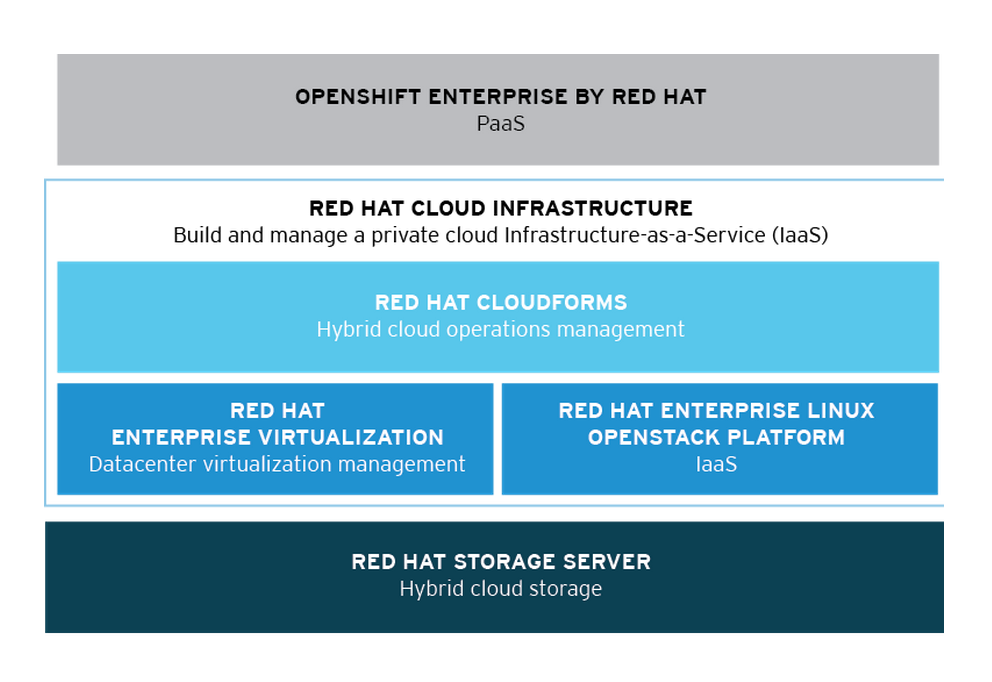 “It became clear to us that we would serve our customers best with a fully engineered, integrated and consistent stack that supports the development and deployment of the full range of workloads,” Tim Yeaton, senior vice president of Red Hat’s Infrastructure Group, told Linux.com. “(This) allows them to move seamlessly among the various deployment choices, with a single management framework that spans all of these.”
Indeed, “the main reason for Red Hat’s interest and work in cloud computing centers on where the market and opportunity in the industry are headed,” agreed Jay Lyman, senior analyst for enterprise software with 451 Research.
“Our market projections indicate enterprise cloud computing infrastructure markets of IaaS, SaaS and PaaS to be worth more than $21 billion, with an additional $22 billion-plus value in cloud-enabling technologies for 2016,” Lyman told Linux.com. “Furthermore, our ChangeWave and TheInfoPro surveys and research indicate continued growth for corporate spending on cloud as more of enterprise application development, deployment and other computing are migrated to the cloud.”
Given Red Hat’s roots as an operating system vendor “and its early expansion into middleware with JBoss, it is naturally positioned to support enterprise infrastructure wherever that is, whether traditional data center, public, private or hybrid cloud,” Lyman added.
In short, “Red Hat has always been known for its focus on enterprises, and as enterprises have moved to and adopted cloud computing — both technically and strategically — Red Hat’s enterprise focus has rightly shifted more to cloud,” he said.
The vast majority of Red Hat’s customers pursue a hybrid cloud approach, “mixing public cloud with on-prem(ise) private cloud and continued virtualized and single-server deployments,” Yeaton noted. “We consequently view hybrid as a given for the market.”
Accordingly, the company focuses on building platforms for enabling open hybrid clouds, and that’s a context in which openness is more important than ever, he said.
“First, customers continue to want the benefits they’ve enjoyed with open source in other software categories: choice, value and avoiding single-vendor lock-in,” Yeaton explained. “Second, open source and its collaborative development model are accelerating cloud technology innovation and are really setting the pace for future innovation in cloud and cloud-related technologies such as Big Data.”
Finally, “the open innovation model enables customers to participate directly in the innovation process,” Yeaton added. “We believe open, hybrid cloud is the best approach to meeting customers’ needs today and for the long term.”
Red Hat was not the first Linux provider to embrace the cloud — Canonical’s Ubuntu was the first to aggressively address cloud computing, Lyman pointed out. “Red Hat was also not the first Linux or open source software vendor to join and support OpenStack, with both SUSE and Ubuntu able to claim longer histories with the open source cloud community.”
In addition, the company now faces a competitive landscape in which the proprietary competition “is itself involved and savvy with open source software — a prime example being VMware, which is an OpenStack Foundation member and has deepened its open source involvement over the years,” Lyman added.
Still, “Red Hat is now clearly trying to do with OpenStack what it was able to accomplish with Linux in leveraging contribution and open source community for enterprise customers and market share,” he said.
Partnerships and certifications with companies like Inktank are a key part of that plan.
“Building a robust, certified partner ecosystem is a key reason that Red Hat has been successful to date with Red Hat Enterprise Linux, and we are strongly championing this for cloud as well,” Yeaton said. “We are happy to have companies like Inktank certifying their Ceph Enterprise to further enhance customer choice.”

The Defense Advanced Research Projects Agency, or DARPA, sponsors a lot of technology through grants to universities and private labs, with projects running the gamut from robots to electroencephalography caps, to software and new programming languages. A lot of that knowledge is open source, but it hasn’t always been easy to access. Today, DARPA has responded to requests from the research and development community by publishing the DARPA Open Catalog, a website that aggregates source code and other data for all public DARPA-funded projects.
“Making our open source catalog available increases the number of experts who can help quickly develop relevant software for the government,” Chris White, the DARPA program manager behind the…
 For some time now, the folks at Canonical, and particularly Mark Shuttleworth, have been discussing delivering Ubuntu with a development model that keeps the OS converged for use on desktop, mobile and server devices. We’ve been waiting to see granular evidence of how this kind of unified development might work, and a new discussion forum post titled Default File Manager with Unity8 in Future Desktops provides an example. It lays out requirements for a new file manager to be developed for Unity 8 for desktops and laptops. This would actually be the Ubuntu Touch file manager, now in development.
Nautilus—a file browser found in many Linux distributions and now part of GNOME—would give way to the new file manager under the proposed plan. There have been complaints from the Ubuntu community about the Nautilus file manager as implemented for Ubuntu.
 DK Panda from Ohio State University presented this talk at 2014 HPC Advisory Council Stanford Conference. “This talk will focus on programming models and their designs for upcoming exascale systems with millions of processors and accelerators. Current status and future trends of MPI and PGAS (UPC and OpenSHMEM) programming models will be presented.”