The first Intel Core “Haswell” based Chromebooks – laptops that run Google’s open source Linux-based Chrome OS – arrived this month amid strong Chromebook sales. This week the browser-oriented OS advanced on two more fronts.
First, Chrome OS took another step toward the tablet with a new version 30 stable release that added touch-enabled text selection and drag-and-drop support.
 Second, Google revealed a version of the Chrome browser that runs under Windows 8’s Metro mode, enabling a Chrome OS-like interactive environment within Windows that runs new Chrome Apps.
This triple threat of expanding OEM sales, the potential for hybrids and tablets, and a sneak attack from within Windows shows signs of a major market disruption. Chrome OS may not only pose a new threat to Microsoft, it may also be moving into Android’s mobile turf.
Chromebooks tap Haswell
After a slow start, Chromebook sales have been surging, driven by the ARM-based, $249 Samsung Chromebook and other low-cost models. According to a September NPD Research report, this summer Chromebooks provided “all the growth in the challenged notebook market.” In July, NPD estimated Chromebooks represented 20 to 25 percent of the under-$300 U.S. laptop market.
The overall PC market share is way too small – about 4-5 percent according to Gartner 1Q estimates— to predict Chrome OS will save the struggling PC market. Yet reviews and sales of Chromebooks are improving, especially as prices drop and Google adds features like free Google Cloud storage.
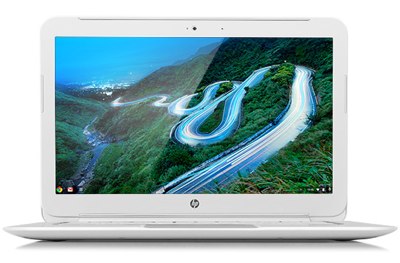
Last month, HP unveiled the first Chromebook with a Haswell processor. The $300 HP Chromebook 14 replaces its earlier, $330 Pavilion 14 model, and offers a faster Celeron 2955U that helps the laptop achieve up to 9-hour battery life. Reviews have been kind for the laptop, as well as its new $280 sibling, the ARM-based HP Chromebook 11. Last week, Acer launched its own Haswell-based laptop, running the same Celeron 2955U. The $250 C720 Chromebook is slimmer and 30 percent lighter than Acer’s previous Chromebook, and lasts 8.5 hours.
Chromebook hybrids first, tablets second?
None of the new Chromebooks offer touchscreens. The new touch features in Chrome OS apply only to Google’s $1,300 Pixel Chromebook, a laptop with a 2560 x 1700, 12.85-inch touchscreen. We’ll likely see at least one more affordable touchscreen laptop appear before the holidays, and possibly even a 2-in-1 hybrid laptop/tablet. A standalone tablet is less likely. We should know more on Oct. 31, when Google is expected to make some Chrome OS announcements in addition to launching the Nexus 5 smartphone and Android 4.4 (“KitKat”).
Chrome OS tablet rumors have been floated for years, but the rumor mill has lately gone quiet. The Chrome touch UI may need more fine-tuning before it can stand alone without a mouse and keyboard. A tablet would also pose a marketing dilemma for Google and its partners. Before the first Chrome OS tablet ships, Google will need to clarify its Chrome OS strategy in regard to Android.
Yet, the waters have already been muddied as Android expands into touch-enabled hybrid laptops. Just today Lenovo announced the A10, its first quad-core Android laptop. Although most of the early Android hybrids have run on the same ARM processors found on tablets, we’ll soon see hybrids based on Intel Haswell and Atom Z3000 (“Bay Trail-T”) processors. This week, Intel CEO Brian Krzanich said Intel was cutting prices on its SoCs, and that we’ll soon see $99 tablets, $299 laptops, and $349 touch-enabled 2-in-1 hybrids running Windows 8 or Android on Haswell or Bay Trail processors.
Chrome OS sneaks onto Windows PCs
The strong market for Chromebooks is due in part to the growing maturity of Chrome OS. Last month, the OS took another step forward with the release of Chrome Apps. The first 50 Chrome Apps are based on web technologies, and can run in any Chrome browser, not just Chrome OS. Yet, they’re more similar to desktop applications or native Android apps than to previous Chrome applications. For example, they can run offline and outside of a browser, and interact with devices via USB and Bluetooth. With Chrome Apps, Google has taken another half-step away from its vision of web-centric computing, an approach shared by Mozilla with its HTML5-based Firefox OS.
The apps may also represent a new strategy for Google, According to The Verge this week, Google has updated the developer version of the Chrome 32 browser to run a Chrome OS-like embedded OS implementation within Windows 8’s Metro mode. The implementation is still buggy, but it provides Google’s Chrome, Gmail, Google, Docs, and YouTube icons, and lets users arrange windows and load Chrome Apps.
Technically, this is not Chrome OS. Yet, by allowing the Chrome browser to tap into Metro mode, Google offers a close approximation. Metro enables Windows users to do more from within their browsers, including accessing Windows APIs for rendering HTML5.
HP flirted with a similar strategy of luring users to WebOS by embedding it within Windows, but it never followed through with its plans. It will be interesting to see if Google’s Metro implementation is simply a curiosity or a major disruption.
A merger of ChromeOS and Android?
The Chrome OS imitation is helped by the increasing sophistication of Chrome browser and its close alignment with Chrome OS. Cross-pollination has also been occurring to a lesser degree with Android, as features are shared between the two platforms. Not only is Chrome OS gaining touchscreen support, but more and more Android devices ship with the Chrome browser.
Still, this is a far cry from the widely predicted merger of Google’s two OSes. The merger theory has been on the rise since Chrome OS chief Sundar Pichai took over the Android team earlier this year from Android creator Andy Rubin.
Although Google may provide Chrome OS with an emulator to run Android apps, a full merger is unlikely, as this would cause havoc in the Android ecosystem and force Google to step farther away from its cloud-oriented philosophy. A more likely possibility, however, is that Google will start pushing Chrome OS as the preferred platform for high-end tablets and phablets by the end of 2014, leaving Android to the growing market in lower-end smartphones.
This argument was posited recently by Galen Gruman in InfoWorld . Gruman suggests the cloud-focused Chrome OS is a better platform for extending Google’s data mining business than Android. He also sees a reduced focus by Google on Android, noting the incremental recent Android releases and lack of cutting-edge products emerging from its Motorola subsidiary.
Gruman speculates that Google may even push Android out of smartphones altogether and focus it on embedded applications like TV interfaces and the Internet of Things. This would be a radical move, but at least Google would be advancing into a new market rather than having its two platforms compete over the same turf.