Intel left plenty of room for speculation yesterday at the Intel Developer Forum (IDF) when it announced a low-power, small-footprint processor family called the Quark. One of the biggest questions is whether it will support advanced platforms like Linux.
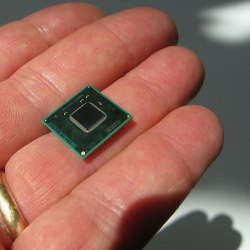 The 32nm-fabricated Quark core is a single-core, single-thread CPU that measures one-fifth the size and uses one-tenth of the power of the upcoming, 22nm “Silvermont” Atom cores. Although the full Quark processor will likely draw more power, this is still a quantum leap in power efficiency.
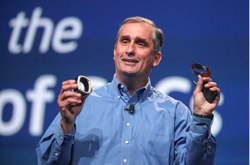
The Quark is designed for applications ranging from simple, wireless-enabled “Internet-of-Things” (IoT) devices in industrial, energy and transportation, to wearable computing. At the IDF event, new Intel CEO Brian Krzanich held up what appeared to be a smartwatch reference design based on the Quark, as well as a medical patch.
According to GigaOM, an Intel spokesperson described the Quark as a “synthesizable Pentium ISA compatible CPU core.” The software stack is said to include security, manageability, and connectivity features.
No release date was announced, but sample form-factor reference boards for the Quark are due in the fourth quarter. According to PCMag, the first Quark chip, called the Quark X1000, will begin production by the end of the year.
EETimes has already identified one early customer. Dalkin is testing the Quark in an HVAC system. The reference board includes WiFi and 3G support, as well as McAfee security software.
The reference platform used by Dalkin is said to be an embedded OS from Intel subsidiary Wind River, but there was no mention of whether it’s Wind River Linux or Wind River’s VxWorks real-time OS (RTOS). At publication time, Wind River said it was unable to comment on a request for OS information.
While the Quark may well be intended as a vehicle for VxWorks, the Quark’s x86 foundation, and Intel’s claims of an “open architecture” and “standard industry software support” would suggest the possibility of Linux support. The “open architecture” claim may refer primarily to Intel’s uncharacteristic decision to partially open up the platform for other chipmakers to participate.
Although the core is closed and will not be licensed, and all Quark chip manufacturing will at least initially occur in-house, the Quark offers “a standard fabric you can attach your IP to,” Intel’s Krzanich told the IDF audience. He added that Intel would collaborate with third parties to customize the chips for specific “sensors, algorithms, and accelerators.”
ARM’s IoT processors
The Quark’s partially open fabric is a step toward ARM’s successful policy of licensing Cortex IP to other chipmakers. ARM is primarily addressing the IoT and wearable markets with its Cortex-M and more powerful Cortex-R microcontrollers. Cortex-M3 and –M4 chips have been rapidly stealing market share from other microcontroller unit (MCU) platforms, with the Cortex-M3 finding its way into smartwatches like the Sony SmartWatch 2 and Qualcomm Toq. Some smartwatches offer more advanced Cortex-A processors, however, such as the Samsung Galaxy Gear, which has a Cortex-A9-based Exynos 4212.
 Neither the Cortex-M or –R chips supply a memory management unit (MMU), although the Cortex-R has a memory protection unit. Lacking an MMU, they are typically controlled by RTOSes, with Linux support limited to the very minimalist uClinux.
ARM microcontrollers are increasingly being teamed with Linux-ready Cortex-A processors in hybrid system-on-chips. For example, Broadcom’s StrataGX BCM5862x SoC combines a Cortex-A9 processor running Linux with a Cortex-R5 based FlexSPARX ARM core. Freescale’s Vybrid F SoC, meanwhile, combines a Linux-ready, 500MHz Cortex-A5 processor with a Cortex-M4 core running Freescale’s MQX RTOS.
Aside from the venerable ARM9, the Cortex-A5 is ARM’s lowest-power offering that can run a full Linux or Android distribution. It’s twice as fast as the Cortex-A8 it replaces, while delivering lower power consumption than ARM11, such as the Broadcom chip that powers the Raspberry Pi. Atmel’s Cortex-A5 based SAMA5D3 processor runs at 200mW in active mode and below 0.5mW in low-power mode. By contrast, Atmel’s ARM9-based AT91SAM9G20 runs Linux on just 80mW.
MIPS also offers some low power CPUs for the Internet of Things. For example, Arduino began shipping a partially MIPS-based Arduino Yún hacker board this week. The Yún integrates the functions of an Arduino Leonardo, featuring an Atmel ATmega32u4 MCU, with an Atheros AR9331 WiFi SoC running OpenWRT Linux on a 400MHz MIPS CPU.
Connecting the Quark dots with ISF?
Although Intel did not mention its M2M-focused Intelligent Systems Framework (ISF) announced earlier this year, the Quark would appear to fit in nicely with the framework. ISF is defined by Intel as “a set of interoperable solutions designed to address connecting, managing, and securing devices and data in a consistent and scalable manner.” It also includes software from McAfee and Wind River.
Intel’s challenge with the Quark is that it’s a low-margin business, so perhaps it hopes to boost its income selling ISF services supporting the processor. No pricing was announced, but Intel will likely need huge volumes to make the Quark profitable. While extolling potential medical applications, including Quark-based devices that can be swallowed, new Intel President Renee James called the Quark “literally disposable.” That’s one way to ensure repeat customers.



 This week is proving to be another interesting one at KDE. Sebastian Kügler posted a demonstration video of KDE Plasma 2 snapshot in action. Lukas Tinkl posted about the new Plasma NM. And, bonus, the best KDE distribution for 2013 has been decided.