

Shuah Khan is a Senior Linux Kernel Developer at Samsung’s Open Source Group. She has contributed to various kernel sub-systems including the Android mainlining project, LED class drivers, IOMMU, DMA, and more. Her current focus areas are Power Management and PCIe ASPM. She also helps with stable kernel release maintenance testing and bug fixes. In this Q&A she describes her work space and the hardware she uses for kernel development.
This is the third article in a series on kernel developer work spaces — a new take on the popular 30 Linux Kernel Developers in 30 Weeks series. Previous posts featured kernel developers Steve Rostedt and Greg Kroah-Hartman.
What do you like most about your work space?
I work remotely from home in Colorado. My work space is spacious and has ample room for all three of my laptops and then some. It has several large windows making it the sunniest work space I have ever used. In addition to that, it offers good views of the Rocky Mountains. Another advantage is, when I talk to my laptops, there is nobody to give me strange looks.
Workspace is not very useful without a few development and test systems and some meaty development work. I use several systems for kernel development and testing stable kernel releases. Samsung Series 9 900X4C Intel Corei5 is my primary development system. It has 16GB of RAM and 250GB SSD drive. I run Ubuntu 12.10 on it and it is very fast. I routinely run 3 to 4 Linux kernel compiles in parallel when I test stable kernel releases. Compiles are quick and boot testing goes very fast.
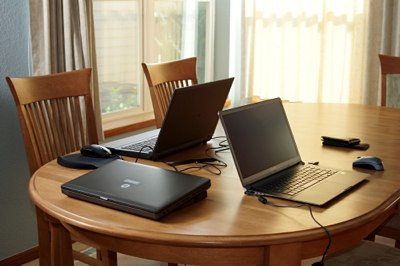 HP ProBook 6475b AMD A10-4600M APU with Radeon(tm) HD Graphics is my second test and development system. This system helps me test and debug AMD specific
problems if any. HP Compaq dc7700 SFF desktop Intel Core-i2 is my third test and development system I use to run cross-compile tests on stable releases for various architectures. Running cross-compile tests on an x86_64 system helps sanity check the releases on other architectures and find build problems early before the stable kernels are released.
What do you like least?
As I use dining table as my desk, there is no good way to tuck power cords out of the way and power cord management gets messy at times.
What’s the oddest work space you’ve ever used?
I work outdoors occasionally. The one odd work-space I have used and still use when weather is too nice to be indoors, is a picnic table. I have good wifi coverage in my backyard.
 Is there a particular item in your work space that we should know about?
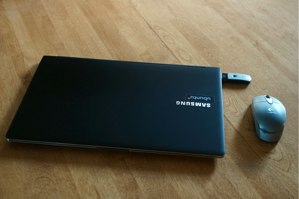
Besides being able to do what I love doing, working for Samsung has an added benefit of getting my hands on the latest Samsung laptops for kernel development. Samsung Series 9 900X4C deserves a special mention. This is my first experience with a Samsung laptop and a system with SSD. I was a bit skeptical about systems with SSDs prior to owning this laptop. I found that with a combination of SSD and 16GB of RAM, this system is very fast and makes development a breeze. It is surprisingly lightweight and sleek for a laptop with an 8-hour battery.
 A new effort called