The Lima driver is slowly but surely progressing for supporting ARM Mali graphics hardware in an open-source world. A Mesa driver has been started, their demo code can be faster than the binary driver, user-space memory management is being tackled, and evidently the management at ARM Holdings isn’t too happy…
Do High-Profile OpenStack Departures Spell Trouble?
In a major announcement from Dell Computer last month, the company announced that its public cloud ecosystem and strategy will be centered on partners Joyent, ScaleMatrix and ZeroLag, and will emphasize recent acquisition Enstratius. That represented a very major reversal of its plans to deliver public cloud services based on the open source OpenStack cloud platform. Meanwhile, IBM–which has been firmly in the OpenStack camp–is spending billions to buy SoftLayer for its cloud computing infrastructure tools and services.
All of this is what I was getting at in my recent post, “In Five Years, Expect Far Fewer OpenStack Service Providers.” OpenStack has had much more hype than it has had deployments so far, despite its massive promise.
Intel 2.21.9 X.Org Driver Calls Out More Regressions
Chris Wilson of Intel’s Open-Source Technology Center is back to pushing out xf86-video-intel driver updates at an expedited rate. Rather than the new releases being about advancing the SNA acceleration architecture or new features, the past few have been about correcting regressions and other bugs…
OpenSUSE 13.1 Switching To Ruby-Based YaST
YaST, the SUSE-developed administration and control utility that’s original to the German-based Linux distribution, is being rewritten in Ruby for the upcoming openSUSE 13.1 release…
Red Hat Betas Web-Developer Tool Collection
The latest for Red Hat Enterprise Linux users with Red Hat Subscriptions is a beta of a collection of dynamic languages and databases selected for web developer use, which offers them newer versions than what comes with RHEL.
J.P. Morgan Cuts 2013 Forecast for IT Spending
Global IT spending is now slated to rise just 0.6 percent this year, down from the investment firm’s prior forecast of 1.2 percent. [Read more]
The Linux Standard Base: Order From Chaos
Imagine going out to do your shopping errands in a world devoid of standards. What would that be like? Without standard sizes, something as routine as buying clothes would be an exercise in frustration. Finding a replacement bulb or buying tires for your car would require unique parts made only by the manufacturer. That’s why the world of Linux has the Linux Standard Base, which offers a way to standardize many of the system internals used by Linux.
Big Switch Leaves OpenDaylight
Friction over how to begin merging the code bases for the open source software defined networking project has seen Big Switch, a founder company, leave the project after sixty days.
Jeff Layton on Getting Started with HPC Clusters
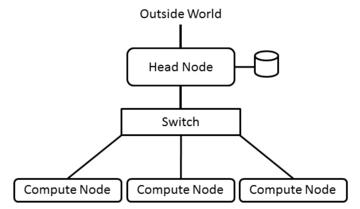
Generic Cluster Layout
Over at Admin Magazine, Dell’s Jeff Layton has written a wide-ranging primer on Getting Started with HPC Clusters. And while he covers the bases with traditional beowulf topics, Layton says that using virtualization is a great path to understanding.
One of the quickest and easiest ways to really get started is to use virtualization, which is sort of the antithesis of HPC: Virtualization takes a single system and makes it appear to be several separate systems; HPC tries to take several systems and make them appear to be a single system. You can use your laptop or desktop to run a number of VMs and then use them to learn about HPC applications or administering clusters. In doing so, you not only learn about HPC, you learn about virtualization for Linux, which is not a bad skill to have.
Read the Full Story.
Related posts:
- Jeff Layton on the Cloud’s Changing Role in HPC
- Jeff Layton on Why Application Profiling is the Key to Survival
- Jeff Layton on Matlab-Like Tools for HPC
The post Jeff Layton on Getting Started with HPC Clusters appeared first on insideHPC.