
Install Linux Malware Detect (LMD) On CentOS
In this tutorial I will show you how to install and configure a great malware detector software called LMD (Linux Malware Detect) in your CentOS server.
Read more at HowtoForge
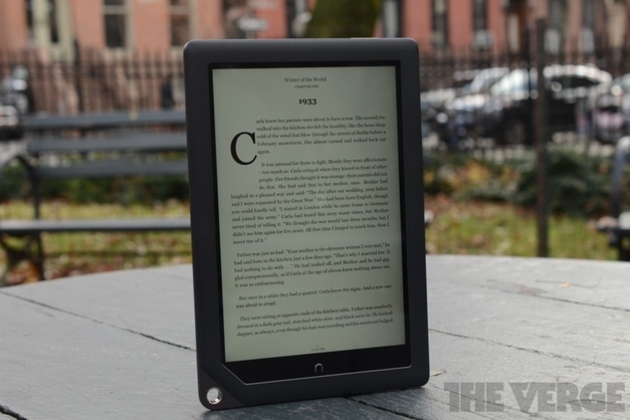
Barnes & Noble’s Nook tablets have always been surprisingly good Android devices with one critical flaw: very few apps. That’s because to-date they have relied on the company’s own app store, which offered a tiny fraction of what was available on Google Play. That’s all changed, as the company has announced that the Nook HD and HD+ will be getting a software update that will include the Google Play store and access to the over 700,00 apps contained therein. It will also come pre-loaded on future devices. You’ll be able to not only access apps through the Google Play store, but also the books, magazines, and movies that Google offers.
Barnes & Noble won’t be shutting down its own content and apps store — though we imagine most users…
Join some of the most prominent leaders in the open source cloud for a Linux Foundation live video chat next Tuesday, May 7 at 10 a.m. PST, via Google Hangouts On Air.
 Participants will include cloud experts from CloudStack, Eucalyptus, Gluster, OpenShift, OpenStack, Puppet Labs, Rackspace and Red Hat. Joe Brockmeier, CloudStack community evangelist at Citrix, will moderate the discussion on open source cloud topics such as:
– portability
– tools and methods for security
– hypervisor support
– AWS API compatibility
– and more.
The group will also take questions and comments from anyone with a webcam and headset who wants to join in. Sign up for the event on the Linux Foundation’s public calendar listing, or join on Tuesday at the Linux Foundation’s Google+ page.
The hour-long chat will provide a glimpse at the upcoming open cloud panel discussion on infrastructure and portability at the Enterprise End User Summit May 14-15 at the New York Stock Exchange in New York. Request an invitation.
Interested in other live chat opportunities with the Linux Foundation? Follow us on Google+, Twitter or Facebook for event updates. This is the third chat in our Live Linux Q&A series following a Facebook chat with Linux.com tutorial writer Carla Schroder and a live Twitter chat with Adapteva CEO Andreas Olofsson on the $99 Linux supercomputer.
Three Android-powered NASA “PhoneSat” nanosatellites deorbited and burned up in the atmosphere on April 27 after successfully completing their six-day mission. Meanwhile, the Android- and Linux-powered STRaND-1 nanosat, which was launched by the U.K.’s Surrey Satellite Technology Ltd. and Surrey Space Centre on Feb. 25, is still orbiting, but has yet to phone home.
Despite the risks of space, a growing number of organizations are developing tiny, low-cost nanosatellites built with Linux, Android, and Arduino gear. Like the NASA and Surrey missions, many are using open source designs.
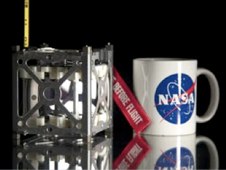 Collectively these projects are testing the feasibility of low-cost, low-weight satellites based on COTS components, pushing their limits under the intense cold and radiation of space and the vibration of launch. For space agencies, the nanosatellites’ simple designs, small sizes, off-the-shelf components, and frequently open source software have the advantage of lowering costs. Even more savings are found at launch thanks to light weights and modest footprints, ranging from the size of coffee mugs to toasters.
Yet, it’s more than tight budgets that are driving the boom in nanosats. The miniaturization and increasing sophistication of Linux- and Arduino-based single board computers (SBCs), as well as the arrival of powerful, hackable Android smartphones, complete with cameras and I/O, enable organizations to quickly design and launch nanosats. Instead of spending years shoehorning multiple features into expensive, larger scale satellites, governments, organizations, and private companies can quickly send up many more single-purpose satellites as the need arises. Or they can deploy numerous satellites around the world for coordinated data collection.
Potential uses for nanosats include heliophysics studies, close-Earth observation, qualification of components for space flight, and science and technology education projects. Lunar, asteroid, and planetary expeditions are also a possibility.
As for the growing crisis of space junk, nanosats have the advantage of being small and typically low orbit, and therefore easily and safely destroyed. Both the PhoneSat and STRaND-1 projects were designed to deorbit and burn up after their missions were completed. In addition, nanosats are perfectly suited for monitoring space junk to protect other satellites and spacecraft.
Nanosats based on Android phones offer the further advantage of a standardized app platform for running experiments. This opens up space experiments to students and hackers around the world. Before we take a close look at the Android-based PhoneSat and STRaND-1 experiments, here are some other nanosat projects and products that involve typically open source Linux and Arduino platforms:
OpenCube Initiative — non-profit open source group with goal of standardizing CubeSat interfaces.
Aalto-1 — an open source Linux-based nanosat design from Finland’s Aalto University.
Cosmogia’s Dove-1 — 3U CubeSat nanosat built on Arduino boards and other COTS equipment, with successful deployment on the same Antares rocket that carried the NASA PhoneSats.
NanoSatisfi’s ArduSat — Kickstarter-funded, Arduino-based 1U nanosat billed as “the first open platform allowing the general public to design and run their own space-based applications, games and experiments.”
Tyvak Nano-Satellite Systems — sells a variety of Linux-based “Intrepid” SBCs and “Endeavor” 3U and 6U nanosat craft, and recently won NASA contract to produce a Linux avionics computer for a “nano-launch vehicle.”
Andrews Space — manufactures a line of Linux-based CubeSat “Cortex” SBCs and avionics computers.
Xiphos Technologies— sells a range of Linux-based “Q6” avionics boards aimed at the nanosat market.
NASA Ames launched three PhoneSats aboard a test flight of the Orbital Sciences Antares rocket on April 21. By building the craft around Android Nexus smartphones, NASA sped production time and kept costs low. The two PhoneSat 1.0 devices cost $3,500 each — making them the cheapest satellites ever to reach orbit. The PhoneSat 2.0 cost $7,000.
All three PhoneSat satellites adopted a four-inch cube 1U CubeSat design. The PhoneSat 1.0 “Graham” and “Bell” craft incorporated largely unmodified HTC-built Nexus One smartphones linked to one-way radios. The “Alexander” device featured a more advanced PhoneSat 2.0 design, sporting a faster, gyroscope-equipped Samsung Nexus S and adding a GPS receiver and two-way S-band radio. It also added solar panels, which were intended to keep the satellite operational for up to two weeks. Yet, the nanosat apparently deorbited and burned up after six days along with its siblings.
The Nexus phones had only minor modifications. The phones’ batteries were swapped out for larger external Li-Ion packs, and on the PhoneSat 2.0, cellular components were removed to save on weight.
The PhoneSat experiment was deemed “successful” by NASA. The phones sent status reports and photographed Earth, with the image packets captured and reconstructed from some 250 registered amateur radio ground stations around the world.
New PhoneSats are set to launch later this year, possibly including a PhoneSat 3.0 craft that includes heliophysics sensors. It will also feature a fold-out design that will allow more craft to be carried into orbit in the same cargo space.
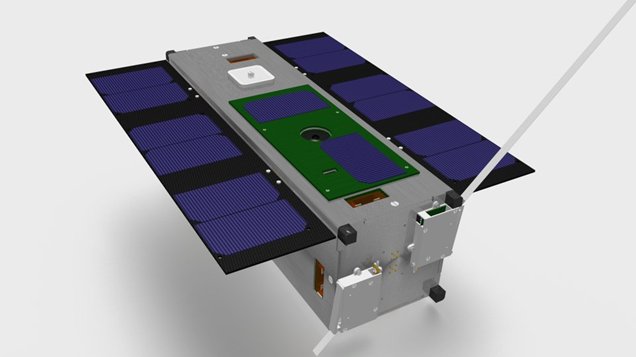 Surrey Satellite Technology Ltd. (SSTL) and its launch partners, Surrey Space Centre (SSC) and the Indian Space Research Organization (ISRO), intended the 3.5kg, 3U CubeSat (30 x 10cm) STRaND-1 to be the world’s first smartphone-based satellite, beating NASA to the punch. It didn’t quite work out that way.
After the Feb. 25 launch from India, the nanosat settled into a 785-km, sun-synchronous orbit, and the Linux-based flight computer worked fine. In mid-March, however, just as its Nexus One phone was set to be activated, the STRaND-1 stopped communicating. It’s unclear whether the problem stems from the computer, the satellite modem, or Surrey’s ground station, which had suffered from previous glitches.
SSTL has yet to give up on its nanosat, which is scheduled to fly for another four months. “There are lots of variables to check out, so this could take a couple of weeks,” SSTL spokesperson Joelle Sykes told Spaceflight Now on April 25.
Assuming the STRaND-1 comes back to life, the unmodified Nexus One will carry out scientific experiments while leaving the satellite communications and flight control to the Linux computer. Later in the flight, the plan is to turn some in-orbit controls over to the phone.
The computer is based on Digi’s ConnectCore Wi-9C SBC, built around Digi’s 180MHz ARM9 NetSilicon NS9360 processor, and features USB and WiFi links to coordinate satellite communications. If things get too chilly for the Nexus One, the Wi-9C, which supports extended temperatures, activates a processor-intensive program on the phone to heat it up. The STRaND-1 also carries two experimental, energy efficient propulsion systems, one using a water/alcohol mix, and the other an electric Pulsed Plasma Thruster (PPT) system.
The phone’s Android apps were developed by winners of a Facebook competition. They include a telemetry experiment, an app that monitors magnetic fields, and a “360” app that uses the smartphone’s camera to establish position with the help of the craft’s GPS system. If the STRaND-1 and its phone are activated, the public can request coordinates to be used for photos, with images posted on the 360 website.
Finally, to test the slogan from the movie “Alien” — “In space, no one can hear you scream.” — a Scream in Space app will play submitted recordings of screams over the phone’s speaker. It will then gamely attempt to use the phone to record the sounds through the vacuum of space.
Until then, however, the only screams you hear may be those of frustration emanating from Surrey, England. An April 16 tweet from SSTL noted, “Right now we just want to poke it with a sharp stick or kick it in the shins. Works on other stuff :-).”
If the STRaND-1 finally switches on it will be the most ambitious and longest duration Android-based nanosat to date. We wish them the best.
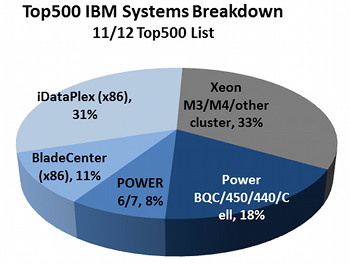 Over at The Register, Dan Olds looks at how IBM’s potential sale of their x86 business to Lenovo would affect Big Blue’s HPC business.
As a share of IBM’s total sales to the Top500, typical x86 boxes are the largest segment in terms of system count at 33 per cent. These are IBM’s M3/M4 and other traditional rackmount “pizza box” systems. The vast majority are dual-socket Xeon-based servers that can be found in pretty much every data centre in the world. Interestingly enough, 43 out of 63 of these systems reside in China and are used by Internet service providers. So if some sort of IBM-Lenovo asset sales takes place, Lenovo will have a home court advantage with these customers – and increase its presence on the Top500 list from a single system to 40+.