
The market is still young. But companies big and small are positioning themselves to be at the center of the wearable computing business when it explodes. [Read more]
Read more at CNET News
When you’re buying a new computer with performance in mind, integrated graphics are generally not the ones you want. Even though they’ve improved greatly over the years, “Intel HD Graphics” has become synonymous with “doesn’t play things very well,” continually lagging behind dedicated GPUs from the likes of AMD and Nvidia.
Now, Intel hopes to break the cycle and the naming association in one fell swoop. The company claims its new Intel “Iris” Graphics, embedded in upcoming Haswell CPUs, can offer double or triple the performance of the Intel HD Graphics 4000 that comes with current Ivy Bridge processors. That’s significant: typically each generation offers only a double-digit percentage boost.
That doesn’t mean every new Haswell…
Linux use in the enterprise is increasing as the Linux Foundation verified last month in its Enterprise End User Survey.
In fact, more than 80 percent of respondents plan to increase the number of Linux servers in their organizations over the next five years. And 75 percent reported using Linux in the last two years in new applications, services and Greenfield deployments.
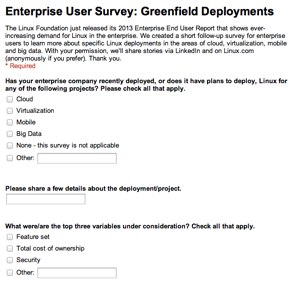 These are huge, impressive statistics. But what does it mean to those administrators and developers on the ground who work with Linux every day? To get some real world examples of Linux deployments in action, we followed up on the report with an informal poll of the Linux Foundation’s LinkedIn community.
Nearly 50 LinkedIn group members responded with project details, including the top considerations for choosing Linux, the biggest barriers to adoption, the results of their deployments and advice to others considering using Linux.
Cloud, virtualization and mobile deployments were the most popular uses of Linux in the survey. With low total cost of ownership, available features and security listed among the top reasons for using Linux in a Greenfield deployment. And time savings, efficiency and increased usage by end users ranking as the top results for deploying with Linux.
While many of the respondents chose to keep their project details anonymous, a few who were willing to share their stories publicly are featured here (coincidentally, both are from Poland). Many more in-depth Linux enterprise use stories will be presented at the Enterprise End User Summit in New York May 14-15. Request an invitation.
Poznan University of Technology, Institute of Computing Science in Poland has many years of experience using Linux. So it recently decided to virtualize more machines for use by its IT research group using Linux and KVM. They use virtual machines in the department’s cloud to simulate a large number of nodes, which helps evaluate their protocols, algorithms and methods.
“Linux is the best platform for IT research. It gives plenty of space for automation (automatic deployment, installation, packages), high performance and a flexible network stack, and many open source tools,” said Dariusz Dwornikowski, via email.
In addition to the department’s experience with the platform, he cited the feature set, low total cost of ownership, security, stability and flexibility as reasons they went with Linux and KVM for virtualization. The result has been extended use of the distributed systems by their researchers.
The only glitch they encountered in the project, he said, was that some of the hardware they used had low-quality Linux drivers.
“These are not big hardware problems, because we always confirm that specific hardware works nicely with Linux,” he said. “Yet, there are situations where hardware providers should take Linux users more seriously.”
Ganymede, a social gaming company also based in Poland, recently migrated its bare metal development environment into a fully virtualized one using Xen and KVM on top of CentOS / RHEL 6.x Linux distributions.
They’ve also deployed OpenStack to give their developers the ability to manage the virtual machines themselves, “as a proper DevOPS team,” said Maciej Lasyk in the LinkedIn survey.
They had already been using SoftLayer and Amazon S3 cloud solutions but also deployed their own cloud over bare metal boxes in SoftLayer DC.
“It’s cheaper to host your own cloud solutions and you have full control over your resources,” Lasyk said. “Of course there are other TOC costs here, but in the end, when you have a lot of boxes and very good team, you can really cut some costs using a hybrid platform.”
He listed time and cost savings, as well as a boost in the motivation of their engineers as the benefits to using Linux.
“When you deploy your services properly over some good cloud solution, you can automate a lot, and then… just sleep well,” he said.
Thanks to Maciej and Dariusz for sharing your stories!