Red Flag Software, a Beijing, China-based software company specialising in the development of open-source software products for the local market, has announced the release Red Flag Linux 8.0. This is the company’s first major release in over four years. Some of the new features include: Linux kernel 3.6.11….
Open Home Control will provide a framework for creating a large network of different devices that offer AES-256 data encryption and can resend data packets when transmission is disrupted.
To spur OpenFlow adoption, the Open Networking Foundation have a $50,000 prize for whoever can produce an OpenFlow driver to become an open source reference for developers and vendors.
Last month, scientists recommended that cars electronically disable cellphone functions while the vehicles are in motion, and now the Department of Transportation is co-signing the idea. In the National Highway Traffic Safety Administration (NHTSA) guidelines released on Tuesday, the agency recommends blocking several common functions unless the car is stopped and in park, including manual text entry for text messaging and internet browsing, video-based entertainment and communications, and the display of certain kinds of text, such as text messages, web pages, and social media content. The recommendations stopped short of coming out against hands-free voice and texting apps, which a recent study has found can still significantly impact…
Here’s a job title you may not have considered: Open Source Officer. The CIA hires Open Source Officers (OSOs) to collect and analyze publicly available information in foreign affairs to provide unique insights into national security issues. OSOs may specialize in an area of the world (country or region) or a specific topic (like, emerging media technologies or cyber security).
Spanish online phone seller and Telefonica partner Geeksphone announced the availability of the first two developer phones running Mozilla’s Linux-based Firefox OS distribution. The $194 Peak smartphone offers a dual-core, 1.2GHz Qualcomm Snapdragon S4 processor and a 4.3-inch IPS display, with 8- and 2-megapixel cameras, while the $119 Keon has a 1GHz Snapdragon S1, a […]
Some colleagues of mine are asking users if they would pay for Linux. Given that folks pay for Windows and Mac, why wouldn’t they pay for Linux? Some of the answers so far are quite interesting. Perhaps they’re not as you’d expect.
Linux users are known, among other things, as being cheapskates. That was the excuse many larger gaming houses cited as why they quit porting to Linux. Some distribution leaders find the exact opposite. Besides all the business sponsors, Linux Mint rakes in over $5,000 a month in user donations. Many others have donation buttons and some raise respectable numbers. Certain software makers have raised some decent funds from Linux users, like the Humble Indie Bundles. But as a general rule of thumb, Linux users ain’t paying for shift.
From data centers to embedded sensors, energy use is one of the toughest issues facing computing. The Linux kernel community has already made great progress in boosting energy efficiency, but there’s still more work to be done to optimize Linux systems, with one area of focus on power-aware scheduling.
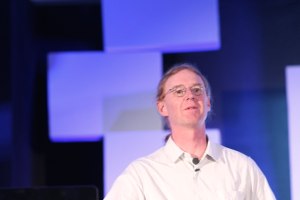
LWN editor Jon Corbet presented an overview of the issues and potential solutions for improving power management with the kernel scheduler in his Linux kernel weather forecast keynote last week at Collaboration Summit in San Francisco. And breakout session presentations by Preeti Murthy, a software engineer at IBM, and Morten Rasmussen, who works on the power management team at ARM, went into further detail on the kernel changes. All three presentations are available on YouTube and embedded here for your convenience.
Corbet summarized the problem by first explaining what the kernel does well. A Linux machine can drop into a deep, low-power idle state for long periods of time when the processor has no work to do. In fact, he said, “Linux is more efficient at doing nothing than anything else out there at this point.” On the other end of the spectrum, when a system is running flat out on a big task, there isn’t much room for improvement because it needs all the available processing power, Corbet said.
It’s the area in between, when the system is “moderately loaded”, that Linux could be more efficient, he said. That means instead of spreading the workload across all CPUs in a system, the load would be shifted to a subset of CPUs while the others shut down to save power.
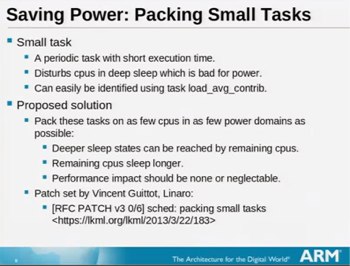
To accomplish this, kernel developers have a few proposed solutions to improve the scheduler, the section of the kernel responsible for assigning CPU space to various tasks. One class of patchsets for symmetric multi-processing systems (with identical CPUs) groups small tasks together on a few processors, while spreading big jobs out across processors that can then return to idle quickly. While the big.LITTLE ARM architecture, which pairs large and small processors together in a heterogeneous patchwork, has its own set of solutions.
The Power-Aware Scheduler
Preeti Murthy gave an overview of the power-aware scheduler, which is not yet part of the mainline kernel, and how it achieves load balancing across groups of processors. She gave more detail on the per-entity load-tracking metric patchset, which would allow the scheduler to calculate percent utilization of the processor as the basis for distributing individual tasks to under-utilized CPUs.
“The goal going forward is to integrate CPU idle drivers and the scheduler so they can communicate and do better scheduling,” Murthy said.
Morten Rasmussen went further still into task load tracking in his Tuesday session. He reported some encouraging results in a test of the patchset, which saw 36 percent less energy use when running an Ubuntu MP3 playback program on an ARM big. LITTLE test chip.
“It’s important to make informed decisions about where to place tasks,” Rasmussen said. “If you place it on a big core it will run really fast but you’ll pay more energy per instruction than if you were excecuting the same task on a little CPU.
“Suddenly you need to consider what kind of task I have and is it really worth running it faster but paying more in terms of energy?” he said. “…The strategy is to not use the high performance cores unless it’s absolutely necessary because they will drain your battery faster.”
Despite encouraging work, however, Murthy anticipates that convincing the rest of the kernel community to adopt proposed scheduler changes will take some time.
“Scheduling is a very core part of Linux and if you try to change its behavior, like the way we are doing now, the kernel maintainers don’t really like it. Nor do the developers,” Murthy said. “They would like very good experimental results to back it up (without regressions).”
A full selection of videos from Collaboration Summit is now available on video.linux.com.
Inforce Computing has unveiled a $149 Linux- and Android-friendly Pico-ITX boardset based on a 1.7GHz quad-core Qualcomm Snapdragon S4 Pro APQ8064 processor. The tiny IFC6410 module is equipped with 2GB of DDR3 RAM, and provides HDMI, LVDS, a MIPI-CSI camera interface, built-in WiFi/Bluetooth, and numerous other functions. The IFC610 100 x 70mm boardset consists of […]



 Some colleagues of mine are
  Corbet summarized the problem by first explaining what the kernel does well. A Linux machine can drop into a deep, low-power idle state for long periods of time when the processor has no work to do. In fact, he said, “Linux is more efficient at doing nothing than anything else out there at this point.” On the other end of the spectrum, when a system is running flat out on a big task, there isn’t much room for improvement because it needs all the available processing power, Corbet said.
 “The goal going forward is to integrate CPU idle drivers and the scheduler so they can communicate and do better scheduling,” Murthy said.