
Home Blog Page 1977

Jon Corbet’s Linux Forecast, Netflix and More from Collaboration Summit

Afternoon sessions at The Linux Foundation’s Collaboration Summit featured Netflix, Intel, Red Hat, Linux Foundation collaborative projects and the Linux weather forecast by Jon Corbet. Here are some of the highlights.Netflix-cockcroft
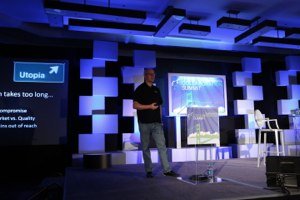
Netflix

As of November, the Neflix streaming video service comprised about one third of the downstream web traffic in the U.S., said Adrian Cockcroft, Director of Architecture for the cloud systems team at Netflix.

“Thanks for building the Internet so we can fill it with movies,” Cockcroft said. 

Incredibly, there is no data center behind Netflix. The application is “cloud native”, running on 500 to 1,000 Linux-based web machines and distributed across three Amazon service zones, an infrastructure that provides a highly agile and available service, Cockroft said. If something goes wrong, Netflix can continue to run the entire service on two out of three zones — a scenario it tests often with its open source Chaos Gorilla software. 

“We go around trying to break things to prove everything is resistant to it,” he said. 

This year, Netflix is also working on multi-region availability so that if anything goes wrong in one zone they can easily switch traffic back and forth across regions. This will prove a challenge, though, as DNS vendors all have wildly different APIs and are designed to be hand-managed by an engineer, Cockroft said.

Still, the company won’t be satisfied until it has created a system that will work as a complete, cloud-native open source platform. It has the functionality and scale they desire, but they are adding more features in an effort to make it more portable and easier to deploy. They’re also seeking contributions from end users and vendors such as Eucalyptus, Cloudstack and OpenStack that are interested in using NetflixOSS in private enterprise clouds.

The Netflix open source program is growing and the company is making an effort now to come up with a set of best practices; hire and retain top engineers; and build up the Netflix technology brand and the benefits of a shared ecosystem.
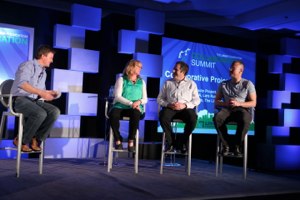
collaborative projects panelLinux Foundation Collaborative Projects Panel

With two recent announcements of new collaborative projects at the Linux Foundation, OpenDaylight and Xen, it was an ideal time for executive director Jim Zemlin to lead a panel on taking a project open source and the benefits of working with the foundation. Beyond the standard challenges of creating great code, choosing a license and governance model, open source projects must also attract new community members — that are often competitors — and create shared resources for marketing, training and other programs. 

It’s our mission to “spread the collaborative DNA of Linux” to other industries and projects, Zemlin said.

In creating the openMAMA project, a market data API for the financial industry, the New York Stock Exchange was seeking broad adoption and started to explore open source as an option. The company thought originally it would only open source the header files but involving the Linux Foundation, they learned that wouldn’t be enough to attract participants, said Michael Schonberg, Director of Market Data Engineering at Quincy Data and an openMAMA founder. Working with the foundation also helped NYSE bring its legal team up to speed quickly on open source practices and lended credibility to the project with its competitors.

“We ended up open sourcing more than we thought we would,” Schonberg said. 

The Yocto Project was founded on open source projects such as Open Embedded, said Tracey Erway, a Senior Marketing Manager at Intel and Advocacy lead for the Yocto Project. But similar to the NYSE, Intel was seeking a solution for industry-wide problems, not just its own. They want to grow the number of projects compatible with Yocto, further develop the community, attract more users and do developer training.

“The Linux Foundation made the process easier for us in a hundred million different ways,” Erway said. “It’s not anything Intel could have pulled off on its own. The results are really showing how well a project can be kicked off and be highly successful.”

Unlike Yocto or openMAMA, the Xen Project had been around for a decade before coming onto The Linux Foundation as a collaborative project. It is, however, trying to expand from a project sponsored primarily by one company, Citrix, to having all 30 contributing organizations come together to collectively drive the project forward. 

“As a project we haven’t worked and engaged the users as much. The Linux Foundation is really focused on that,” said Lars Kurth, community manager for the Xen Project. The project aims to grow its contributor base by working with Linux Foundation members, he said.
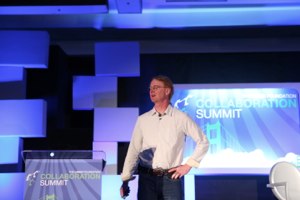
Jon CorbetLinux weather forecast 

The Linux kernel has made great strides since the 3.3 kernel was released in March 2012. Some 3,172 developers working for more than 370 companies merged 68,000 changesets, released 5 kernels and added 1.53 million lines of code. Big changes in the past year include bufferbloat fixes, an improved networking subsystem and adding 64-bit ARM architecture, among many others.  

“We’ve been busy, as usual,” said Jonathan Corbet, a Linux kernel contributor and co-founder and editor of LWN.net, in his annual Linux weather forecast. 

The 3.9 release could come as soon as this weekend, poised to set a record for the most developers involved in a single kernel release. Intel is also set to replace Red Hat as the No. 1 contributor to the kernel, behind volunteer developers. Mobile and embedded companies such as Samsung, TI and Linaro have also increased their contributions to the kernel, Corbet said.

3.9 will bring improvements such as KVM virtualization support on ARM, the addition of PowerClamp for managing power consumption of processiors in a datacenter setting, and dm-cache for increasing storage performance.

As for future releases, Corbet predicts kernel developers will continue to tackle NUMA scheduling and memory management as well as power-aware scheduling and big.LITTLE. In networking he focused on multipath TCP that would allow devices to use both wi-fi and cellular interfaces together. One other area of development is namespaces, a piece of the containers issue, Corbet said. The problem is that namespaces fixes right now create security issues and therefore won’t be enabled in distributions anytime soon, he said.

In conclusion, Corbet said the Linux and open source communities can no longer be accused of following in the footsteps of proprietary software. 

“We’ve now reached a point where interesting things tend to be done on Linux first,” Corbet said.

But, this also means the Linux community is navigating in the dark. Without a clear vision of what it will become, different notions of the Linux system have emerged, including the Android and Ubuntu architectures, with disputes that have sometimes become public. 

“Everybody is trying to distinguish themselves in a way that we’re getting back to a point that wrecked Unix,” Corbet said. It hasn’t happened yet, he said, “but we need to keep this in mind.”
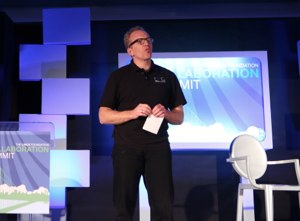
Dirk Hohndel, Chief Linux and Open Source Technologist at IntelIntel 

Open source enables freedom and innovation. This was the message of the afternoon’s final two speakers: Dirk Hohndel, Chief Linux and Open Source Technologist at Intel and John Mark Walker, Gluster Community Leader at Red Hat.

Intel has seen a dramatic shift toward open source, Hohndel said, and is now advocating for the use of HTML5 as an open web platform for application development.  The web is the one thing that binds together client facing compute devices, whether it’s your phone, watch, glasses or soon, an implant, he said. This common platform can help developers easily code across a diverse ecosystem of mobile devices. 

“Why have a native application that provides the same information (as a website)?” Hohndel said. “I want a platform… that’s easy for the developer.. and (provides) an application-like experience for the end user.” 

To accomplish this, developers must shift their focus from designing for compute to making applications power and performance aware, he said. Intel is working with the W3C to create standards that allow access to platform features like bluetooth, camera, and audio that are traditionally hard to get to from Javascript and HTML.

“The measure of success will be web applications that run like native applications,” Hohndel said. 
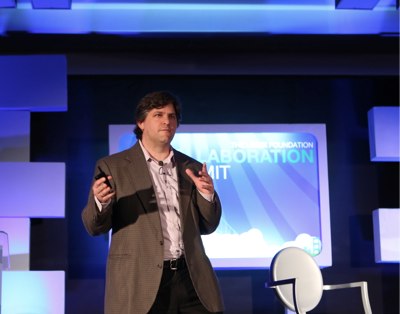
John Mark WalkerRed Hat/ Gluster

Total victory has already been achieved by the open source software community, Red Hat’s Walker argued. No new piece of proprietary software is likely to gain ubiquity these days, he said, Open source is where innovation is happening. 

The next step for open source victory, then, is in the data center. Ironically, “the new lock-in,” he said, is proprietary services and data sitting on top of open source software. The old argument against using proprietary software is that you wouldn’t buy a car with the hood welded shut. Similarly, in the cloud the question is “would you drive on a road system that didn’t let you choose your route?” 

Walker proposed five tests of an open hybrid storage system:

1. A single namespace. Your data appears the same regardless of context or platform, and it’s presented the same way regardless of the application presenting it.

2. Unified protocols. The ability to store data regardless of format and the ability to access it by a variety of protocols.

3. Elasticity across platforms. It expands where and when you need it.

4. Storage-aware applications. They work with compute to decide where data can go.

5. Open source software-led. There’s no other proprietary mix that can acheive the same level of agility.
 

Talks by Jaguar Land Rover, Samsung, Adapteva Underscore Industry Trend Toward Collaboration

The Linux Foundation’s executive director Jim Zemlin sees a new trend in the technology industry toward a collaborative development model. Companies are focusing their research and development efforts outward and participating more in open source projects to accelerate innovation and progress, he said in his opening remarks at The Linux Foundation’s Collaboration Summit in San Francisco.

It’s no coincidence, then, that the conference kicked off this morning with a warm welcome to the Xen Project, the foundation’s newest collaborative project, which is also celebrating its 10-year anniversary today as a virtualization platform. The announcement comes on the heels of last week’s OpenDaylight software-defined networking project launch. 

Matt Jones Jaguar Land Rover“What we see now is that most technology is being defined by this collaborative development,” Zemlin said.
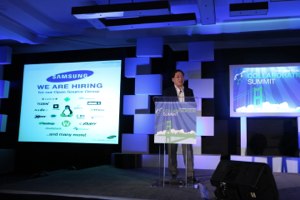
Jaguar Land Rover

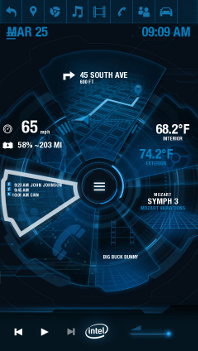
The Automotive Grade Linux work group is a prime example of how this new collaborative model is taking over an industry that hasn’t traditionally been open to third-party developers. AGL today released the IVI & remote vehicle interaction demonstration, a downloadable open source image for creating an in-vehicle-infotainment system complete with the CAN stack and an HTML5 application framework and sample user interface.  

The goal is to create an open source IVI platform that meets customer expectations to have the experience from their consumer electronics devices in their vehicles such as voice control, constant connectivity and media management, said Matt Jones, a Senior Technical Specialist for infotainment systems at Jaguar Land Rover and the Vice President of the non-profit GENIVI Alliance, an automotive industry effort to drive adoption of an IVI open-source development platform.

“We’re heavily involved with AGL to enable open source and Linux within automotive as a whole and focus on making it easier for developers with reference hardware and software platforms,” Jones said. Such technology “has been available in lots of vehicles but nobody has given it away before.”

The group is now looking for collaborators to help integrate navigation into the UI, as well as BlueZ for telephony and has announced a developer contest. Developers can compete for the chance to work with the AGL and Jaguar Land Rover by entering work in three categories: best user experience, best visual appearance, and best new concept or additional feature. The contest runs April 15 – May 17 and winners will be announced at the Automotive Linux Summit in Tokyo at the end of May.

Samsung“I want what we create to be available on every vehicle,” Jones said. “It should be easy to translate that software across platforms. We just need to get the features out there.”
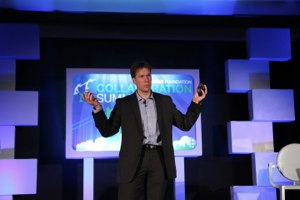
Samsung

While the automotive industry is just starting to dive into open source, Samsung Electronics has established itself as a significant contributor to the Linux kernel and the open source community. The consumer electronics giant began using open source about 10 years ago, starting with embedded Linux in some prototype devices, said Sang-bum Suh, Vice President of the software platform team in the Software R&D Center at Samsung. That soon expanded to flat panel TVs when the company switched from a RTOS to Linux. And its use of Linux now extends to smartphones, camcorders and cameras.

Last year Samsung’s Galaxy Android smartphone sold more than 200 million units and 57 million digital TV units, “all based upon linux and comprised of open source components,” Suh said. 

“I believe that open source components have contributed to Samsung’s business success very much.” he said. So much so that Samsung has expanded its contributions to Linux and open source, becoming one of the top 10 contributors to the Linux kernel in 2012. It now employs more than 20,000 software developers whose work is based in large part on open source components, Suh said. And they’re hiring. 

“We believe we have been successful in the past on hardware components,” Suh said. “In the future we’d like to add software Andreas Olofsson, CEO Adaptevacapabilities to that hardware success.” 
Adapteva

The final morning keynote brought rounds of applause from attendees as Adapteva CEO Andreas Olofsson unveiled two Parallella boards – the first off the assembly line since the company’s Kickstarter campaign six months ago. (For more background on the Parallela and Adapteva’s vision, see our Q&A and a recap of our live chat with Andreas.) Holding one board in each hand, Olofsson discussed the immense challenges Adapteva and the rest of the computer industry faces in finding ways to improve performance and minimize energy consumption. 

Adapteva is “possibly the world’s smalled semiconductor company,” he said, trying to solve some of the biggest problems in computing.  

Chip design trends will shape the future of computing, addressing power conumption, a memory bottleneck, wiring, thermal density, yield issues and more. Parallel computing is the answer, he said. 

“Today we’re at a high level of abstraction but parallel programming isn’t there yet,” Olofsson said. “The challenge is how to make parallel programming as productive as Java or Python is today… running on any type of hardware.” A beginning programmer should be able to do parallel programming as easily as someone with 20 years of experience, he said.

The Parallella, a dual-core processor that runs on Linux, is Adapteva’s attempt to create a market for parallel programming by making it cheap and easy.

“One of the key things in launching this project was (realizing) the only way to make it work is to make it completely open… which can be incredibly scary to a hardware engineer,” Olofsson said.

The past six months the three-developer company didn’t  know if it could really deliver on the project, he said. Now they see it working. After more testing and production, they’ll ship 6,300 boards to their kickstarter backers and will give away 100 free kits to universities.

“The good news is we have boards working,” Olofsson said. “We’re running a little bit late but we’re going to ship them this summer.” 

The Linux Foundation’s Collaboration Summit is taking place this week in San Francisco, from April 15-17. Catch the rest of our day-one keynotes for free via our live video stream on the Events website. And check back into Linux.com later today and tomorrow for more coverage and photo slideshows of this week’s event.


Welcome Xen as a Linux Foundation Collaborative Project

Today we’d like to welcome Xen as the newest Linux Foundation Collaborative Project.

The Xen Project is 10 years-old this week, and its contributors have doubled in the last few years. Xen usage continues to grow and today the project is being deployed in public IaaS environments by some of the world’s largest companies. 

Additionally, the Xen Project has adopted mainline kernel development practices and is progressing ever closer to the mainline kernel community. As of Linux kernel version 3.0, Linux can run unmodified as a Xen host or guest

Also about a year ago, the Xen Project’s former host, Citrix, started focusing on formalizing Xen’s governance practices and simultaneously looking for a vendor-neutral home where it could continue to flourish. The Linux Foundation is happy to provide that home. 

Some of you may be wondering: what about KVM or other virtualization solutions in Linux? Does this affect anything?

Virtualization is important to Linux and the open source community and both Xen and KVM are widely accepted by users and developers. The advancement of both benefits developers, users and vendors. The open source model is predicated upon freedom of choice, so supporting a range of open source virtualization platforms and facilitating collaboration across open source communities is a priority for The Linux Foundation. 

We work closely with the KVM developer community and great ecosystem represented by our friends at the Open Virtualization Alliance. For instance, The Linux Foundation manages the logistics each year for the KVM Forum, and this year we’ll be hosting the KVM Technical End User Summit at the Enterprise End User Summit in New York in May in partnership with IBM. It always has been and will continue to be a priority for us to highlight the KVM community’s content at our events and on Linux.com. 

The market has proven there is opportunity for more than one way to enable virtualization in Linux, and both KVM and Xen have their own merits for different use cases. Historically in open source we’ve seen that two independent approaches to a question can yield amazing results, particularly when they are given an opportunity to cross-pollinate. We believe that by supporting both the Xen Project and KVM communities, The Linux Foundation can help advance the state of Linux virtualization for all and most important support and advance Linux for users. 

We invite everyone to join us this evening at the Julia Morgan Ballroom from 6 p.m. – 9 p.m. to wish the Xen Project a happy 10th birthday and toast to the future of Linux virtualization. 

You’re Invited: Design the Future of Automotive Infotainment


Like many of us you are probably using your car almost every single day: commute to work, take the kids to school, run errands, go shopping, or just for fun. You name it. And while spending all this time on the road you may be using the in-vehicle infotainment system built into your ride for navigation, listening to music from the radio, accessing content stored on my mobile device, making phone calls, getting traffic updates and much more. And whether or not you are entirely happy with the solution that the maker has built into your car you may have the one or other idea on how things can be improved. Or maybe you think this is all lame and you can do a much better job. Well, here is your opportunity.

The Linux Foundation’s Automotive Grade Linux (AGL) collaboration project is announcing the first AGL User Experience Contest. We are calling for all programmers, software engineers, web designers, car enthusiasts and anyone who loves a challenge to participate in designing the future of automotive infotainment.

agl-demo-home-small

Enter the contest and design the user experience you would like to see in your next ride using HTML5, CSS and JavaScript. AGL provides a framework for you to download, modify and extend as your creativity inspires you. The sky is the limit. You may create a new theme for the existing applications, create new applications, redesign the entire framework.

From all submissions received by the deadline on May 17, 2013 at 11:55pm a jury of experts will be electing a winner and two runners up in these categories:
    •    Best User Experience
    •    Best Visual Appearance
    •    Best New Concept / Additional feature

Each winner and runners up in each category will be receiving a tablet computer valued at $450. In addition to that the winners of each category will receive the opportunity to collaborate with AGL and Jaguar Land Rover on a proof of concept.

For details about the contest, terms and conditions, and how to enter visit the Automotive Grade Linux website.

Microsoft Reportedly Considering Selling a Smartwatch of its Own

The tech giant has requested components for a potential touch-enabled watch device, executives at Asian suppliers tell the Wall Street Journal. [Read more]


Read more at CNET News

Linux 3.9-rc7 Might Fix A Rare 32-bit PAE Bug

Linus Torvalds has announced the release of the Linux 3.9-rc7 kernel with the final release of the Linux 3.9 kernel likely being imminent…

Read more at Phoronix

IBM Pushes New SystemZ Back-End For LLVM

IBM is becoming increasingly interested in SystemZ for a variety of purposes, including the use of the Gallium3D LLVMpipe driver. As a result, IBM developers have created a new LLVM back-end for their mainframe computers…

Read more at Phoronix

Freedreno Driver Begins Work On Adreno A320

The open-source Freedreno driver that seeks to provide a fully open-source Qualcomm Adreno graphics driver for Linux with OpenGL ES acceleration by a Gallium3D driver, is beginning to support the Qualcomm GPU found within the Google Nexus 4…

Read more at Phoronix

SPGT: Open-Source Remote 3D Gaming

SPGT, short for Single Player Game Transmitter, is an open-source project that provides support for remote desktop transmission of games and other interactive 3D applications…

Read more at Phoronix

Development Begins on a Lightweight KDE Version

A number of openSUSE developers have started to work on KLyDE, the K Lightweight Desktop Environment. By removing unnecessary components, they aim to create a fast and simplified version of the open source desktop environment.

Read more at The H