
GNOME developer Travis Reitter is reporting on the decision by the GNOME developers to make JavaScript the standard language for GNOME application development.
Read more at The H
Linux is literally everywhere, powering everything from the New York Stock Exchange to mobile phones to supercomputers and consumer electronics. More people have a stake in this shared resource than ever before, and that is represented by the number of people we’re seeing at our events and Linux training courses to the support we receive in new memberships. It’s also represented in our social channels.
Each of the social channels we host – from Google+ and YouTube to Facebook, Twitter,LinkedIn, Pinterest and Identi.ca – is unique. The way people collaborate and share information on each of these channels is diverse but the common denominator is the passionate engagement and active participation, which is illustrative of a growing community that supports the largest collaborative project in the history of computing.
 The Linux Foundation Facebook community is about to welcome its 100,000th fan, and we invite you to join us in celebrating this milestone by sharing on our page why you support Linux. As we hit 100,000 on the Facebook fan dial (we’re now at 96,645), we’ll reward one of our most loyal fans with a $100 Linux.com Store Gift Card and a free ticket to LinuxCon North America or LinuxCon Europe. The winner will be chosen at random from a list of people who comment most frequently on our posts; more comments = a better chance to win. The winner will be contacted after we together reach the 100,000 milestone.
So please keep sharing your enthusiasm/energy/knowledge about Linux and help us celebrate this growing community.
 E17, “the only software which has taken longer to develop than Duke Nukem Forever,” was released little over a month ago, but today brought clues and news that the reign of E18 has begun. It actually began weeks ago because a new snapshot was released today, as well as an update to E17.
The first clue came from Jeff Hoogland, the founder of Bodhi Linux, in a blog post today. He said, “The first showing of Enlightenment DR18 (or E18 for short) has become a reality.” Hoogland has packaged up the new updates for his users, but a snapshot is available for those who would like an embryonic peek at E18.
The second clue came with a post to e17releasemanager.wordpress.com cryptically titled, “Moving On.” The only text was a link to the newe18releasemanager.wordpress.com. There the post stated that the e18releasemanager is “going to get right into it in a manner far more serious than the weak blog of my predecessor”…Read more at Ostatic
 James Bottomley has substantially restructured the mini bootloader to allow any Linux version to be launched on PCs with UEFI Secure Boot. The boot loader’s development has been sponsored by the Linux Foundation. The revised version uses a different method to boot the more complex secondary bootloader; this enables it to co-operate with Gummiboot, which was introduced last summer. Gummiboot doesn’t load or start Linux itself like GRUB does, instead it accesses EFI mechanisms; this keeps its structure significantly less complex than that of GRUB…Read more at The H

What do 16th century Incas, 18th century shipyards and 21st century professionals have in common? Phil Verghis describes an issue that has plagued civilizations and industries throughout history: inadequate access to lessons already learned. We all understand the importance of sharing knowledge, so why is it difficult for us to implement it into our daily business practice?
Dancing E is a startup aimed at….Read more at OpenSource.com
 Dell may be close to a deal that would take the PC maker private, Reuters reports. Citing “two people familiar with the matter,” the news service reported that the company could announce an agreement as early as Monday. Expectations are that Dell would be bought out by a group led by its CEO and private equity firm Silver Lake Partners.
Whether or not desktop 3D printing is the forerunner of the “third industrial revolution,” as Jeremy Rifkin and Chris Anderson have suggested, it’s definitely one of the hottest tech trends around. Open source DIY hacker engineers, artists, and craft designers have led the surge on the low end while higher-end models are already being used in rapid prototyping and short-run, custom manufacturing.
The market has been fueled by open source hardware communities, primarily the RepRap project and the MakerBot community. RepRap released its first open 3D printer kit design in 2007, inviting hackers and manufacturers to tinker with hardware and software. A RepRap-based industry has emerged almost as magically as the plastic objets that grow layer by layer in a 3D printer.
There are now over a dozen open source spinoffs of RepRap’s Darwin, Mendel, Prusa Mendel, and Huxley designs. The naming scheme reflects RepRap’s evolutionary model: A RepRap printer can fabricate its own plastic parts, fulfilling much of the project’s goal to be entirely self-replicating.
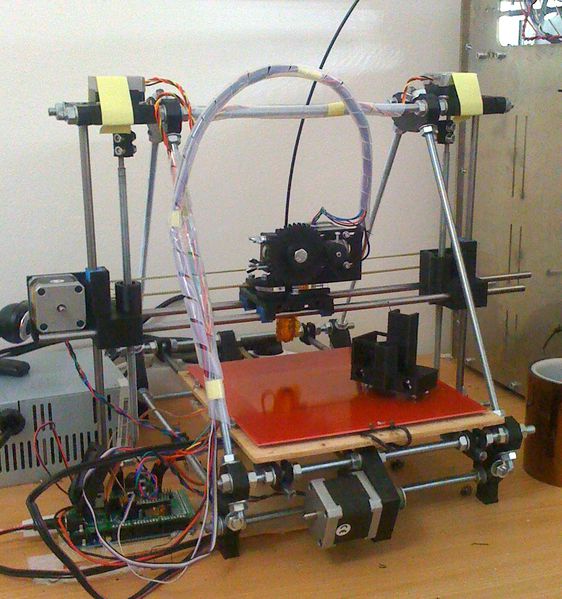 RepRap Prusa Mendel
End products range from art objects to plastic toys to parts for more complex devices like lamps and even a plastic housing for a Raspberry Pi. For those who dismiss 3D printers as just another craft craze that will generate mounds of plastic landfill, advocates point to the ability to use biodegradable plastics, as well as the targeting of niche markets with limited runs instead of creating plastic waste through volume manufacturing. Digital fabrication evangelists tout the technology as fostering a new, decentralized manufacturing ecosystem with faster time-to-market and support for more device customization.
Since Linux.com reported on 3D printing a year ago, the industry has exploded. At the time, it was hard to find a preassembled open source 3D printer, but there are now over a dozen models available in both finished and kit form. Most are based on RepRap, but there are also some original open source designs ranging from the low-cost, $400-$800 Printrbot and Solidoodle printers to more feature-rich $1,400-$1,800 models like Type A and Ultimaker.
The open desktop models join a larger 3D printing market still dominated in revenues by proprietary, commercial vendors like Stratasys and 3D Systems, which sell higher end 3D printers and even pricier rapid prototyping and additive manufacturing equipment costing $50,000 and up. Stratasys developed the thermoplastic extrusion technology called Fused Deposition Modeling (FDM), which is used by RepRap and most other desktop printers. In this process, one or more types of plastic are heated and applied in layers via tiny nozzles until an object emerges.
The open hardware movement has turned the digital fabrication industry upside down, says Jarkko Moilanen, an open source community builder on projects including Meego, and the founder of the P2P Foundation funded research group, Statistical Studies of Peer Production. “The popularity of mostly open source, low-cost printers have forced the big players to lower their prices,” says Moilanen.
Last year, his organization published one of the first major research studies spanning both commercial and consumer/hobbyist 3D printing. Some 55 percent of the 384 3D printer owners who responded to the survey were involved in at least one open source project, and nearly 20 percent planned to in the future. Only 26 percent had no interest.
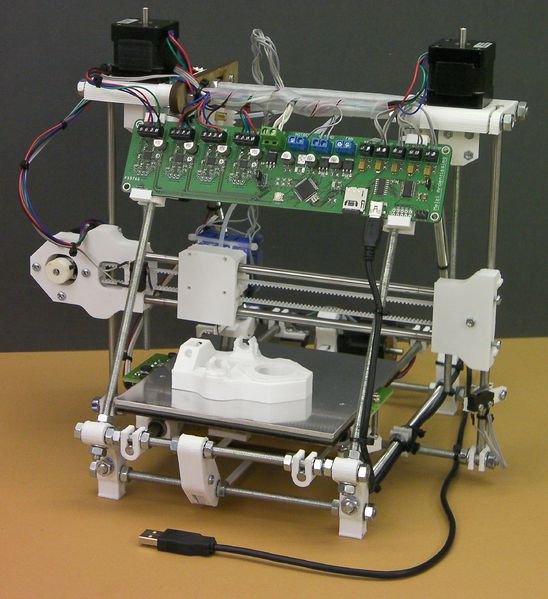 RepRap Pro Huxley
The open model has helped to accelerate development on the low end far beyond what would likely have occurred under traditional market dynamics, suggests Moilanen. “The latest 3D printers have a lot better reliability, usability and ease-of use, and are almost ready for the masses,” he says.
The movement was fueled by the perseverance of RepRap and its volunteers, as well as “the growing variety of hackerspaces, which function as incubators,” says Moilanen. In addition, a number of projects came to life on crowd-funding sites like Kickstarter, and many more are in the queue.
Almost all of the new desktop 3D printers now offered by commercial vendors are proprietary, but the open source movement appears to be steering some toward more openness. On 3D Systems’ personal 3D printer page, which features its new Cube 3D printer, the company trumpets its upcoming “multi-front strategy to democratize access and accelerate the adoption of 3D printing for the student, the hobbyist and ultimately, the consumer.”
So far, the most popular desktop 3D printer has been an original open source design based only loosely on RepRap: MakerBot’s Replicator. Much to the dismay of the open hardware community, however, in September, MakerBot announced that the Replicator 2 would be proprietary. The move was said to be in response to the arrival of an almost identical clone of the Replicator called the Tangibot.
Open source hackers argued that that the community was already successfully boycotting Tangibot for its abrogation of the FOSS credo of innovation. MakerBot may instead perceive that such community enforcement will lose effectiveness in a fast-growing market that is moving beyond hackers to a broader audience.
To be fair, MakerBot has not gone entirely proprietary, as the original Replicator is still open. MakerBot’s popular Thingiverse online store and hacker community remains free and open, unlike online retail stores for 3D printing designs like 3D Systems’ Cubify site.
In Statistical Studies of Peer Production’s survey of 358 3D printer users last year, about a quarter of respondents said they used RepRap devices, followed by about a fifth for MakerBot. These were followed by mostly proprietary commercial firms led by 3D Systems and Stratasys, each with about a fifth when you factor in their new subsidiaries, ZCorp and Object, respectively. The only other open source vendor on the list was Ultimaker, with less than 10 percent. In this year’s survey update, Moilanen expects to see a larger share for MakerBot, and perhaps the appearance of some other open vendors such as Printrbot.
While Moilanen believes that open source will continue to push desktop 3D printing, the field is growing so fast, he expects proprietary forces will emerge as well. “There will be more cases like MakerBot, with startups building products on open source and then turning closed source,” says Moilanen. “The 3D printing community is bound to mature gradually and find ways to deal with commercialism.”
Come back next week for our guide to open source and Linux compatible 3D printers.
Image Credits
 MariaDB is due to replace MySQL in Fedora 19 and, in this version, udev will handle network device names. Additionally, the developers are still discussing the integration of Apache OpenOffice 4.0
Linux has not received much attention from the major gaming houses, even though it seems a natural fit as a robust gaming platform, so the announcement of the Steam for Linux beta last December generated a lot of interest.
A Linux game port can be done in one of two ways. The first way is to use the operating system’s own resources and to make allowance for a variety of versions and functinally equivalent applications. The second way is to recreate the norms of another operating system and require specific applications and versions. Despite the client being available as a .DEB package, Valve‘s Steam beta for Linux generally opts for the second approach, making it less promising than it might have been.
Steam is a multi-platform software distribution tool that includes social features such as friends lists and chat, both in-game and out. Although Steam has recently started carrying other software, its main emphasis is games and related items, particularly ones written by smaller development houses. As you might expect, much of the software it carries, as well as the Steamwork API for game development, includes so-called Digital Rights Management, activation, and other forms of copyright restriction — elements to which many Linux users are philosophically opposed, and which can require extra steps if you want to transfer a Steam game to another computer, or even to log in to the web page from another computer.
 The popular Half-Life is available on Steam for Linux
Instructions for running Steam under WINE have been available for some time. However, being a native app, the beta has been widely greeted as a sign that Linux is finally being taken seriously by gaming companies, and that a long-standing defficiency in Linux is about to be corrected. Apparently, gamers can only be content so long with Pingus and Battle of Wesnoth.
To use Steam, you must install the Steam client to your machine. Officially, the client works on Ubuntu 12.04 and 12.10 only, but, some clues for installing on other distributions have been provided by the Valve developer community.
If you search the Internet or the Steam discussion forums, you can also find additional suggestions about how to install the client on other distributions, including Debian, Fedora, and Linux Mint. Similarly, you may need to search for how to install the 32bit client on a 64bit system. Be sure, too, to have your distro’s latest release.
If you are merely curious, better that you stick with Ubuntu, which has provided detailed instructions. But even that is not enough. You need a video driver with hardware acceleration, not just for most of the games, but –strangely — simply to run the client. You also need the latest version of Flash from Adobe to view content on the Steam site — an earlier version or Gnash won’t do, although nothing warns you of the fact.
Yet another unmentioned specification is that the client won’t run on Kubuntu, even though KDE generally runs GNOME-based applications without difficulty. For some reason, the client will run on Xubuntu, but the indications are that it is designed for a very limited set of standard software, with few allowances for any substitutions.
Once you have the necessary system configuration, installation of the client and logging into Steam is straightforward. However, both the client and the site itself include the usual proprietary end-user license agreements that limit both the company’s liability and your rights to privacy, although you may be comforted by the promise that your personal information will only be “used internally” by Valve, and not passed on to third parties.
Steam’s site is reminiscent of the Ubuntu Software Centre. In fact, if you’re looking at both at the same time you may have a moment’s trouble telling one from another.
Like the Ubuntu Software Centre, the main part of the site is a listing of available games, varying in price from a couple of dollars to something close to the sticker price in the store. Most games have Flash trailers or at least screen shots, as well as a short description, with links to community groups and news about the game. Advertising is heavy, with users logging in to the Featured Items page of sales and discounts. Payment is thorough a typical digital shopping cart that supports the standard credit cards and payment sites.
However, with the possible exception of some free Flash games, Linux users can ignore most of the site. No doubt because the client is in beta, Linux games are confined to a single page. As I write, sixty-four are available — over twice the number listed a few days before Christmas 2012. Most are adventure games, with an emphasis on fantasy and war, and are available for multiple platforms. So far, none are Linux only, as you might expect considering the small size of the platform’s gaming market.
Other features are available from the top menu: account management — including Steam badges for unlocked achievements for the games you are playing — backup to a cloud, and tools for finding other players and befriending them. Linux users are limited only by the games they can play, and can access all these tools freely,
If you are a dedicated gamer, Steam for Linux is probably what you have been waiting for. It has the potential to encourage more porting of games to Linux, and to put Linux gamers on something closer to an equal footing than they have enjoyed up until now.
However, such promise comes at a price. While the beta may become more flexible later in its development, right now it is obtrusively non-Linux in its rigid requirements. Couldn’t Valve have hired developers with more experience of the intricacies of Linux to ensure that the beta was in keeping with users’ expectations?
Even more importantly, at least some users may balk at the idea of a separate management system primarily for games, let alone a return to the proprietary universe of end-user agreements and copyright restrictions that many escaped from. For these users, the price for using Steam to grow the Linux games market might well be one that they decline to pay.