Earlier this month, Texas Instruments (TI) announced it was cutting 1,700 jobs and dropping its consumer mobile processors to focus on the general embedded market. TI cited the reduced profitability of the consumer mobile business, which is marked by intense competition and short lifecycles.
Others noted the growing competition from device vendors like Apple and Samsung, which now design their own ARM processors. In addition, pricing pressures have grown sharply, due in part to one of TI’s chief customers, Amazon. The online retail giant, which uses OMAP chips in its Kindle Fire tablets, considered buying the mobile, Android-focused portion of TI’s OMAP processor business before negotiations broke down.
 By comparison, the embedded realm beyond smartphones and tablets is marked by longer product lifecycles, lesser price sensitivity, and long-term projected demand. TI is already a leader in the general market, where its ARM Cortex-based OMAP processors typically run embedded Linux instead of Linux-based Android. In recent years, however, TI has begun to add Android support to its general embedded CPUs, such as its OMAP-related Sitara processors. In fact, Android’s potential for expansion in embedded, combined with Linux’ own increasing domination of the field, may have helped TI refocus on the wider embedded market.
Android and Linux Surge in Embedded Share
Only 4 percent of Android-based units shipped in 2011 were devices other than smartphones (77 percent) or tablets/ereaders (19 percent), according to a VDC Research report released in June. Of these, a quarter were military communications devices. Another quarter were split equally between medical and automotive systems, and the rest were “other.”
Despite this modest start, VDC projects that Android’s numbers will grow considerably, stating in a blog post: “We believe new use cases for Android will continue to emerge and fuel the platform’s growth path.”
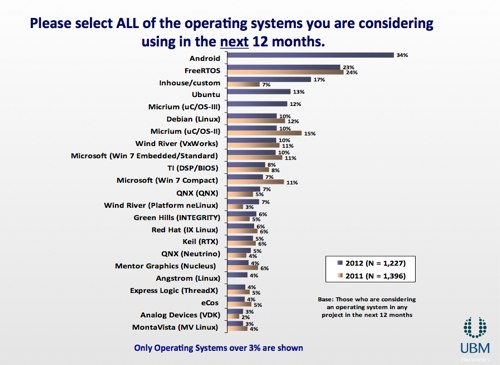
In UBM Electronics’ more recent 2012 Embedded Market Study, Android and Ubuntu were broken out for the first time from the Linux total. Some 13 percent of the surveyed embedded engineers reported using Android in a current project, second only to in-house/custom (22 percent), and followed by 12 percent for Ubuntu. More impressively, 34 percent reported that they are considering working with Android in the coming year.
Android appears to be growing more at the expense of the traditionally dominant real-time operating systems (RTOSes) and Microsoft’s various Windows flavors than of embedded Linux itself. The Linux score for current projects, including Ubuntu, was 35 percent — up from 31 percent in 2011 — or 48 percent when Android is added to the total. For OSes under future consideration, Linux and Ubuntu totaled 43 percent, or 77 percent when Android is added.
Some 41 percent in the UBM survey said open source was the main criteria for picking an embedded OS. Indeed, the open source, microcontroller-focused FreeRTOS has been the fastest growing RTOS in recent years, and is second only to Android in “considered” OSes, with 23 percent. By comparison, Microsoft’s combined Windows score dropped from 24 percent of current projects in 2011 to 19 percent in 2012.
X86 port and New ARM Modules Expand Android’s Footprint
Linux, Linux-based Android, and Windows all profit from the growing demand for intelligence, wireless capability and multimedia savvy in embedded gadgets. Like embedded Linux, Android now supports a full range of embedded architectures, having been ported to x86, PowerPC and MIPS. Intel and its Android Developer Community are primarily focused on smartphones and tablets, but a foundation is being established for a range of future Intel Atom-based devices running Android.
Android is also benefiting from the recent increase in ARM-based embedded modules and boards, most of which support the Google-led OS. While x86 continues to dominate the computer-on-module (COM) market, a new ARM standard promoted by Kontron called ULP-COM, has been endorsed by 24 competitors including Adlink and Advantech.
Kontron recently launched an Android-compatible Kontron ULP-COM-sAMX6i module with industrial-focused features, based on Freescale’s i.MX6 Cortex-A9 processor. Last week, GreenBase Technology announced the world’s first ARM Cortex-A15 module, an OMAP5-based, ULP-COM-compatible GK-5432 device that runs Android.
Embedded Linux still offers better industrial support than Android, and is a better fit for limited computing resources, but Android has the advantage of a ready-to-roll UI stack, as well as pre-integrated middleware components such as GPS, wireless radios, cameras, and sensors. This makes life easier for developers, a growing number of whom have Android experience, or come from a similar embedded Linux background.
Ready-to-Roll GUI Adds Appeal
Android also offers hundreds of thousands of apps. Most are unsuitable for dedicated applications, but many can fit in quite nicely, further reducing development costs. Finally, workers using these interfaces are also increasingly familiar with Android or something like it, thereby reducing training time.
As noted by RuggedPCReview. Android is initially finding traction in vertical-market, rugged mobile handhelds and tablets, including field service and military devices. New models from vendors like Adlink and General Dynamics/Itronix increasingly support Android.
Android is also appearing in other embedded applications where Linux is a contender, including medical devices, set-top boxes, audio appliances, home automation, and point-of-sale (POS) systems. In the newer RTOS-dominated genre of automotive computers, Android is only a step behind Linux. Meanwhile, an Advantech blog post recently projected that Android will quickly spread in digital signage systems, where it profits from its support for NFC communications.
Android is only beginning to follow Linux into the Industrial HMI (human machine interface) market, mostly in touch-panels designed to control industrial equipment. Some industrial sites are starting to replace fixed panels with custom Android tablets that communicate with microcontrollers via WiFi.
Although “headless” versions of Android designed to run without a UI layer are under development, few such applications are likely to move soon to Android. This puts many industrial applications out of range, and limits the impact in one area where embedded Linux is a major player: networking and telecom equipment.
Security and Real-Time Limitations
One of the biggest obstacles to Android’s embedded adventure is security, an issue that has attracted more attention now that so many embedded devices are being equipped with WiFi and Internet access. According to VDC, security fears can be partially addressed with virtualization firmware on multicore processors. Here, Android or embedded Linux will power the user interface while a securely sandboxed RTOS controls critical processes. (Last month military contractor and rugged handheld maker General Dynamics acquired Open Kernel Labs, a leader in Android embedded virtualization.) For devices with higher security requirements, Security Enhanced (SE) Android, an offshoot of SELinux, may play a major role.
Android and Linux both have work to do with real-time requirements, where response time to I/O must be speedy, deterministic, and ultra-reliable. This is one reason why both OSes are making far more gains in the short-term in patient infotainment systems and Class I medical devices rather than more critical Class II or Class III systems. The Linux kernel is improving on this score, with special versions continually being developed by OSADL based on the PREEMPT_RT patch series.
A variety of development efforts are underway to broaden Android’s efficacy beyond consumer devices. On the low end, for example, Google’s Android Open Accessory Development Kit (ADK) enables hackers to control Arduino-based devices via USB and Bluetooth.
Meanwhile, open source development projects like BeagleBoard.org are providing improved Android support with the help of Linaro Android code. Commercial embedded development vendors such as Intel-owned Wind River are also aggressively targeting Android tools for a wider embedded market, adding support for industrial protocols like CAN.
As Android embarks into new embedded territories, one of the best developer resources is The Linux Foundation’s Android Builders Summit, to be held Feb. 18-19 in San Francisco.




 “If Steam coming to Linux shows Linux to be superior for gaming, it might kill Windows and Mac OSX in the long run, because gaming is a very important market for desktop,” Levac, a computer science student at McGill University in Montreal, Quebec, Canada, said via email. “In any case, if we get better support from third-party drivers, it will be a big plus for everyone in the community.”