The Nook HD and Nook HD+ tablets announced by Barnes & Noble on Sept. 25 aren’t receiving the same breathless coverage given Amazon’s Kindle Fire HD and Fire HD 8.9″. Yet, the new Nooks are billed as being faster, lighter, and offering higher resolution displays than Amazon’s HD models, while costing roughly the same. Early impressions appear to be mostly positive, with praise for the tablets’ design and build quality.
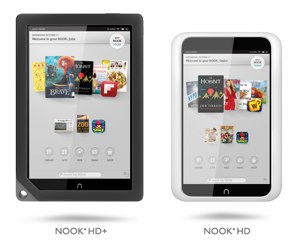 Available now for pre-order, with shipments due by Nov. 1, the tablets replace the Nook Tablet and older Nook Color. Like Amazon’s Fire HD models, the Nook HD and Nook HD+ run a customized version of Android 4.0 (“Ice Cream Sandwich”) on a dual-core Texas Instruments processor. The new Nooks move up to a faster OMAP4470 model, however. The 7-inch Nook HD is clocked at 1.3GHz compared to the Fire HD’s 1.2GHz, while the 9-inch Nook HD+ matches the 1.5GHz speed of the Fire HD 8.9″.
The claimed battery life of up to 10.5 hours is on par with the Fire HD tablets, and hardware features are similarly basic. The Fire HDs have the advantage of offering front-facing cameras, as well as support for dual-band Wi-Fi. Yet, they lack one Nook HD feature that is arguably more important: a micro-SD slot.
Nook HD Breaks Resolution Record
The Nook HD’s pricing — $199 with 8GB of storage and $229 with 16GB — can’t quite match the Kindle HD’s $199 (16GB) and $249 (32GB). The 7-inch tablet has been completely redesigned with a more rounded shape and more grippable plastic. The key advantage is that it’s lighter than Google’s Nexus 7 and much lighter than the Fire HD, weighing 11.1 ounces (315 grams) compared with 13.9.
The Nook HD also bests both of these 1280 x 800-pixel tablets with a 1440 x 900 IPS display. In fact, Barnes & Noble claims the Nook HD offers the highest resolution display available on a 7-inch tablet.
The better bargain of the two appears to be the Nook HD+. It sells for $269 or $299 for 16GB or 32GB, respectively, compared to $299 (16GB) or $369 (32GB) for the Fire HD 8.9″. B&N’s first 9-inch tablet weighs in at a respectable 18.2 ounces (515 grams), and features a 1920 x 1280 IPS display, essentially the same as Amazon’s 8.9-inch tablet.
ICS Buried Deep
Most Android aficionados will likely take a pass on the Nook HD for the same reason they’ll bypass Amazon’s latest tablets. Both offer a walled garden approach designed to push the companies’ digital wares, with heavily customized UI layers that cover up the impressive interface of the underlying Android 4.0 code.
The Nook UI layer has been updated for ICS with a new “paper” motif. It also features a family-friendly personalization feature that enables different profiles on the same tablet. In addition, the tablet launch is accompanied by a new Nook Video service.
Some Android techies will buy the Nook HD models on the assumption that unlike the Fire, the tablets will be quickly rooted. Still, with the Nexus 7 available for just $199, there’s less motivation to reskin the Nook than there used to be with the Nook Tablet.
Walmart Puts Out the Fire
Barnes & Noble shares one advantage Amazon lacks: This holiday season the Nook HD and HD+ will be available at Walmart and Target. Following Target’s eviction of Kindle products in May, Walmart confirmed last week that it will soon discontinue sales of Amazon’s tablets.
Retailers are receiving miniscule profits on Amazon’s tablets, reflecting the company’s own razor-thin margins. In addition, there is increasing evidence that shoppers are sampling the tablets in stores, but then buying them for less on Amazon.com. In a few years, brick-and-mortar stores may not matter much compared with online mega-malls like Amazon.com, but in 2012 they still count for a lot.
With Microsoft’s investment in B&N earlier this year, it looked as if the struggling book retailer might bail out of the cut-throat tablet wars, and move to Windows 8. That plan, which would presumably require higher pricing, may still be waiting in the wings if the Nook HD line falters.
For now, however, the company is sticking with Android, and for good reason. Considering its consumer focus, there is no other compelling option but to compete with Amazon to the bitter end. The Nook Tablet may have faltered over the last six months, but B&N remains a staunch competitor. The company ranked fifth in worldwide tablet share in the second quarter, with 1.9 percent compared to Amazon’s 4.2 percent, according to iSuppli.
That percentage could increase now that it has some more competitive designs. Better yet, it can count on Walmart and Target to help it compete with Amazon’s powerhouse online store.
Like Amazon’s tablets and the Nexus 7, the Nook HD should help drive down prices on the low end. I’d prefer to see a more open-ended, Nexus-like version of Android on the Nook HD, but all in all, the new line-up bodes well for the continuing health of the Android tablet market. When the iPad Mini hits this fall, Apple should find the 7-inch market far more formidable than the competition encountered by the iPad.
 While the