
Home Blog Page 2250

CloudOpen Q&A: SUSE’s Michael Miller on Why Linux is the Natural OS for the Cloud

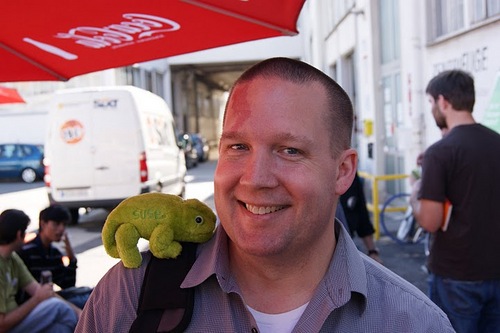
In the latest of our LinuxCon and CloudOpen keynote Q&A series we talk to SUSE‘s Vice President of Global Alliances Michael Miller. Miller will be talking in his keynote at the events about how service-oriented clouds are bridging the divide between IT and lines of businesses. He also hinted twice during our conversatoin about a big announcement coming.
You’re keynoting at LinuxCon and CloudOpen about service-oriented clouds. Can you give us a teaser for what we should expect from your presentation?

Miller: One of the key things that is driving interest in the cloud is IT being more responsive to the needs of the line of business. Enterprises that are having early success with their cloud implementations are using cloud as the impetus to have conversations between IT and the line of business and are changing the way they think about each other’s roles. The service-oriented cloud is the next step in the evolution. IT will work with the business users of the cloud to standardize certain services like a database or load balancers that can be repeatedly delivered and ease the deployment of cloud workloads. And SUSE will be making a major announcement that will sit at the heart of this service oriented cloud.

What are you hearing from SUSE customers about cloud and open source?

Miller: Well a couple of years ago we kept hearing from the senior management teams that they weren’t ready for cloud, because they were unsure how they were going to manage data and security. But, we also kept seeing SUSE Linux Enterprise Server be run more and more in public clouds like Amazon Web Services, IBM Smart Cloud and 1&1. Over the past year or so, our customers have started asking a lot more questions about private cloud. Their concerns with the public cloud around data and security haven’t gone away, but I think they are looking to learn about cloud, while gaining some of the benefits of flexibility and business responsiveness by establishing a private cloud. For the most part, when they come to SUSE to discuss these things, it is all open source. They view Linux and open source solutions as driving their clouds.

What role do you believe Linux is playing in the accelerating cloud computing space?

Miller: Linux as a technology, with its straightforward subscription model, has been key to the rise of cloud computing. Being able to leverage an open, flexible and reliable technology on commodity hardware makes the economics and technical advancement work. And as cloud advances beyond just test and development, and we see more enterprises use the cloud in production it will be critical that these Linux workloads are fully supported, too. But, while Linux as a technology is important, for the advancement of cloud – the success of Linux as an open source development model may be even more important.

Agility, flexibility and customization is the promise of cloud computing. It is also the promise that open source, particularly Linux, has been delivering on for more than twenty years. We believe that open source development has begun and will further lead to a new generation of innovations that enable enterprises to realize the promise of the cloud. Enterprises need open standards and the industry working as a community to ensure that prior technology investments are not made obsolete and that new investments are future proof by a shift into the cloud.

So while we believe Linux will be operating system of choice for cloud infrastructure and workloads, we also believe that Linux has shown the path to big successful industry change through open source development projects.

What open cloud projects are you keeping a close eye on and why?

Miller: We are definitely keeping our eye on a few open cloud projects. CloudStack. Eucalyptus. But, OpenStack was the project that has really gotten our attention. It clearly was the project with the greatest industry support and most vibrant community. OpenStack was also the project that our customers kept asking us about. Obviously, as a platinum member of the OpenStack Foundation we are highly invested in ensuring the long-run viability of the project. The move by OpenStack to form the foundation we believe will not only ensure the ongoing vitality of the project, but also ensure the project’s development goals benefit the industry and not just one company. In the same way, that Linux was developed to benefit the many over the few.

As we get set to launch a product based on OpenStack in the next month, we are primarily following other open cloud projects from a competitive standpoint.

How have you seen Linux adapt quickly before to advance a new market opportunity? Do you see parallels today with cloud computing?

Miller: One of the areas where Linux adapted quickly was in virtualization. Starting with Xen and now with the emergence of KVM, Linux support for hypervisors and the evolution of that support was both rapid and very relevant to the current discussion on cloud. Xen and KVM, today, deliver performance on par with commercial hypervisors while providing the scalability, lock-in avoidance and cost reduction that customers are looking for. If you look at the public cloud providers using Xen powered servers for their infrastructure (Amazon, Rack Space, Go=Grid and others) you could almost conclude that open source hypervisors make public clouds possible.

To catch Michael Miller’s keynote presentation, check out the LinuxCon/CloudOpen schedule.
OpenStack Quantum Project Aims to Define Future of Networking

Much debate has occurred recently over whether Amazon’s API should be considered a de facto standard by cloud computing service providers. Those who reject this notion (ahem, Lew Moorman) say you can’t clone Amazon’s cloud by copying its API alone.

“Having API compatibility for the basics like loading and getting an object is very easy but these technologies do complex things and will always be different because there are different technologies underneath,” Moorman, president of Rackspace, said in an interview for our July 10 Leaders of the Open Cloud article.

Cloud platforms must start from scratch to innovate and truly meet the needs of customers and vendors.

So I was intrigued when HP’s Richard Kaufmann told me in an interview a few weeks back that there’s one unique case study, in particular, that demonstrates how the OpenStack community is reinventing cloud computing – not just remodeling existing platforms.

The Quantum Project is working to design next-generation virtual networks with no model for comparison, said Kaufmann, chief technologist for cloud services at HP, which contributes to the Quantum Project.

I heard much the same statement last week from Lew Tucker, Cisco VP and CTO of cloud computing, in his OSCON session about the Quantum Project. This is new ground. There’s no such thing as programmable infrastructure, or what project leaders call a network-as-a-service. The Quantum Project has set out to correct this, starting by problem-solving the issues with current technology. 

“Fixed networking today is really a problem,” Tucker said to a roomful of sysadmins and developers.

“When you look at the general model of cloud computing, networking is tied up in the compute service. That makes it really hard to build that service,” Tucker said. “Provisioning of various vendors is hard and maintaining will be even harder.”

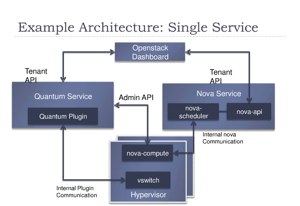
Example Quantum ArchitectureThe Quantum Project aims to break out networking from the rest of the OpenStack services to build a new layer of abstraction for two-way communication between an application and the infrastructure.
“The network service completes the trinity of the cloud – with compute and storage services,” Tucker said.

Quantum, a core part of the OpenStack project starting with the next Folosm release, aims to allow the software above the stack to control that infrastructure through a well-defined interface – an API that developers can access.  Project participants are also developing a plugin component to the architecture to allow customers and vendors to experiment with new extensions but keep the API stable.

“We hope to nail down the API very shortly,” Tucker said.

He predicts this mechanism of a simple API with plugins will lead to the development of many vendor-specific plugins for things such as quality of service and port profiles. A slew of new networking services will also arise as a result. 

“We’ll have a new way of inserting computing into the network,” he said. “A lot of things around data flow will start to drive it. And we’ll end up with a new notion of what we mean by a virtual datacenter.”

The Quantum Project has big aspirations and it hopes to meet them by working through a community process in an open format so that all can contribute and benefit.

“OpenStack is really setting out to build an alternative end to end,” Moorman said. “When they say we’re going to do networking, they’re not just setting out to copy Amazon, but asking how should networking be done in the modern world?”

Ask a Kernel Maintainer

I’ve been writing an occasional “Ask a kernel maintainer” column on the lwn.net weekly kernel page. It’s been a while since I last wrote one, so I figured it’s time to start it up again.

So, consider this an open request for questions that you’ve always wondered, but never knew who to ask, or how to find the answer to, that you have had about the Linux kernel.

Note, any question that can easily be answered by reading either the Documentation/HOWTO or Documentation/SubmittingPatches or Documentation/CodingStyle files in the Linux kernel source code are not eligible. You should read them first before asking.

Please
This e-mail address is being protected from spambots. You need JavaScript enabled to view it
or post them in this Google+ thread, and I’ll work over the next few weeks to answer them in the column.

5 Best New Features of the Linux 3.5 Kernel Release

Following some initial concern earlier in the month about a large volume of small, last-minute pull requests that ultimately necessitated a seventh release candidate, Linux creator Linus Torvalds on Saturday published the final version 3.5 of the Linux kernel.

Tux“Ok, not a lot happened since -rc7,” Torvalds admitted in his announcement email. “There’s a number of MIPS commits (for some reason MIPS has had a horrible track record with the -rc time schedule, I suspect I should just stop pulling late in the game), but most of the rest is pretty small.” 

In addition to bringing a raft of new drivers and fixes, this latest version of the Linux kernel is notable for new features including metadata checksums in the Ext4 filesystem, new probes to help find performance problems in user applications, and an Android-style opportunistic suspend feature.

Ready for a rundown of the highlights? Here are some of the best new features you’ll find in Linux 3.5.

1. Metadata Checksums in Ext4

Playing a little bit of catch-up with filesystems such as ZFS and Btrfs, the Ext4 filesystem  in Linux 3.5 has now gained the ability to store checksums for various metadata fields. So, “every time a metadata field is read, the checksum of the read data is compared with the stored checksums,” the Linux 3.5 changelog explains. “If they are different it means that the metadata is corrupted.” Because it’s focused on internal metadata structures and not data, no significant performance cost is expected to be associated with this new feature under typical desktop and server workloads. 

2. A User-Space Monitor

Uprobes, meanwhile, is a new performance monitor that’s essentially equivalent to Kernel Dynamic Probes (Kprobes) but for the user-space side. Using it, performance probes can be placed in any user application memory address, where they will collect debugging and performance information nondisruptively and help identify any performance problems. 

3. Better Android Compatibility

When Android code was merged into Linux earlier this year, there was some controversy over Android’s “suspend blocker” functionality used for power management. The technology has been especially problematic because drivers in Android devices use the suspend blocker API, but the lack of such an API in Linux has made it impossible to merge them. Now, with Linux 3.5, similar functionality in the kernel called “autosleep and wake locks” should make it easier to merge drivers from Android devices. 

4. A Weapon Against ‘Bufferbloat’

Then there’s the new queue management algorithm in Linux 3.5 called Codel (short for “controlled delay”) that aims to battle “bufferbloat,” or the problem that arises when there’s excessive buffering across an entire network path. With this new technology, in fact, bottleneck delays can be reduced “by several orders of magnitude,” according to the Codel project page

5. Extended Seccomp Sandboxing

Back in 2005 Linux 2.6.12 gained support for seccomp, or “secure computing,” which is a  sandboxing mechanism that enables a state in which only a very restricted set of system calls can be made. Now, with Linux 3.5, seccomp has been extended into “a filtering mechanism that allows processes to specify an arbitrary filter of system calls (expressed as a Berkeley Packet Filter program) that should be forbidden,” the changelog explains. “This can be used to implement different types of security mechanisms.” The Linux port of the Chromium Web browser, for example, supports this feature to run plugins in a sandbox. 

This, of course, is only a very small selection of what’s new in Linux 3.5 — a wide variety of driver, graphics, performance and other improvements are also included. A much fuller account is available in the changelog on KernelNewbies.org.


Arduino Used as Master Key for Hotel Rooms

Using an inexpensive Arduino board, a security researcher has managed to read the private cryptographic key from the memory of the Onity HT lock systems – used by a number of hotels around the globe – and unlock it

Read more at The H

Mac Malware Crisis as Apple Lets Slip its Mountain Lion

Includes bonus Windows Trojan, stealth ninja style

Miscreants have developed a sophisticated multi-platform attack dog designed to maul Windows and Mac OS X computers.…

Read more at The Register

DrWright for Linux Forces You to Stop Typing and Take a Break

Click here to read DrWright for Linux Forces You to Stop Typing and Take a Break

Linux: We’ve discussed several appsfor Windows and a few othersfor Mac that remind you to take breaks periodically, but Linux users need some love too, and DrWright, a free, open-source utility that locks your system periodically so you take a break, gets the job done. More »


Read more at Lifehacker

WinFF Makes Multi-File Conversion Painless

Converting media files is often one of the messiest chores that audio and video fans must tolerate, but WinFF is one of the simplest methods I have found to convert audio and video file formats to make them compatible on my growing collection of mobile media platforms. Unlike other excellent single-purpose media converters for the Linux desktop, WinFF can convert any mix of multiple selected file formats as easily as performing a batch operation in a file manager.


Read more at LinuxInsider

Is This The Most Boring Branch Of Enterprise Mobility?

Within the enterprise mobile sphere, there was one thing I almost used to dread writing about because it seemed so deadly dull. At least that’s what I used to think.

KDE’s Rekonq Browser Turns 1.0

Version 1.0 of the lightwieght Rekonq web browser for the KDE desktop is now available to download. Its developers say that the major milestone release should be even faster and more stable

Read more at The H