Home Blog Page 2251

Mesa 8.1 Will Offer Some Speed Improvements For Nouveau

After last week sharing results for AMD Radeon R600g Gallium3D on Mesa 8.0 and 8.1-devel, here are benchmarks for several NVIDIA GeForce graphics cards comparing the OpenGL Gallium3D performance with Nouveau on Mesa 8.0 stable and Mesa 8.1-devel.


Read more at Phoronix

Run IT as a Responsive Business, Beat the Cloud Vendors at Their Own Game

IT departments are increasingly competing with cloud providers, but are hamstrung by maintenance and upkeep costs. A new CIO consortium wants to change that, and help IT run as a business.

Radeon Driver Commit Activity Is On The Decline

After delivering development statistics on the Nouveau driver and the Intel driver, here’s some numbers looking at the development pace of the xf86-video-ati X.Org driver for Radeon graphics cards…


Read more at Phoronix

Microchip Giant ARM Reports Q2 Earnings, ‘Record Order Backlog’

arm products-phone

ARM Holdings — supplier of microchips for Apple’s iPhone and iPad products, Samsung’s Galaxy line and soon technology for Microsoft’s Windows 8 devices — continues to report strong results while riding the wireless device boom and expanding to newer areas. The company reported Q2 earnings (ended June 30) of £135.5 million ($213 million), beating analyst estimates of $206 million. Net profit was up by 48 percent, to £39.4 million compared to £26.6 million for the same quarter a year ago.

Pointedly, the company is gearing up for continuing good fortune, at least for the next quarter: It says it has a “record order backlog” that will let it ride well into Q3, but cautioned that macroeconomic uncertainties may impact what happens in Q4.

“Macroeconomic uncertainty may impact consumer confidence, and some analysts have become less confident in the semiconductor industry outlook in the second half,” it noted in a statement. But it noted that it expects overall revenues for 2012 to be in line with market expectations. That consensus currently is for full-year revenues of $860 million.

Read more at TechCrunch

Microsoft Inks Patent Deal with Service Provider Using Linux Servers

Microsoft’s latest patent licensing deal isn’t like its recent Android/Chrome OS arrangements. It is with a service provider running Linux boxes in its own datacenters.

GNOME Committed to Accessibility

Accessibility is overlooked by many people because they think that it doesn’t affect them. But as Jonathan Snookpoints out, “accessibility is a spectrum. On one end, there are those with severe cognitive and/or physical disabilities; on the other end… well, what is the other end?  People who wear glasses, or are color-blind? What about those who choose to use the keyboard instead of a mouse? Where does one draw the line?” Over time, almost all of us will require assistance of some kind to be able to make full use of our computers and devices. 

Making sure that our technology is accessible is not only the right thing to do but is essential for our success. GNOME has prioritized accessibility since the early days, following a “built in” rather than “bolted on” development model. Because of this commitment, along with the efforts of many dedicated developers, GNOME 2 became an award winning, free and accessible desktop environment.

GNOME accessibility tools

The Accessibility ToolKit (ATK) defines a set of interfaces that must be implemented by all graphical toolkits that want to be accessible. Of course, the GNOME graphical toolkit, GTK+, has a built-in ATK implementation, but other toolkits do it as well like Java/Swing and SWT, OpenOffice/LibreOffice, Mozilla’s Gecko, Clutter and WebKitGTK+.

The Assistive Technology Service Provider Interface (AT-SPI) is an accessibility framework that defines a protocol for providing and accessing application accessibility information. The current version, AT-SPI2, includes a library for bridging the D-Bus protocol to the ATK API and an accessibility client side library in C and Python. This architecture has proved in the years past to be successful and recently Qt has created a bridge to AT-SPI2.  The Qt Accessibility plugin exposes the internals of a Qt application to interested accessibility clients.

Orca is the most popular free accessibility client so far. Orca is a free, open source, flexible, and extensible screen reader that provides access to the graphical desktop via user-customizable combinations of speech and/or braille. Orca has a very lively community of users and contributors all around the world. But there are also other  accessible applications worth mentioning such as:

  • Caribou is an on-screen accessible keyboard solution that is the base for the on-screen keyboard built into GNOME Shell.
  • The built-in GNOME shell magnifier currently offers basic zoom features. But there are clever lightness, brightness, and contrast effects in development to be released soon.
  • Dasher, an efficient alternative text-entry system wherever a full-size keyboard cannot be used, for example, with a joystick or an eye tracker system.
  • Dots is a braille translator of documents though is still in its early stages of development.

GNOME accessibility contributors

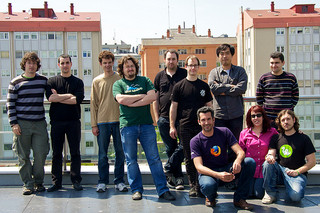
GNOME Hackfest group photoIn 2010, Oracle acquired Sun Microsystems and in that transition GNOME lost full-time developers working on Orca and ATK. Since then, the accessibility effort has been driven mainly by volunteers lead by Alejandro Piñeiro, from the free software specialised company Igalia, who has been working hard in the  ATK implementation of GTK+ and Clutter, and Joanmarie Diggs, famous for her brilliant work as Orca maintainer, recently hired by Igalia.

Other core developers are: Mike Gorse, a SUSE employee who maintains AT-SPI2; Joseph Scheuhammer from the IDRC, who develops the GNOME Shell Magnifier, supported by the Ontario Ministry of Economic Development and Innovation and the ÆGIS Ontario and ÆGIS Europe Projects; Benjamin Otte from Red Hat, who cares about accessibility issues of GTK+; and Mario Sánchez from Igalia who works in WebKitGTK+ accessibility. Other developers like Eitan Isaacson and Fernando Herrera, currently enrolled in Mozilla, have been involved all these years and made several important contributions to accerciser, Caribou and Dots, to name a few. 

The funds for the accessibility effort in recent years have come from the GNOME Foundation, donations from the always-supportive Mozilla Foundation, and from the partnership of the Brazilian organizations F123.org and Mais Diferenças. The Guadalinfo Accesible project from the Fernando de los Rios Consortium in Andalusia (Spain) contracted some local companies like Emergya, Yaco, Onírica or Warp to work on some accessibility features that eventually resulted in new developers to the project, like Alejandro Leiva and Javier Hernández from Emergya.

Funding GNOME usability, accessibility

With the advent of GNOME 3, GNOME has started down an exciting new path in usability, which includes users of all ages and abilities. This drive is not only necessary for those with disabilities but it’s also increasingly needed to make new devices work for any user and open the door for new and alternative ways of interacting with the desktop. In fact, usability and accessibility have much in common. Some issues are clearly related to accessibility; some are clearly related to usability; but many things are in a grey area where accessibility and usability overlap. It is only when a product is totally accessible that it is truly usable. We have lot of work ahead of us to make sure GNOME is what we strive for it to be – a great desktop usable by all.

The accessibility solution developed by GNOME has been adopted by other free desktop environments like Xfce, Unity or KDE. Accessibility is an important issue to address and cross-desktop collaboration is a real win-win approach. This means that many GNOME accessibility improvements will benefit not only GNOME users, but free desktop users in general.  I think is worth mentioning Frederik Gladhorn from Nokia for his great work on the Qt bridge to AT-SPI2.  Thanks to this collaboration, Orca users will be able to access not only GNOME/GTK+ applications, but also KDE/Qt applications.

The GNOME accessibility team is working hard, but its resources are more limited than in the past.  For this reason, the GNOME Foundation started a Friend of GNOME campaign that is drawing to a close to help to tackle the accessibility team’s many goals. In the next GUADEC they will organize an unconference called A11yCamp  where it will be discussed how best to allocate these funds. However, the main goal of the A11yCamp is to help to solve accessibility issues that the participants bring to the event. In the same way accessibility is a spectrum, we  all can help to make it happen.

We hope that with progress on accessibility that Free Software can bring modern computing to people around the world regardless of race, class, creed and abilities.

About the author: Juanjo Marin is a software engineer focused on public administration. Currently he works as System Administrator/Branch IT Manager for the Junta de Andalucía in the Department for Culture and Sports in Cádiz (Spain). He’s also a Free Software advocate and he participates in several FLOSS activities. He collaborates in several areas in the GNOME Project including marketing, accessibility and some programming.

Google Partners Up to Sell Cloud Computing and Storage

Google is launching a new Cloud Partner Program that will formalize the ecosystem around its cloud compute and storage products and bring new ways for customers to tap into Google’s cloud offerings. They’ll also offer levels of service and support that might be difficult for Google alone to provide.

The new Google Cloud Platform Partner program, announced Tuesday on Google’s Enterprise Blog, will feature two types of partners: service partners and and technology partners.

Service partners are the companies and vendors that will supply the knowledge resources for customers to jump into the Google cloud. The technology partners will provide actual software to connect their existing tools or new tools to Google’s Compute Engine, Cloud Storage or the SQL-based BigQuery database engine.

One Partner’s Perspective

One of those technology partners is Jaspersoft, a business intelligence (BI) vendor that’s been building a name for itself in the big data sector.

Playing to its strengths, Jaspersoft was already working with Google to build a connector between BigQuery and Jaspersoft’s BI tools when Google started formalizing the relationship, according to Ben Connors, Worldwide Head of Alliances for Jaspersoft.

As Connors tells it, JasperSoft’s customers were very much driving the push towards connecting to Google’s cloud tools even before the formal Partner Program was put in place. For a company like Jaspersoft, this kind of early interest is a positive sign for the Google Cloud.

“It’s going to look very much like the [Amazon Web Services] EC2 ecosystem,” Connors said in a recent interview.

That kind of enthusiasm from a new partner is to be expected, but there’s some truth in what Connors is saying. Google Cloud is one of just two other players (Microsoft’s Azure being the other) with the scale to seriously compete with Amazon Web Services right now, and the addition of a formal partner program will help put Google on a surer footing when it comes to comparisons with Amazon’s EC2 and Simple Storage Service (S3).

Read more at ReadWriteCloud

Huawei Profit Down 22 Percent in 1H, Blames Economy

Chinese telecoms giant says challenging market and economic landscape caused lower operating profit of US$1.4 billion for first half of 2012 over last year, despite 5.1 percent rise in sales to US$16.07 billion.

Read more at ZDNet News

VMware, Nicira and a Holistic View of Virtualization

Virtualization is far more than merely creating virtual servers or virtual clients. It is a range of technology that spans the entire software stack. Over time, VMware has moved from a one trick pony to having a strong portfolio of virtualization technology. Only IBM, HP, Microsoft and Oracle have a stronger portfolio.

Citrix’s Hinkle Proposes Linux Model for an Open Source Cloud

As the Senior Director of Cloud Computing Community at Citrix, Mark Hinkle oversees Citrix efforts around the open source Apache CloudStack IaaS platform and Xen hypervisor projects.

Citrix is still very closely involved in CloudStack, which was donated to the Apache Software Foundation in April. Citrix developers are now involved in driving user adoption for CloudStack and helping to shepherd the project through the Apache Foundation’s incubation process.

Mark Hinkle, Citrix“It was a huge change for the project to move from a company-sponsored open source project to a community-run Apache project,” Hinkle said.

But the project has seen more community contributions in the last 90 days than it did in the last two years it’s been open source, he said. CloudStack has also seen a nice uptick in adoption from a wide range of companies that includes cloud hosting providers, social gaming companies and research labs, among others.  

“We see hundreds of clouds coming online every month and a lot of feedback and contributions from the user and development communities,” Hinkle said.

In the short term, though, Hinkle’s big project is preparing for the Xen Summit developer meetup, he said, which will run Aug. 27-28, before CloudOpen and LinuxCon North America in San Diego Aug. 29-31. Hinkle will also present a keynote on “The Cloud in 20 Years,” at CloudOpen. We talked recently about the company’s involvement in the open source cloud and how it might model Linux.

How do you define an open cloud?

Hinkle: It’s first and foremost that the orchestration platform is open source. The data you store within the cloud is open to you as the end user in a format you can manipulate easily and it’s easily transferable. The API is also open and clearly documented.

What are the barriers to accomplishing an open cloud?

Hinkle: When service providers implement in a way that’s easier to upload data but harder to move large blocks of data, that makes it tough for the cloud to be easily portable.

The other thing is governance. You want to look at projects with a governance model led by an impartial community keeping everybody’s interests in mind.

How do CloudStack and OpenStack differ?

Hinkle: OpenStack is a collection of about 17 different projects; some are even complimentary to CloudStack, like OpenStack Storage (Swift) or Dell’s Crowbar. But what makes us unique is probably the self-service portal and the ability to  easily delegate the creation of infrastructure to people within your organization as well as the ability to offer network services packaged with service offerings.

It’s also been in production commercially for a couple of years so it’s very mature and stable. Citrix has a lot of public customers that have been running CloudStack clouds for well over a year.

I’ve read about concerns recently that too many open source projects competing against proprietary clouds fragments the effort to create a competitive open source alternative. What’s your view on this issue?

Hinkle: That’s crazy talk. In a single vendor-led market the products become mediocre and the expense to the end user becomes high. Especially in a market as large as cloud computing where there’s plenty of room for multiple players, the only time fragmentation is a bad thing is when there’s an incumbent single vendor that owns a majority of the market.

The key is open standards, open APIs, so clouds can be federated and guest infrastructure can be portable. Consolidation and too much standardization doesn’t make much sense if you want innovation and high quality.

Do you have advice for IT professionals considering a move to the cloud?

Hinkle: Think through what the end use requirements are and the level of utility. Do they need highly available storage, computing or disaster recovery, for example, before they start building their cloud? That should be a design point early on.

They should also understand the level of data integrity and backup they need. A lot of people have an ephemeral architecture and data doesn’t need to be archived long-term.

A lot of people are just using cloud as a greenfield. For example, their existing infrastructure may have SAP or other financial data on it and they have to have highly available data but their new project may be images for short-term projects –groups they bring on for a few weeks and then shut down.

Sometimes we call that the Amazon model where you’re going to keep your costs low for temporary projects. Then there’s the legacy model from VMware where you build highly redundant datacenters. In our experience the new greenfield opportunities are more Amazon-like and migrations are more VMware like.

What do you plan to discuss in your keynote at CloudOpen?
Leaders of the Open Cloud logoHinkle: I wanted to look at the 20 years of Linux and apply the lessons we learned there so we have the same degree of success with the cloud that we did with open source Linux.

There are multiple vendors that offer Linux distributions through the years and continue to. They may have used the same underlying kernel but they always adhered to open source and open standards. Adhering to the Linux standards base made it a widely deployed operating system that gives you a great amount of choice.

One of the big lessons we learned from Linux was that while every distro wanted to be the best, at the end of the day we all worked from a common code base that made Linux what it is. At the point where we don’t collaborate at least at some level, we’re not going to see the success that Linux had in the open cloud. We don’t want the competition to be among open source cloud platforms. The issue is proprietary systems that don’t believe in open source and don’t serve the best needs of their customers.

How does the industry go about creating standards?

Hinkle: I don’t know that you cause standards to happen as much as they evolve. The only standard everybody acknowledges is the open virtualization format driven by a small group of vendors and championed by the DMTF (Distributed Management Task Force).

What’s happening now in the cloud is the evolving standard is the Amazon API because they are the leader. If you wanted to be a private cloud vendor you want to keep compatibility that way. Sometimes de facto standards just arrive and everybody accepts them because they make sense and cause less strife for users.

I think the next one will be in the platform space, PaaS. How can payloads be deployed from (VMware’s) CloudFoundry to Red Hat’s OpenShift to others? How that happens remains to be seen.