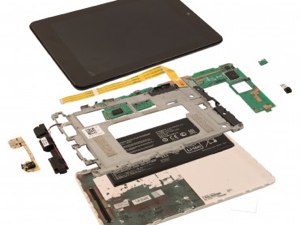
 Google began shipping pre-orders to the Asus-manufactured Nexus 7 on July 13, featuring Android 4.1 and a $199 (8GB) price aimed directly at Amazon’s Kindle Fire. Judging from the early reception, the Fire has met its first major rival in the 7-inch tablet market: Nexus 7 inventory is sold out, and new orders won’t ship for at least another week on Google’s online site, and possibly until August at retailers, according to CNET.
Together, these two tablets are accelerating an industry trend toward better unit sales of 7-inch Android tablets and taking the focus away from their pricier, iPad-like 10.1-inch siblings. They’re also making it harder for the coming wave of new 7-inch tablets from Apple, Samsung, Microsoft and others to compete as they face greater pressure to price low.
UBM TechInsights recently estimated Google is selling the Nexus 7 at a loss, citing a $184 manufacturing cost for the $199 version. On July 11, however, AllThingsD reported on a study by iSuppli that claims the Nexus 7 actually costs Google/Asus $151.75 in parts. *(See footnote, below.) With manufacturing and other costs factored in, iSuppli estimates Google is breaking even.
Amazon’s initial subsidization of the Fire was similar. Last November, iSuppli estimated the Kindle Fire cost $185.60, or $201.70 including manufacturing costs, meaning the tablet was sold at a slight loss. Some costs have since declined, so iSuppli calculates the Nexus 7 costs $18 more than the Fire, which is now making a small profit.
For Amazon and Google, going small and cheap makes sense, as tablet-derived sales from their online stores trump any profits from hardware sales. But other tablet vendors will have to choose between going high-end or fighting it out in the price war and sacrificing features.
Google vs. Amazon
In September, the Nexus 7 will have fresh competition from an upgraded version of the Fire, according to AllThingsD. Previous rumors have pointed to an upcoming 10.1-inch Amazon tablet, as well, and according to Bloomberg, the online retailer is even readying its first smartphone.
Yet Amazon will likely keep its focus on the 7-inch Fire upgrade, if only to keep in step with the Nexus 7. The next-gen Kindle Fire will be thinner and lighter, and will add a camera, says AllThingsD. It will also move up to a 1280 x 800 display, thereby matching the Nexus 7 and enabling a more tablet-like 1.60 aspect ratio.
There will be considerable pressure to reduce the price. If Amazon chooses to advance to a quad-core processor to match the Nexus 7, however, it will be tough to drop even to $189 without once again taking a loss.
Apple iPad mini: How low will it go?
As Amazon attempts to maintain its position as the world’s leading 7-inch tablet vendor, it will have more than Google to worry about. Apple now appears to be preparing a 7- to 8-inch version of the iPad, despite Steve Jobs’ earlier aversion to the smaller format. The tablet is set for a September, October, or year-end release, depending on whether you believe the Wall Street Journal, Bloomberg, or other sources, including Macotakara. The latter says the “iPad mini” will be made in Brazil by Foxconn and feature a 7.85-inch screen with 1024 x 768 resolution.
The iPad mini is expected to be remarkably affordable for an Apple product — and cheap enough to hurt Amazon, Google, and other tablet vendors. It’s doubtful, however, that Apple will beat the break-even pricing of Amazon and Google. While Cupertino has the huge online retail presence necessary to justify such a “razor-razorblade” strategy, its long history of premium branding and high profit margins would suggest slightly higher pricing.
Android Price vs. Features
Other Android vendors selling 7-inch tablets will face greater pressure to go low. There are dozens of 7-inch Android tablets selling for less than $200 or well below, but few have at least two processor cores and 1028 x 600 resolution.
Samsung’s dual-core Galaxy Tab 2 7.0, for example, sells for $250 with 8GB. Samsung tablets have always sold well, and Samsung is sufficiently big and profitable to play very close to the margins. Yet, without major online content sales, even Samsung could find it difficult to match a break-even strategy for long.
Meanwhile, Barnes & Noble may well pivot from its once successful, now struggling Android-based Nook Tablet to partner with Microsoft on its Surface tablets. Microsoft’s slates are likely to be priced higher and aimed primarily at business users.
A few major tablet vendors will choose to skip the price war and fight it out in the risky, high end, hoping to lure users with cameras, pens, ports, 4G radios, and corporate features. Most, however, will go low and gamble by sacrificing features. Some will wager there are still enough novice consumers left who don’t care about thickness, weight, and battery life. Others will skip the cameras and ports, settle on 1024 x 600 resolution, or forego software extras like Google Apps.
Whichever way they go, the risks will be high. The only good news is that tablet demand appears to be even higher.
Note: Unlike TechInsights, iSuppli’s analysis was based on a study of the hardware itself, says AllThingsD. Both studies noted that Google would make a profit on the 16GB, $249 version, since the extra 8GB memory costs only $7.50 — a far cry from the $50 premium.

 The S-Wallet has opened and absorbed $310 million-worth of connectivity and location patents from British chip company CSR, which already supplies SiRF GPS chips to Galaxy devices. In addition to boosting its patent portfolio, Samsung also invested $34 million to buy a five percent stake in the firm itself, giving it access to a large development team working on audio, automotive, indoor location and other functions. The deal won’t let Samsung use CSR’s camera technology, but it will — the Korean manufacturer says — “solidify its position as a leading semiconductor solutions provider.” Given how Sammy is already intent going it alone with its Exynos processors, we have no reason to doubt it.
 Reuters, Bloomberg Businessweek | Email this | Comments