The Raspberry Pi single board computer (SBC) that began shipping in April in $25 and $35 versions has taken the hacker world by storm. Yet, the education-focused, development board is just the latest and cheapest of a number of recent open source, community hardware projects designed for hobbyist devices, educational platforms, prototyping, and even some limited-run commercial products. Most of the seven open-spec boards listed below cost $100 to $200, but unlike the ARM11-based Pi, they feature ARM Cortex-A8 and -A9 processors and support Android in addition to running various Linux distributions.
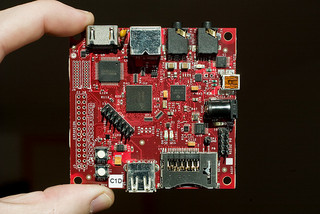 Open-spec prototyping boards and devices have been available since the early days of embedded Linux, led by devices like the OpenMoko hacker phone born in 2007. Texas Instruments (TI) was the first major semiconductor vendor to realize that offering a low-cost hobbyist board as an alternative to its expensive evaluation modules would expand the reach of its chips. In June 2008, TI announced the $150 BeagleBoard, based on its 600 MHz OMAP3530 processor — the speedy Tegra 3 of its time.
With the BeagleBoard and subsequent open-spec projects featuring TI ARM Cortex chips, TI was smart enough to manufacture the boards, and then stay out of the way. The widely imitated BeagleBoard.org community has always maintained its independence.
Few of these projects come close to matching the activity of BeagleBoard.org, but several have devoted followings. Meanwhile, cheap boards like the Raspberry Pi and BeagleBoard.org’s BeagleBone have inspired a number of low-cost ARM/Android devices that appear to be aimed at hackers, but are not so open, such as Via Technologies’ $49 APC board.
True open hardware projects provide full schematics, forums, open source code repositories, and websites where spin-off projects can be showcased. They offer a low-cost ride on the latest ARM Cortex processors, giving developers the tools and community feedback they need to create innovative devices with Android and Linux.
Seven Open Source Boards
 BeagleBoard/BeagleBone: Along with the microcontroller-focused Arduino project, BeagleBoard.org is one of the top open source hardware communities in the world, boasting thousands of developers working on hundreds of projects. In August 2010 BeagleBoard.org added a BeagleBoard-xM model with a faster 1 GHz TI DM3730 Cortex-A8 processor and an 800 MHz TI DSP capable of 720p video output. The $149 board doubled RAM to 512 MB and added Ethernet and a camera port.
Today, the Beaglistas seem more enthralled with the $89 BeagleBone. Announced last October, the 3.4 x 2.1-inch device runs a 720 MHz TI Cortex A8 processor, and can boot in as little as five seconds. The design includes expansion connectors that support stackable “cape” expansion boards for touchscreens and I/O, not unlike Arduino Shields.
Both the BeagleBoards and BeagleBone can now run Android 4.0, in addition to numerous Linux distros. Recent BeagleBone projects include 3D printers, sensor devices, watches, robots, and a “descriptive camera” that prints out metadata about a given scene. The BeagleBone even drives an underwater robot called the OpenROV.
Trim-Slice: The Trim-Slice from Israel-based CompuLab is not an SBC, but rather an enclosed mini-PC. Still, the computer is highly hackable and is supported by forums, wikis, and open source downloads. Supporting Android 4.0 and various Linux distros, the Trim-Slice runs Nvidia’s popular Tegra 2 dual-core Cortex-A9 processor.
The Trim-Slice is loaded with I/O, and is even available in a Trim-Slice H version with a 250 GB hard drive. Prices range from $213 to $338, but steep discounts are available for open source developers.
CraneBoard: Announced in December 2010 by Bangalore-based Mistral Solutions, the $199-and-up CraneBoard is built around TI’s 600 MHz AM35x Sitara CPU and code-compatible with the BeagleBoard. The industrial/HMI-focused board is loaded with I/O, including a CAN bus, and supports Power-over-Ethernet (PoE). While it appears to be in wider use than the nearly defunct, TI-based HawkBoard, the community appears to be small, and there have been complaints about the lack of support.
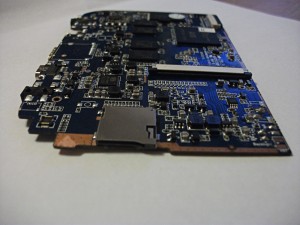 Gooseberry: The Gooseberry board was launched last week by some hackers who got tired of waiting around for the similarly U.K.-based Raspberry Pi to ship in quantity. The 40 pound ($63) Gooseberry is actually a slightly tweaked version of an SBC found within a no-name Chinese Android tablet. It’s somewhat similar in specs to the Raspberry Pi, but has a more powerful 1 GHz Cortex-A8 Allwinner A10 processor that enables it to run Android 2.3 out of the box, along with Ubuntu. (Android will likely be ported to the Pi, as well, but its ARM11 chip will not likely do it justice.)
Unlike the Pi, the Gooseberry offers WiFi, as well as touchscreen support. So far quantities have been minimal, however, so this may well remain a modest affair.
Origen board: It’s been pretty quiet over at Origenboard.org since Samsung, board integrator InSignal, and open source ARMs tools company Linaro announced the Origen board a year ago. Based on Samsung’s dual-core, 1.2 GHz Exynos 4210, the Origen board was the recipient of a Linaro Android 4.0 port in January. Origenboard.org says the board sold out in February, and an updated version is due in the third quarter.
Considering that Exynos powered the hot-selling Samsung Galaxy S II smartphone, the slow progress is a little surprising. Yet, the chip has made little headway outside of Samsung’s own products, and it has already been eclipsed by the quad-core version of the Exynos found in the Galaxy S III. The price is also a bit high, ranging from $199 to $394 for a version that includes a seven-inch touchscreen.
PandaBoard: Since PandaBoard.org announced its flagship board in December 2010, offering TI’s 1 GHz, dual-core OMAP4430, the community has attracted considerable momentum. Last December the PandaBoard was upgraded to an ES version with a 1.2 GHz OMAP4460, a DSI expansion header, switchable boot order, and Android 4.0 support. Like the original, the 4.5 x 4.0-inch board features TI’s WiLink 6.0 wireless module.
PandaBoard projects have been many and varied, including robots, mesh networks, and computer vision systems. Last week, MIT and Phoronix’ Michael Larabel unveiled a 96-core, solar-powered compute cluster running Ubuntu on 48 PandaBoard ES boards, using just over 200 Watts.
Snowball: Calao Systems and ST Ericsson unveiled the 3.34 x 3.34-inch Snowball board and Igloo community in February 2011. Based on ST-Ericsson’s dual-core, 1 GHz Nova A9500, the Snowball offers HDMI output, as well as wireless and sensor connectivity. Igloo members benefit from Android 4.0 and Ubuntu support packages from Linaro and Movial, as well as a Tizen port released in May. This month, Calao Systems discounted 500 Snowball (SKY-S9500-ULP-C12) boards to 145 euros ($181) each, down from 156 euros, and has released some new expansion boards.
In the fourth quarter, Calao plans to release its own open-spec board, separate from Igloo. The SKY-T3359-IXX will be based on TI’s low-cost, low-power AM3359, a 720MHz Cortex-A8 processor designed to supplant ARM9 CPUs.



 Debian dominated especially when it came to storage volumes – 63 percent of Debian/ Ubuntu users had at least 1 Terabyte of data stored on file servers versus 46 percent who reported the same data volume on Red Hat servers.