Home Blog Page 338

Hot Technologies on Track at Open Source Summit

Open Source Summit North America is right around the corner. There will be hundreds of sessions, workshops, and talks, all curated by experts in the Linux and open source communities. It’s not an easy feat to choose the topics and sessions you want to attend at the event  because there are so many topics and only so much time.

In this article, we talk with Laura Abbott, a developer employed by Red Hat, and Bryan Liles, a developer at Heptio, a Kubernetes company, based in Seattle, Washington, about the upcoming event. Abbott is on the program committee for Open Source Summit, and Liles is one of the program chairs, working hard “to build out a schedule that touches on many aspects of Open Source.”

Hot topics

“I’ve been interested in cloud-native applications for a few years now, and I spend most of my time thinking about the problems and developing software in this space,” said Liles. “I’m also interested in computer vision, augmented reality, and virtual reality. One of the most important topics in this space right now is Machine Learning. It’s amazing to see all the open source solutions being created. I feel that even as a hobbyist, I can find tools to help me build and run models without causing me to go into debt. Personally, I’m looking forward to the talks in the Infrastructure & Automation and the Kubernetes/Containers/Cloud Native Apps tracks.”

Here are just a few of the must-see cloud computing sessions:

As a kernel developer, Abbott gets excited when people talk about their future kernel work, especially when it involves the internals like the page cache or memory management. “I also love to see topics that talk about getting people involved in projects for the first time,” she said. “I’m also excited to see the Diversity Empowerment Summit and learning from the speakers there.”

You may wonder as we are moving toward the cloud native world, where everything is running in a cloud, does Linux even matter anymore? But, the fact is Linux is powering the cloud. “Linux is what’s powering all those topics. When people say Linux. they’re usually referring to the complete platform from kernel to userspace libraries. You need a solid base to be able to run your application in the cloud. The entire community of Linux contributors enables today’s developers to work with the latest technologies,” said Abbott.

A few of the featured talks in the Linux Systems and Development track include:

Latest Trends

“DevOps is unsurprisingly a hot topic,” said Abbott. “There is a lot of focus on how to move towards newer best practices with projects like Kubernetes and how to best monitor your infrastructure. Blockchain technologies are a very hot topic. Some of this work is very forward looking but there’s a lot of interest in figuring out if blockchain can solve existing problems,” said Abbott.

That means OSSNA is the place to be if you are interested in emerging trends and technologies. “If you are looking to see what is coming next, or currently involved in Open Source, you should attend,” says Liles. “The venue is in a great location in Vancouver, so you can also take in the city between listening to your peers during talks or debating current trends during the hallway track,” said Liles.

Abbott concluded, “Anyone who is excited about Linux should attend. There’s people talking about such a wide variety of topics from kernel development to people management. There’s something for everyone.”

Sign up to receive updates on Open Source Summit North America:

This article originally appeared at The Linux Foundation.

The Use Cases for Blockchain, Real and Hypothetical

Blockchain has finally gotten over the Wall Street hump. Now that BitCoin and Ethereum are essentially old news, the actual technology behind these commodities is beginning to trickle into real-world enterprise applications. Blockchain, it seems, has many useful use cases out there in the business world, and with the help of the Linux Foundation and IBM, enterprises can now take advantage of the open source Hyperledger implementation of blockchain technology.

On today’s episode of The New Stack Analysts podcast recorded live at OSCON 2018, Klint Finley, a reporter with Wired and the author of the “Wired Guide to Blockchain,” said that he had a few real and hypothetical use cases the piece he wrote a few months ago. “Blockchain feels like the thing that is the hardest to parse the value out of the hype. With cloud computing, it was clearly an enormously hyped concept, but there were use cases and benefits. With big data it was coming out of actual real use cases at places like Google and Yahoo! With the Internet of Things, that’s probably the least well established of those at this point, but there are still established use cases for that. With blockchain it feels really preliminary,” said Finley.

Tracy Kuhrt, community architect at the Hyperledger Project at The Linux Foundation, pointed out a few of the current use cases for Hyperledger, however. 

Read more at The New Stack.

An Introduction to Using Linux on Embedded Single-Board Computers

Most of the more powerful compact form-factor single-board computers (SBCs) run one of the popular Linux distributions designed for use with these embedded boards. While there isn’t a specific version of the Linux kernel for embedded applications, the difference from a PC or desktop device running Linux is usually very small.

Typically being more reliant on Flash memory than having plenty of RAM and a hard disk – and in some cases also being ‘headless’, i.e. having no HDMI or video output – the distribution for embedded applications is tailored to available resources, rather than not being capable of running certain functions or commands. For the headless SBCs the only way to interact with them is through the Linux command line, so a good grounding in the basics of Linux is essential. Also, at a device and peripheral connectivity level, such as with GPIO interfaces and I2C functions, there are a number of Linux resources that are important to know. In this article we’ll cover some of the commands you are most likely to use when connecting up your embedded SBC to the real world. It is assumed that you have some basic Linux command line skills.

Before getting to work with the command line interface (CLI), let’s review some of the benefits of using Linux. Found running on anything from compact SBCs with embedded microcontrollers through to multi-core data-centre servers, Linux is an extremely efficient and scalable operating system (OS).

Read more at New Electronics

The Kubernetes Third-Year Anniversary Is Just the Beginning

A vibrant development community continues to help make Kubernetes the profoundly successful open source project it has become. In just a few years after Kubernetes was created as an in-house project by Google, Kubernetes’ governance processes have also served to underpin the platform’s adoption as well.  And a healthy community is at the heart of any successful source project.

At the same time, the open source community is not a “static asset.” To be permanently successful and to move forward, any open source project also needs a growing pool of contributors in order to survive. That’s why the Kubernetes community is working on multiple programs, focused on onboarding contributors, including the Kubernetes Mentoring initiativeKubernetes Contributing guide and Office Hours, as well as “Meet our Contributors sessions”Outreachy and even Google Summer of Code (GSoC), which is one of the most popular and well-known programs for the new contributors to the open source projects in the world. Some of the stand-out contributors have also garnered industry recognition.

Releases, Features and Roadmap

Kubernetes is a technology, first and foremost. And the project obviously couldn’t be so successful if the technology did not offer such a profound benefit to organizations.

The most important releases of Kubernetes occur four times per year, providing a new set of features each time. The patch releases (delivering security patches and bug fixes) take place even more often, keeping the codebase always up-to-date.

Read more at The New Stack

Learn more in the Kubernetes project update from Ihor Dvoretskyi coming up at Open Source Summit in Vancouver.

Top 10 Reasons to be at the Premier Open Source Event of the Year | Register Now to Save $150

Here’s a sneak peek at why you need to be at Open Source Summit in Vancouver next month! But hurry – spots are going quickly. Secure your space and register by August 4 to save $150.

  1. Awesome content: 250+ sessions on Linux systems, cloud native development, cloud infrastructure, AI, blockchain and open source program management & community leadership.
  2. Deep Dive Labs & Tutorials: Including Hands-On with Cilium Network Security, Cloud-native Network Functions (CNF) Seminar, Istio Playground Lab, Practical Machine Learning Lab, First Tutorial on Container Orchestration plus many more – all included in one low registration price.
  3. 9 Co-located Events: Linux Security Summit, OpenChain Summit, Acumos AI Developer Mini-Summit, Cloud & Container Apprentice Linux Engineer tutorials, CHAOSSCon and much more!

Read more at The Linux Foundation

Useful Tricks You Might Not Know About Git Stash

If you have been using Git for a while you might have used Git stash. It’s one of the useful features in Git.

Here are some of the useful tricks I learned about Git stash last week.

  1. Git stash save
  2. Git stash list
  3. Git stash apply
  4. Git stash pop
  5. Git stash show
  6. Git stash branch
  7. Git stash clear
  8. Git stash drop

Git stash save

This command is like Git stash. But this command comes with various options. I will discuss some important options in this post.

Read more at Dev.to

Load Testing Round Up: 8 Tools You Can Use to Strengthen your Stack

Although often used interchangeably, performance testing and load testing are not exactly the same. Performance testing is the more general practice of testing an application’s responsiveness and stability under real-life scenarios.

Load testing is a specific subset of performance testing that is meant to determine the application’s quality of service when being used by a specific number of users simultaneously. Load testing software simulates numerous simultaneous uses throughout the application, allowing you to identify bottlenecks caused by throughfare or by massive concurrency.

Load testing may seem like an obvious practice but it can be overlooked. When you test your own application each day, it is easy to forget that what you see and what your users see may be very different. Any client-server application needs load testing in order to determine its limits and improve user experience.

Staging environments

Testing in a staging environment is key to performance testing of all stripes. Having one gives you a buffer between your development environment and the client’s production environment. This allows you to catch errors and slowdowns before you push to production, thus keeping your clients happy. There are many online tools that can help your team set up a staging environment for your site, including SiteGround and Vagrant. Use these software suites to create a staging environment that closely resembles real-use cases.

Read more at ButterCMS


Open Source Certification: Preparing for the Exam

Open source is the new normal in tech today, with open components and platforms driving mission-critical processes at organizations everywhere. As open source has become more pervasive, it has also profoundly impacted the job market. Across industries the skills gap is widening, making it ever more difficult to hire people with much needed job skills. That’s why open source training and certification are more important than ever, and this series aims to help you learn more and achieve your own certification goals.

In the first article in the series, we explored why certification matters so much today. In the second article, we looked at the kinds of certifications that are making a difference. This story will focus on preparing for exams, what to expect during an exam, and how testing for open source certification differs from traditional types of testing.

Clyde Seepersad, General Manager of Training and Certification at The Linux Foundation, stated, For many of you, if you take the exam, it may well be the first time that you’ve taken a performance-based exam and it is quite different from what you might have been used to with multiple choice, where the answer is on screen and you can identify it. In performance-based exams, you get what’s called a prompt.”

As a matter of fact, many Linux-focused certification exams literally prompt test takers at the command line. The idea is to demonstrate skills in real time in a live environment, and the best preparation for this kind of exam is practice, backed by training.

Know the requirements

“Get some training,” Seepersad emphasized. “Get some help to make sure that you’re going to do well. We sometimes find folks have very deep skills in certain areas, but then they’re light in other areas. If you go to the website for Linux Foundation training and certification, for the LFCS and the LFCE certifications, you can scroll down the page and see the details of the domains and tasks, which represent the knowledge areas you’re supposed to know.”

Once you’ve identified the skills you need, “really spend some time on those and try to identify whether you think there are areas where you have gaps. You can figure out what the right training or practice regimen is going to be to help you get prepared to take the exam,” Seepersad said.

Practice, practice, practice

“Practice is important, of course, for all exams,” he added. “We deliver the exams in a bit of a unique way — through your browser. We’re using a terminal emulator on your browser and you’re being proctored, so there’s a live human who is watching you via video cam, your screen is being recorded, and you’re having to work through the exam console using the browser window. You’re going to be asked to do something live on the system, and then at the end, we’re going to evaluate that system to see if you were successful in accomplishing the task

What if you run out of time on your exam, or simply don’t pass because you couldn’t perform the required skills? “I like the phrase, exam insurance,” Seepersad said. “The way we take the stress out is by offering a ‘no questions asked’ retake. If you take either exam, LFCS, LFCE and you do not pass on your first attempt, you are automatically eligible to have a free second attempt.”

The Linux Foundation intentionally maintains separation between its training and certification programs and uses an independent proctoring solution to monitor candidates. It also requires that all certifications be renewed every two years, which gives potential employers confidence that skills are current and have been recently demonstrated.

Free certification guide

Becoming a Linux Foundation Certified System Administrator or Engineer is no small feat, so the Foundation has created this free certification guide to help you with your preparation. In this guide, you’ll find:

  • Critical things to keep in mind on test day

  • An array of both free and paid study resources to help you be as prepared as possible

  • A few tips and tricks that could make the difference at exam time

  • A checklist of all the domains and competencies covered in the exam

With certification playing a more important role in securing a rewarding long-term career, careful planning and preparation are key. Stay tuned for the next article in this series that will answer frequently asked questions pertaining to open source certification and training.

Learn more about Linux training and certification.

11 Ways (Not) to Get Hacked

Kubernetes security has come a long way since the project’s inception, but still contains some gotchas. Starting with the control plane, building up through workload and network security, and finishing with a projection into the future of security, here is a list of handy tips to help harden your clusters and increase their resilience if compromised.

Part One: The Control Plane

The control plane is Kubernetes’ brain. It has an overall view of every container and pod running on the cluster, can schedule new pods (which can include containers with root access to their parent node), and can read all the secrets stored in the cluster. This valuable cargo needs protecting from accidental leakage and malicious intent: when it’s accessed, when it’s at rest, and when it’s being transported across the network.

1. TLS Everywhere

TLS should be enabled for every component that supports it to prevent traffic sniffing, verify the identity of the server, and (for mutual TLS) verify the identity of the client.

Note that some components and installation methods may enable local ports over HTTP and administrators should familiarize themselves with the settings of each component to identify potentially unsecured traffic.

Source

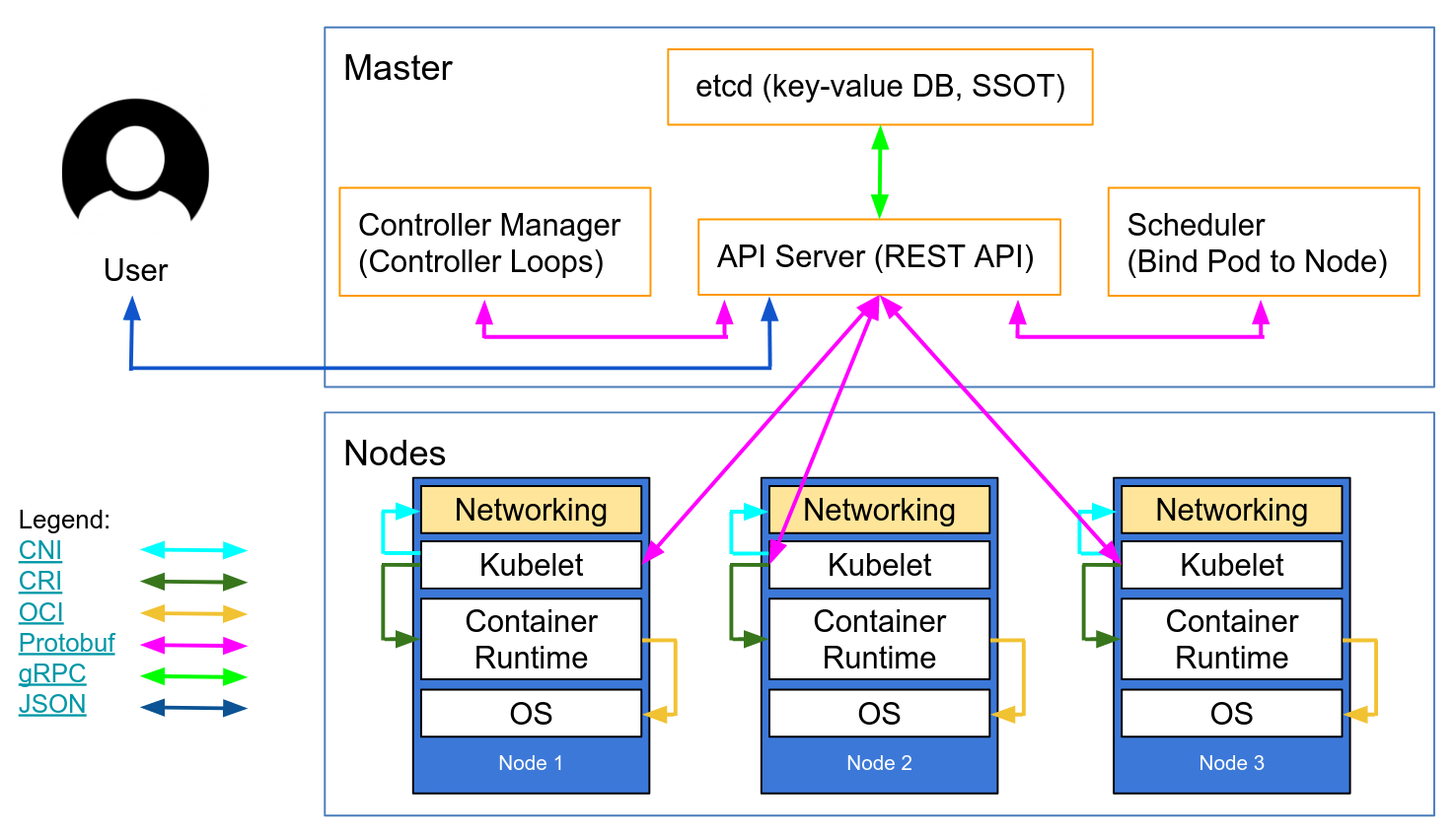
This network diagram by Lucas Käldström demonstrates some of the places TLS should ideally be applied: between every component on the master, and between the Kubelet and API server. Kelsey Hightower‘s canonical Kubernetes The Hard Way provides detailed manual instructions, as does etcd’s security model documentation.

Read more at Kubernetes.io

Google: Security Keys Neutralized Employee Phishing

Google has not had any of its 85,000+ employees successfully phished on their work-related accounts since early 2017, when it began requiring all employees to use physical Security Keys in place of passwords and one-time codes, the company told KrebsOnSecurity.


Security Keys are inexpensive USB-based devices that offer an alternative approach to two-factor authentication (2FA), which requires the user to log in to a Web site using something they know (the password) and something they have (e.g., a mobile device).

A Google spokesperson said Security Keys now form the basis of all account access at Google.

The basic idea behind two-factor authentication is that even if thieves manage to phish or steal your password, they still cannot log in to your account unless they also hack or possess that second factor.

Read more at KrebsOnSecurity