Home Blog Page 459

Linux Laptops Get a Boost from Hacker Board Projects

Recently, Linux desktop usage has grown from 2.14 percent to 3.23 percent according to NetMarketShare. Much of this increase appears to have come from Linux-based Chromebooks, which are likely undercounted due in part to their widespread use in schools.

Yet, there are signs of Linux desktop life beyond Google’s Chrome OS, which exists in a somewhat parallel universe to mainstream Linux. Ubuntu, for example, continues to expand into the mainstream, although at a grindingly slow pace. As with Chrome OS, most of the action is happening in lower end laptops, often emerging from hacker board projects. The newly shipping Olimex Teres-A64 and upcoming Reform laptop, for example, are based on open hardware and software. Two of the most popular new low-end Linux laptops — the newly revised Pi-top and Kano products — are hackable Raspberry Pi based kits aimed primarily at education.

On the high end, meanwhile, Purism is pushing the limits of open software with its Librem laptops, although the hardware is still closed. Finally, traditional Linux laptop dealers like System76 and ZaReason are now selling Linux-equipped laptops with the latest Intel 8th Generation “Coffee Lake” processors (see farther below).

Olimex Teres-A64

Earlier this month, Bulgaria-based Olimex, which is known for its community backed OLinuXino SBCs, launched an open source Teres-A64 laptop kit for 240 Euros ($284). The 11.6-inch laptop runs Ubuntu Mate on the same quad-core, Cortex-A53 Allwinner A64 used by the A64-OLinuXino SBC.

The highly modular Teres-A64, which also includes removable keyboard, I/O, and touchpad boards, features open schematics and CAD files so developers can customize add-on boards and other features. The laptop ships with 2GB RAM, 16GB eMMC, and a microSD slot. There’s a 1366 x 768-pixel eDP LCD, a full keyboard, mini-HDMI and USB ports, and a 9500mAh battery. There’s no Ethernet, but you get WiFi and Bluetooth.

MNT Reform project

The MNT Reform project, which was recently revealed by Liliputing, aims to build a similarly modular and open source laptop kit, in this case built on the NXP i.MX6. The i.MX6, which is underpowered, but well supported with open source software, was also used by the fully open source Novena laptop. The Novena was a hit on Crowd Supply back in 2014, but the last update, posted Jan. 2016, indicated the project was still struggling to fill its original orders.

The Reform project appears to have learned one lesson from Novena by making a simpler device. Still, this is a more advanced design than the Teres-A64, adding SATA, USB 3.0, and mini-PCIe expansion, among other extras. Like the Teres-A64, it has a modular design, letting you exchange the screen or remove the keyboard to swap boards.

The prototype’s mainboard, which supports up to 4GB of RAM, is built on the TinyRex Ultra module from Slovakia-based Fedeval. The TinyRex is not open source, but the developers are considering moving to Fedeval’s similarly i.MX6-based, but fully open OpenRex SBC, or expanding to the faster i.MX8.

The Reform integrates a Commodore 64 like clicky keyboard and old-school trackball. There’s a netbook-like 10-inch HD screen, a 120GB SATA SSD, and a 3,000 mAh battery. All these specs may change by the time the laptop goes on sale for $600 to $950. Meanwhile, the developers are attempting to include as many open source drivers and omit as many proprietary blobs as possible.

Raspberry Pi laptops: Pi-top and Kano

Not surprisingly, the Raspberry Pi has been the foundation for many Linux-based laptop projects. The two most popular commercial products are the Pi-top and Kano, both of which have been revised in recent weeks.

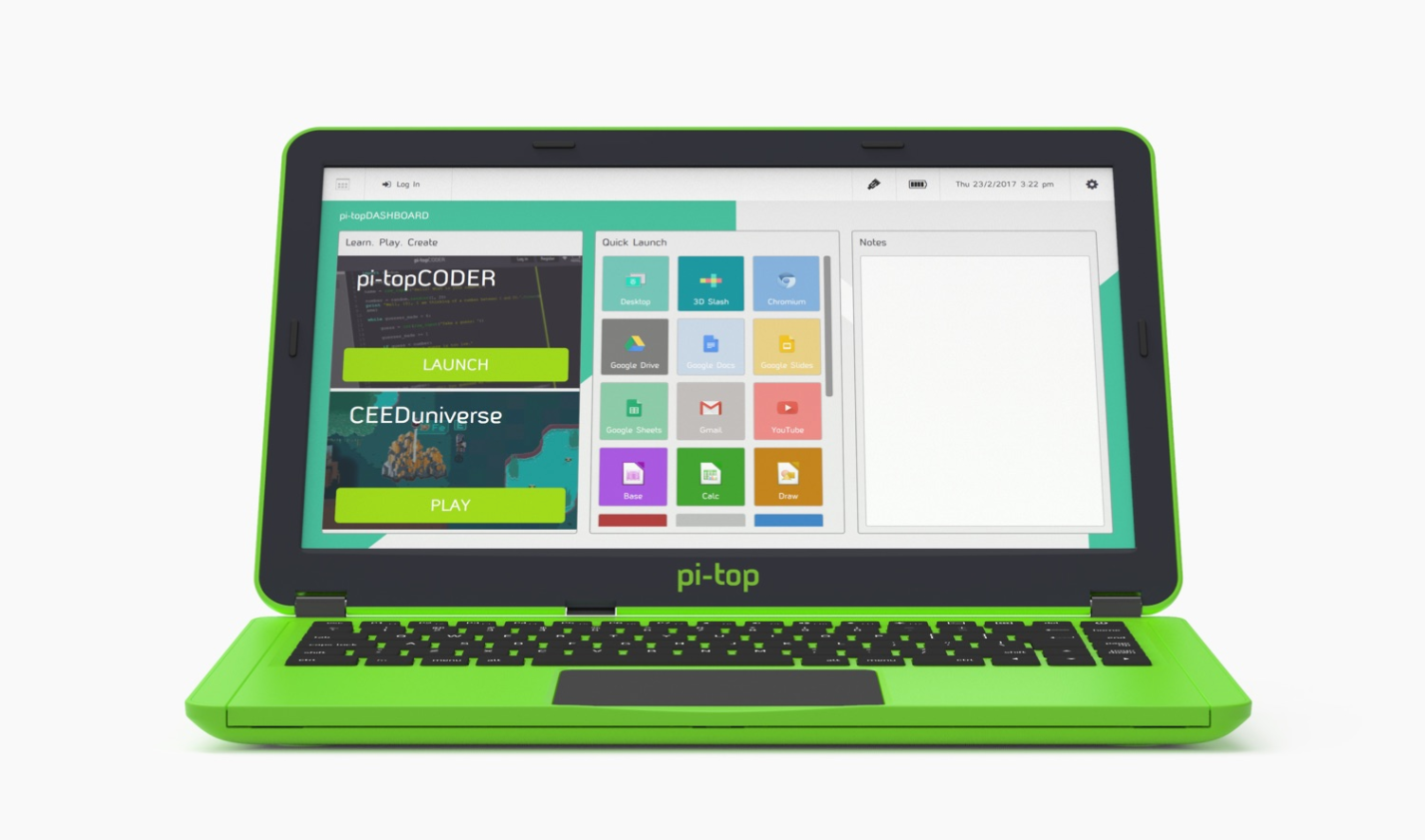
The $320 Pi-top upgrades the circa-2014, 13.3-inch laptop with a faster, Raspberry Pi 3 mainboard, a 14-inch HD screen, and a more modular design. The Pi-top has a slide-off keyboard that reveals a new cooling unit for the Pi and a DIY hacking space with a magnetic sliding rail. The kit includes a breadboard, motion sensor, LEDs, and a microphone.

The Pi-top exposes 10/100 Ethernet, 3x USB 2.0, and audio and power connections, and you can access the other RPi interfaces when the bay is open. Most of the hardware is not open source, but there’s an 8GB microSD card loaded with the Raspbian based Pi-topOS Polaris. The stack includes a Pi-topCoder Python environment, as well as Scratch and a coding game. Other software includes the Chromium browser, LibraOffice, and Minecraft Pi Edition.

The Pi-top competes with Kano’s educational-focused, Raspberry Pi 3 based Kano Computer Kit, although Kano is aiming at a younger audience. You can’t build a complete laptop, but the revised, $250 “Complete” kit adds a keyboard and detached 10.1-inch screen to the kit to give you something similar. You also get battery pack, USB hub, and a Debian based Kano OS augmented with educational software and a visual programming interface.

Librem 13 and 15

Before Purism successfully crowdfunded its Linux-based Librem 5 smartphone, and gained Nextcloud as a cloud partner, the company launched a highly regarded, Linux-driven Librem line of laptops. As with the phone, these are not fully open source products, but the Librem 11, 13, and 15 models are equipped with the same open PureOS Linux distro, and offer security and privacy controls which are generally attractive to the FOSS set.

The currently shipping models are the $1,399 and up Librem 13 and $1,599 and up Librem 15, which run on Intel’s dual-core, up to 3.1GHz Core i7-6500U “Skylake” processor. The CPU offers a relatively low 15W TDP, giving the laptops a claimed 7 to 9 hours of battery life.

The laptops ship with up to 16GB of DDR4, as well as SATA and M.2 slots for HDDs and SSDs. A second M.2 slot provides 802.11n WiFi. To add Ethernet, you need to use up one of the up to 5x (Librem 15) or 3x (Librem 13) USB ports. There’s also an HDMI port, 720p camera, and audio I/O.

Like the Librem phone, there are hardware kill switches, in this case for WiFi, mic, and camera. Purism has also avoided using proprietary chips that could be used for spying.

Linux laptops move to Coffee Lake

Most Linux desktop users buy bare-bones laptops from major vendors and install their own Linux, or dual-boot or erase Windows. For an easier installation, however, you can buy x86-based systems with pre-installed Ubuntu from Dell, and increasingly from other major vendors like Acer, Asus, and Lenovo. Meanwhile, System76, ZaReason, and other smaller resellers have long offered more customized Linux laptops.

Until fairly recently, Linux buyers had to wait for many months to get the latest Intel chips, but now you can get them when the Windows models come out. System76, for example, is now selling the 14.1-inch Lemur and 13-inch Galago Pro with the latest 8th Gen Kaby Lake Refresh chips, also known as “Coffee Lake.” ZaReason has introduced a 14-inch UltraLap 5440, and Dell is expected to release a Linux-driven Coffee Lake laptop soon.

Coffee Lake is yet another 14nm chip like Broadwell, Skylake, and Kaby Lake, with relatively modest performance and power efficiency improvements. However, the U-series chips used in the new laptops offer slightly faster quad- instead of dual-core designs with the same price and 15W TDP, giving you greater performance and power efficiency when running hyperthread-intensive applications. 

The System76 and ZaReason laptops run Ubuntu on either 7th Gen chips or the up to 4GHz Coffee Lake generation Core i7-8550U. The i7-8550U adds $179 to the cost of the Lemur, or $928 in an otherwise minimal configuration, and $219 to the cost of the Galago Pro, or $1,178. The ZaReason UltraLap 5440 goes for $998 with the $198 i7-8550U option. 

The ability to buy laptops with the latest Intel CPUs certainly adds to the allure of high-end Linux laptops. Yet, as with Chrome OS, most of the growth will likely come in lower-cost laptops, in many cases based on community backed boards. Their modular, and in some cases, open source, nature not only appeals to hackers, but also to those looking to extend the life of their laptops with the latest technology.


2017 Linux Kernel Report Highlights Developers’ Roles and Accelerating Pace of Change

Roughly 15,600 developers from more than 1,400 companies have contributed to the Linux kernel since 2005, when the adoption of Git made detailed tracking possible, according to the 2017 Linux Kernel Development Report released at the Linux Kernel Summit in Prague.

This report — co-authored by Jonathan Corbet, Linux kernel developer and editor of LWN.net, and Greg Kroah-Hartman, Linux kernel maintainer and Linux Foundation fellow — illustrates the kernel development process and highlights the work of some of the dedicated developers who are creating the largest collaborative project in the history of computing.

Read more at The Linux Foundation

Linux Foundation Creates a Framework for Sharing Open Data

The Linux Foundation wants to open up the use of data in much the same way it has helped make open-source software a technology force to be reckoned with.

Announced at the Open Source Summit in Prague Monday, the new Community Data License Agreement is designed to cover the use of nonproprietary data, Linux Foundation Director Jim Zemlin said. Although proprietary data sets owned by the likes of Google Inc., Facebook Inc. and other large internet and cloud companies gives them a large advantage in new analytics and artificial intelligence application, open data sets could start to level the playing field.

Read more at SiliconAngle

4 Steps to Solving Any Software Problem

That’s why, whenever I’m helping beginners learn to code, I try to walk them through the process of solving problems in the same way I would at my job. I’d like to articulate those steps here, both for software newbies who are overwhelmed by this whole “coding” thing, and to see how it compares to the process other experienced developers use.

In general, I believe the process of solving a software development problem can be divided into four steps:

  1. Identify the problem
  2. Gather information
  3. Iterate potential solutions
  4. Test your solution

Read more at O’Reilly

OPNFV Euphrates Release Addresses Open-Source NFV Testing, Interoperability

OPNFV has released OPNFV Euphrates, the project’s fifth platform release, focused on enabling service providers to accelerate network functions virtualization (NFV) transformation via open-source NFV. 

A key element of the new release is that OPNFV Euphrates delivers Kubernetes integration as well as enhanced cross-community continuous integration (XCI) and new carrier-grade features such as increased virtualized networks visibility.

These elements are enabled via Euphrates’ platform of pretested, tuned, interoperable open-source NFV components. OPNFV says these components facilitate multiple use cases such as VNF onboarding, network service testing, data plane acceleration, NFVI/VIM validation, MANO qualification, test automation and creation of DevOps methodologies and operational best practices.

Read more at Fierce Telecom

How to Manage Casual Contributors to Open Source Projects

Increasingly, people want to contribute to projects casually—when they want to, rather than adhering to a schedule. This is part of a broader trend of “episodic volunteering” noted by a wide range of volunteer organizations and governments. This has been attributed not only to changes in the workforce, which leave fewer people able to volunteer with less spare time to share, but also to changes in how people perceive the act of volunteering. It is no longer seen as a communal obligation, rather as a conditional activity in which the volunteer also receives benefits. Moreover, distributed revision-control systems and the network effects of GitHub, which standardize the process of making a contribution, make it easier for people to contribute casually to free/libre/open source software (FLOSS) projects.

Although it may be tempting for communities to focus on habitual contributors and newcomers who may become habitual, there are several reasons to devote attention to casual contributors. First, research has shown that casual code contributors deliver benefits to a FLOSS project.

Read more at OpenSource.com

Flexibility, Choice, and Open Source Drive Oracle’s Cloud Focus

At the recent Open Source Summit in Los Angeles, Oracle made some major announcements, including joining the Cloud Native Computing Foundation (CNCF), in an effort to help ease cloud native and container adoption for the enterprise. Additionally, the company has released Kubernetes on Oracle Linux and open sourced a Terraform Kubernetes Installer for the Oracle Cloud Infrastructure. Linux.com talked with Bob Quillin, Vice President Developer Relations at Oracle, to learn more.

Linux.com: You recently joined the Cloud Native Computing Foundation (CNCF) as a Platinum Member. Can you tell us about this commitment and how it came about?

Bob Quillin: Oracle works with some of the most prominent and innovative enterprises in the world – from startups all the way up to Fortune 50 companies. Each and every one of these companies is embracing software as their engine for digital transformation to delight their customers in new ways, beat old competitors and stave off new ones, reach out to new markets, and build enduring business advantage. This translates directly to focusing on new and innovative ways to increase developer velocity and agility to fuel this engine of change.

Bob Quillin, Vice President Developer Relations

Open, container native technologies have become the tools of the trade for these developers who need to move fast, build for the cloud, but retain the flexibility to run where the business or workloads require. They are relying on open, cloud-neutral, and community-driven container-native software stacks that enable them to avoid cloud lock-in and to run in a true hybrid mode – so they can use the same stack in the cloud – for that matter on any cloud – as they run on premise. CNCF shares Oracle’s commitment and is the leading hub for this community effort – thus a natural fit for us to join up with!

Linux.com: Why is open source important to Oracle?

Quillin: Developer ecosystems grow and thrive in a vibrant and supported community – something Oracle believes in, has invested in, and continues to invest in with projects including EE4J, OpenJDK, MySQL, GlassFish, Java, Linux, PHP, Apache, Eclipse, Berkeley DB, NetBeans, VirtualBox, and Xen. This required significant investment in resources for developing, testing, optimizing, and supporting these open source technologies. As a Platinum member of the Linux Foundation and a member since day one, Oracle participates in a number of other Linux Foundation projects, including the Open Container Initiative (OCI), Xen Project, Hyplerledger, Automotive Grade Linux, and the R Consortium.

We are also committed to a number of CNCF technologies – Kubernetes in particular – but more broadly we are also leveraging many other CNCF projects including Prometheus, Envoy, gRPC, and OpenTracing. And this commitment involves engineers and contributions – something many describe as “earning your stripes” or to do the work by “chopping wood and carrying water.”  This is also part of being good open source citizens by contributing to the Kubernetes project and related initiatives – from the main project to areas including security, federation, network, testing, and service catalog.

Linux.com: Another big announcement was the release of Kubernetes on Oracle Linux. Can you explain what that means for developers?

Quillin: Oracle Linux now includes Kubernetes as part of Oracle Container Services for use with Kubernetes, which is part of Oracle Linux 7 and can be used for any environment: public cloud, private cloud, and on-premise. It simplifies Kubernetes setup and deployment and is designed to easily build both the master controller as well as worker nodes, to deliver maximum scalability across a Kubernetes cluster.

Linux.com: How is Oracle itself using Kubernetes? What are some benefits? Challenges?

Quillin: Oracle has announced a new Container Native Application Development Platform with three major parts: (1) managed Kubernetes service, (2) continuous integration/deployment CI/CD, and (3) private registry service, delivered together in a frictionless, integrated developer experience. The Managed Kubernetes service – named Oracle Container Engine – benefits users by helping them create and manage Kubernetes clusters for secure, high-performance, high-availability container deployment on the Oracle Cloud Infrastructure bare metal. From our own experiences, managing and maintaining a production Kubernetes cluster is difficult, so we built a HA, managed Kubernetes control plane on bare metal that manages and maintains that for you while providing enterprise grade performance and security on our cloud infrastructure.

Linux.com: What are some interesting trends you see around Kubernetes and/or cloud adoption and how is Oracle contributing to those?

Quillin: The first major trend we see is a growing adoption wave for open, cloud-neutral, and community-driven container-native technology stacks that avoid cloud lock-in. Why?  Developers and development teams are currently wedged between two bad choices. Either they have to choose an opinionated application development stack from their legacy application platform vendor – which looks “open” at first glance but in reality, consists of closed, forked, and proprietary components – well-integrated, yes, but far from open and cloud neutral. The second choice is a mind-boggling menu of unintegrated, discrete and proprietary components from their favorite cloud provider – thus signing up for layers of DIY integration and administration and slowly getting locked into that cloud vendor drip-by-drip.

What they want instead is the flexibility and choice to run in a true hybrid mode – using the same stack in the cloud – any cloud – as they run on-premise. That has driven our work with CNCF and focused our contributions in areas that help move container and Kubernetes workloads to production including the main project, security, testing, federation, conformance, and service catalog.

A second major trend involves serverless technology and helping to drive a more open, community-driven serverless project. Serverless is a category of cloud services that raises the abstraction level so that developers never think about servers, VMs, and other IaaS components. This could be the next logical evolutionary cloud model – as virtualization disintermediated physical servers and containers are disintermediating virtualization, can serverless disintermediate containers? But as with the rest of the new stack, developers are looking for a serverless approach that is open source, can run anywhere, and is container native. To that end, Oracle recently open-sourced Fn, an open serverless developer platform project available at http://fnproject.io. Fn is open (cloud neutral with no lock-in), can run locally on your laptop or on any cloud, is container native, and provides polyglot language support (including Java, Go, Ruby, Python, PHP, Rust, .NET Core, and Node.js with AWS Lambda compatibility). We believe serverless will eventually lead to a new, more efficient cloud development and economic model and this is just the beginning of that evolution.

To learn more and stay up to date on the latest developments, please visit the Oracle Developers Blog.

Oracle is a Platinum member of The Linux Foundation.

CNCF Brings Security to the Cloud Native Stack with Notary, TUF Adoption

The Cloud Native Computing Foundation continues to vigorously build its portfolio of open source cloud-native technologies. CNCF’s Technical Oversight Committee voted to accept both the Docker-developed Notary trusted content framework and the specification Notary was built on, TUF, as the 13th and 14th hosted projects, respectively.

The organizations announced the new members at the Open Source Summit Europe, being held this week in Prague.

Released by Docker in 2015, Notary manages the metadata needed to ensure the integrity of container image updates, even those on untrusted networks and linked to compromised registries. The software allows developers to sign applications at every step of development, blocking malicious content from being injected into the workflow.

Read more at The New Stack

Automation within the Developer Experience Team

Many companies that provide an API also include SDKs. At SendGrid, such SDKs send several billions of emails monthly through SendGrid’s Web API. Recently, SendGrid re-built their seven open source SDKs (PythonPHPC#RubyNode.jsJava, and Go) to support 233 API endpoints, a process which I’ll describe in my upcoming talk at APIStrat in Portland.

Fortunately, when we started this undertaking, Matt Bernier had just launched our Developer Experience team, covering our open source documentation and libraries. I joined the team as the first Developer Experience Engineer, with a charter to manage the open source libraries in order to ensure a fast and painless integration with every API SendGrid produces.

Our first task on the Developer Engineering side was to update all of the core SendGrid SDKs, across all seven programming languages, 

Read more at The Linux Foundation

Top 5 Linux Pain Points in 2017

As I discussed in my 2016 Open Source Yearbook article on troubleshooting tips for the 5 most common Linux issues, Linux installs and operates as expected for most users, but some inevitably run into problems. How have things changed over the past year in this regard? Once again, I posted the question to LinuxQuestions.org and on social media, and analyzed LQ posting patterns. Here are the updated results.

1. Documentation

Documentation, or lack thereof, was one of the largest pain points this year. Although open source methodology produces superior code, the importance of producing quality documentation has only recently come to the forefront. As more non-technical users adopt Linux and open source software, the quality and quantity of documentation will become paramount. If you’ve wanted to contribute to an open source project but don’t feel you are technical enough to offer code, improving documentation is a great way to participate.

Read more at OpenSource.com