
In his LinuxCon Europe keynote, Dan Kohn, Executive Director of the Cloud Native Computing Foundation (CNCF), provided with a brief history of the cloud and how CNCF fits with where we are now
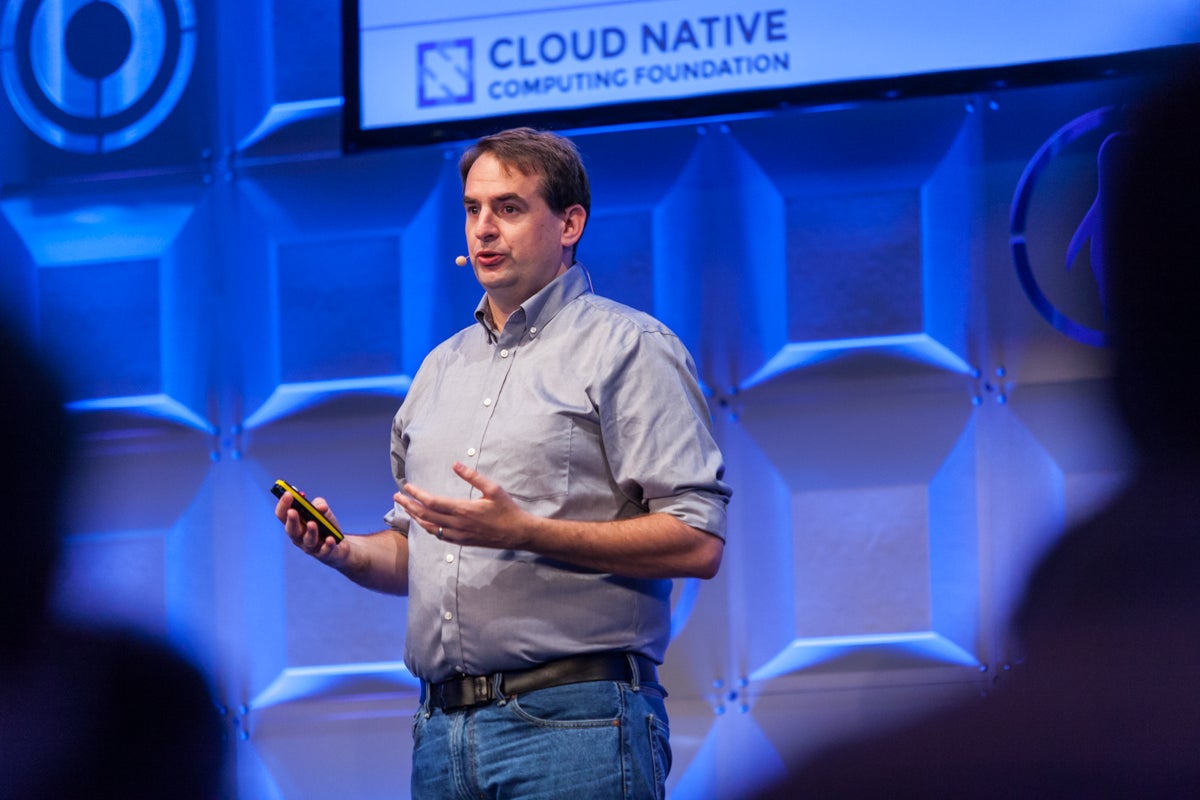
How we use computing infrastructure has changed drastically over the past two decades, moving from buying physical servers to having tools and technologies that make it easy for companies and individual developers to deploy software in the cloud. In his LinuxCon Europe keynote, Dan Kohn, Executive Director of the Cloud Native Computing Foundation (CNCF), provided us with a brief history of the cloud and how CNCF fits with where we are now.
Kohn starts with the year 2000, when you had to buy physical servers before you could deploy a new application, and if you needed more capacity, you bought more servers. In 2001, VMware “had the relatively brilliant idea of virtualizing that server so that each application could have it’s own virtual environment and you could have multiple different applications sharing the same physical server,” Kohn said. Moving on to 2006, Amazon popularized the idea that you could rent your servers by the hour, instead of buying them, and you don’t need to buy more capacity until you actually need it, which can save companies quite a bit of money. In 2009, Heroku made it easy for developers to deploy applications “without having to think of all the details about operating systems and versioning and keeping things up to date, and you didn’t necessarily need to hire the ops staff,” Kohn says.
Next, Kohn shifts from talking about proprietary technologies that shaped the history of the cloud and on to open source solutions, starting with OpenStack in 2010, which provides open source Infrastructure as a Service (IaaS) solutions based on VMs that compete with AWS and VMware. Cloud Foundry came along in 2011 to compete with Heroku to provide an open source Platform as a Service (PaaS) using containers. Jumping to 2013, Docker emerged to take technologies that have been around for years and combine them with better user interfaces and marketing, thus bringing containers to the masses.
This brings us up to the present with the 2015 formation of the Cloud Native Computing Foundation (CNCF). Kohn says that “cloud native computing uses an open source software stack to segment applications into microservices, packaging each part into its own container and dynamically orchestrating those containers to optimize resource utilization.” The value propositions from cloud native computing include isolation, no lock-in, unlimited scalability, agility and maintainability, improved efficiency and resource utilization, and resiliency.
To learn more about how you can host your project at CNCF or get more involved in the project, you can visit the CNCF website and watch the video of Kohn’s entire keynote presentation.
Interested in speaking at Open Source Summit North America on September 11 – 13? Submit your proposal by May 6, 2017. Submit now>>
Not interested in speaking but want to attend? Linux.com readers can register now with the discount code, LINUXRD5, for 5% off the all-access attendee registration price. Register now to save over $300!
The Zephyr Project is still a babe in the technological woods, so it’s only fitting that the open source real-time operating system is driving an innovative wearables solution that aims to improve healthcare for infants. At the recent Embedded Linux Conference Europe, Teresa Cauvel, CTO and co-founder of Chicago-based neonatal health technology startup Neopenda, explained how her company built a neonatal monitoring bracelet for hospitals in the developing world using an Intel Curie module running Zephyr. The complete talk, called “Leveraging IoT Biometrics and Zephyr RTOS for Neonatal Nursing in Uganda” can be seen in the video link below.
Cauvel and co-founder and CEO Sona Shah came up with the idea for Neopenda as graduate students in biomedical engineering at Columbia University. The partners hoped that a new U.N. Sustainable Development goal for ending preventable deaths of under 5-year-olds by 2030 would provide numerous opportunities for technological innovation. “With IoT we can reimagine what’s possible in global health,” Cauvel told the ELCE audience.
Cauvel and Shah decided to develop a wearable for neonatal patients in the first 28 days after birth. They focused on developing countries where 98 percent of preventable neonatal deaths occur and where every year 46 million newborns have complications at or around birth that require special care and treatment. Some 3 million newborns die from these complications. However, 80 percent of the victims die from preventable causes or could have saved by affordable treatments. “Reducing infant mortality is a solvable problem,” said Cauvel.
The problem is being attacked on several levels, from improving transportation to hospitals to developing better treatments for pre-term birth, birth asphyxia, and severe infections. Neopenda is focusing on improving pediatric hospital care. When researching the problem in Uganda in 2015 with the help of the Uganda Paediatric Association, the co-founders discovered there were large unmet needs in monitoring and diagnosis.
“Early detection of distress is really key in newborn care,” said Cauvel. “We want to help staff better manage a large quantity of patients. There are so many critically ill newborns that need care and not nearly enough nurses, doctors, equipment, and supplies. Typically, you might see two nurses responsible for 50 to 75 babies. Standard equipment like vital signs monitors is often prohibitively expensive.”
In early 2016, the partners founded Neopenda with the help of a Kickstarter campaign, as well as grants from Cisco and Vodafone. They started working on a prototype for a wearable vital signs monitor designed for newborns in low resource hospitals. The wearable, which is due to enter trials in Uganda in 2017, is strapped to infants’ foreheads, and measures heart rate, respiratory rate, blood oxygen saturation, and temperature.
“These are all of critically important vitals to track in newborns,” said Cauvel. “They show danger signs when conditions are changing, and help monitor health status.”
The biometrics devices wirelessly communicate to the central monitor, which can be a laptop, tablet, or smartphone, where results are displayed with visualizations. “Health workers can view the status of all the babies and be alerted in real time when newborns are in distress,” said Cauvel. “It helps the staff triage while also providing more detailed information to guide treatment and diagnosis.”
In choosing a technology platform, Cauvel and Shah had several key requirements: The device needed to run on batteries using minimum power, and be rugged enough to resist dust, heat, humidity, and wear and tear. It needed good support for wireless and sensor technology, and be sufficiently scalable to support larger hospitals as well as clinics. It also had to be highly affordable. Neopenda aims to reduce the cost to about $50 per wearable, which is very low for medical monitoring devices.
The initial prototype was built around an Arduino Uno, followed by a model that used the Uno’s ATMega328 MCU breadboarded with WiFi and the most essential components. Power considerations led quickly to swapping WiFi for Bluetooth Low Energy (BLE), which also raised fewer questions about radiation risks.
The current iteration uses the Intel Curie module, which runs Zephyr on an x86-compatible Intel Quark SE CPU. The dime-sized Curie offers the advantage of being smaller, more affordable, and more power efficient than an Arduino. It also furnishes an ARC EM4-based sensor subsystem and a built-in BLE radio, and its 80KB of SRAM makes it more suitable for complex BLE applications.
The Curie’s interfaces between these components and the Quark SE saved a lot of time, as did the availability of a Curie-equipped Intel Arduino 101 board, used for prototyping. Meanwhile, the Curie’s pattern matching engine and 6-axis sensor may hold potential for future applications, said Cauvel.
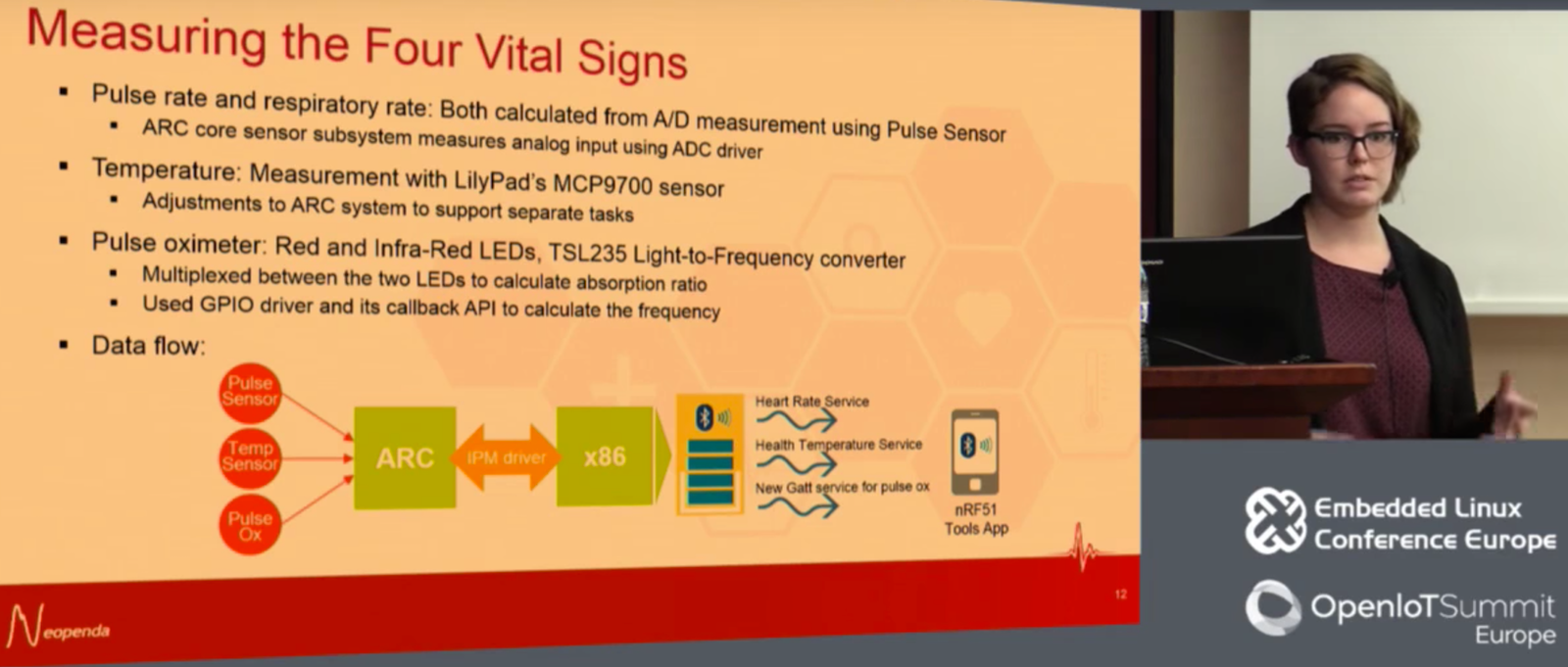
The ARC subsystem controls the Curie’s 12-bit ADC, which “enables us to make accurate DSP measurements,” said Cauvel. The device incorporates a LilyPad MCP9700 temperature sensor, as well as a pulse sensor from pulsesensor.com. Neopenda developed an algorithm that derives the respiratory rate from the pulse rate.
For pulse oximetry, the developers breadboarded a sensor using red and infrared LEDs with a TSL235 light-to-frequency converter. To generate a blood oxygen saturation measurement from this setup, “we multiplexed between the two LEDs to calculate the absorption ratio, and used the GPIO driver and its callback API to calculate frequency,” explained Cauvel.
Zephyr played a key role in the success of the wearable prototype, thanks to its modularity, support for constrained systems, and more advanced capabilities compared to the Arduino IDE. “Zephyr turned out to be a big step up from Arduino because it supports the ARC core, the DSP subsystem, and the x86 host concurrently,” said Cauvel. “Zephyr also supports multi-fibers and interrupts for complex sensor manipulation and communication so it can cleanly handle the data coming in from different sensors simultaneously.”
The developers also benefited from “Zephyr’s rich support for drivers and sensors, as well as sample code and a reliable SDK with cross tool chain,” said Cauvel. “There was already a BSP supporting the Arduino 101 with tool chain to compile for the DSP subsystem in the ARC processor and the host processor. This enabled quick installation of the compiler and tool chain in just a couple of hours, and with the help of the Eclipse IDE, we were able to get the GDB debugger working with DSP and host.”
Cauvel went into more detail about various past and current modifications of each sensor algorithm. Currently, most sensor readings are close to the reliability range of expensive commercial sensors, except for respiratory. “We may need to add Fourier transforms to get better accuracy on respiratory,” said Cauvel. The company has also developed an Android app that interprets the BLE signals and displays data and visualizations.
Cauvel is confident the device will be ready for trials in Uganda in 2017. Neopenda is working on getting a CE mark for certification, and they will need to get approval of the government of Uganda. The plan is to expand in East Africa and beyond. Soon, Cauvel hopes to give thousands of newborns in low resource settings “the healthy start they deserve.”
Watch the complete presentation:
Embedded Linux Conference + OpenIoT Summit North America will be held on February 21 – 23, 2017 in Portland, Oregon. Check out over 130 sessions on the Linux kernel, embedded development & systems, and the latest on the open Internet of Things.
Linux.com readers can register now with the discount code, LINUXRD5, for 5% off the attendee registration price. Register now>>