
Home Blog Page 660

Can Node.js Scale? Ask the Team at Alibaba

Alibaba is arguably the world’s biggest online commerce company. It serves millions of users and hosts millions of merchants and businesses. As of August 2016, Alibaba had 434 million users with 427 million active mobile monthly users. During this year’s Singles Day, which happened on November 11 and is one of the (if not the) biggest online sales events, Alibaba registered $1 billion in sales in its first five minutes.

So when you are talking about scaling a site and its properties for users’ demands, Alibaba tops the list. And how does it scale so quickly? One of the technologies that helps the company is the versatile applications platform, Node.js.

In advance of Node.js Interactive, to be held Nov. 29 through Dec. 2 in Austin, we talked with Joyee Cheung, a developer at Alibaba, about Alibaba’s instrumentation of Node.js; why they chose to use Node.js; and the challenges that they faced with trying to scale Node.js on the server side.

Linux.com: How is Alibaba using Node.js? Why did it decide to use Node.js as a technology?

Joyee Cheung: In Alibaba, we use Node.js for both frontend tool chains and backend servers. For frontend stuff, it is just a natural transition, since Node.js has become the de-facto platform for frontend tooling. But for backend applications, Node.js has come a long way in Alibaba.

We started to adopt Node.js since 2011, and used it as a frontend in the backend – to serve data or render web pages. By then most of Alibaba’s business was still about E-commerce, so the applications were bound to change frequently to meet the demands of sales, marketing and operation. We used Java for most of our applications, which was stable and rigorous, tailored for the enterprise, but it came with the cost of productivity. Meanwhile, the view layer became deeply coupled with other layers on the server side, which made the code harder and harder to maintain. During that time, Rich Internet application and Single Page Applications were on the rise, but we were still limited if the innovation just stayed on the client side. Many improvements to the user experience could not be done without modifications to both sides.

Then we developed the idea of separation of frontend from backend, meaning we take away the burden of frontend-related responsibilities (routing, rendering, serving data through HTTP API, etc.) out of the traditional backend applications and give them to applications dedicated to these kinds of stuff.

The backend applications can keep focusing on business logic and use a more stable and rigorous technology like Java, because they are less subject to change. They provide reliable services via RPC’s called by the frontend-backend applications. These frontend-backend applications can then focus on user experience and better adjust to the changes of design, product, and operation with a more flexible language.

By giving frontend developers the access to our faster and trusted internal network, we can also reduce the overhead of network requests and keep the user state secure behind a set of more restricted HTTP APIs. And nothing is more suitable for this kind of job than Node.js, because it is designed for efficient I/O, quick to start up and deploy, and uses a flexible language in which most frontend developers are already fluent. The separation of frontend and backend on the server side is actually the separation of concern, where we use different technologies to meet the needs of different expertise and handle different frequencies of changes.

It was not an easy ride, however. Many people questioned if Node.js was mature enough for enterprise applications, because it lacked the tooling and infrastructure we had with Java. And because Alibaba is a huge group with many subsidiaries, each with a slightly different technology stack, we needed to unite the effort throughout the group to make this work. To fit Node.js into our architecture and environment, we’ve developed our own npm registry and client (cnpm), customized web frameworks (Egg and Taobao Midway), monitoring and profiling solution (alinode, which I’m working on and is offered to external customers in the Cloud), and numerous middleware that hook into our infrastructure. We also give back to the community by developing cnodejs.org (a Chinese forum for Node.js), having people contributing to Koa.js (which most of our frameworks rely on) and Node.js core(we have three collaborators at the moment), and open sourcing a lot of node modules (most of them are under node-modules and ali-sdk).

Now Node.js runs on thousands of machines in our clusters, handling a moderate amount of traffic across different subsidiaries of Alibaba. It has proven itself after several double-11 sales. We expect it to receive more adoption in the next few years.

Linux.com: What prompted you to analyze the V8 garbage collection logs?

Joyee Cheung: When using Node.js at scale on the server side, garbage collection quickly becomes more important to performance than it is on the client side, since server-side applications tend to run much longer and handle more data than average client-side applications.

When the garbage collector is not working properly with the application, the CPU usage could go up and hurt responsiveness, the memory might not be reclaimed in time and other processes could be affected.

Even when the garbage collector is doing a good job, developers can make mistakes that mislead the garbage collector and result in memory leaks. V8 and Chromium provide tools to analyze the heap and memory allocations, but they don’t reveal the whole picture, especially when it comes to garbage collection.

Luckily, V8 provides garbage collection logs for us (though not documented), and sometimes these logs can shed some light on problems that other tools can’t help us with. Thanks to the LTS plan of Node.js, the format of the garbage collection logs is very stable throughout a LTS version. So now we can put the GC logs into our box of tricks.

Linux.com: After analysis, what performance problems did you discover? How did you solve the problems you encountered?

Joyee Cheung: We have discovered some common causes of performance issues related to GC: inappropriate caching strategies, excessive deep clones, some particular uses of closures, bugs in templating engines, to name a few.

As a team offering performance management solutions, the problems we analyze usually come from other teams (both inside and outside Alibaba), so we need to work together with them to fix the problems. For external clients, we can give a rough direction, since most of the times we cannot access the code base. Things usually get clearer after a few rounds of Q&A.

For internal clients, especially for those who work on infrastructures, we can usually access at least part of the codebase and are usually more familiar with their business logic, thus giving more suggestions.

We provide a platform for monitoring the performance of Node.js applications down to the core, including garbage collections. So after the application is modified and redeployed, we usually ask our clients to check if the statistics they see on our platform goes back to normal. If it is hard to tell by just looking at the figures, we will ask them to turn on the GC log for a few minutes and visualize it using our solution to see if the pattern of the problem has gone.

Linux.com: How can people take what Alibaba did and implement it? Are there certain environments that might find this more useful?

Joyee Cheung:  We plan to open source our parser (and possibly the visualization) for the garbage collection logs in the near future. We have also posted a few articles about our experiences with them on our blog (we plan to translate them into English as part of the documentation).

These tools are more useful to long-running server-side applications that handle at least a fair amount of traffic, especially those who do a lot of serialization/deserialization and data transformation.

View the full schedule to learn more about this marquee event for Node.js developers, companies that rely on Node.js, and vendors. Or register now for Node.js Interactive.
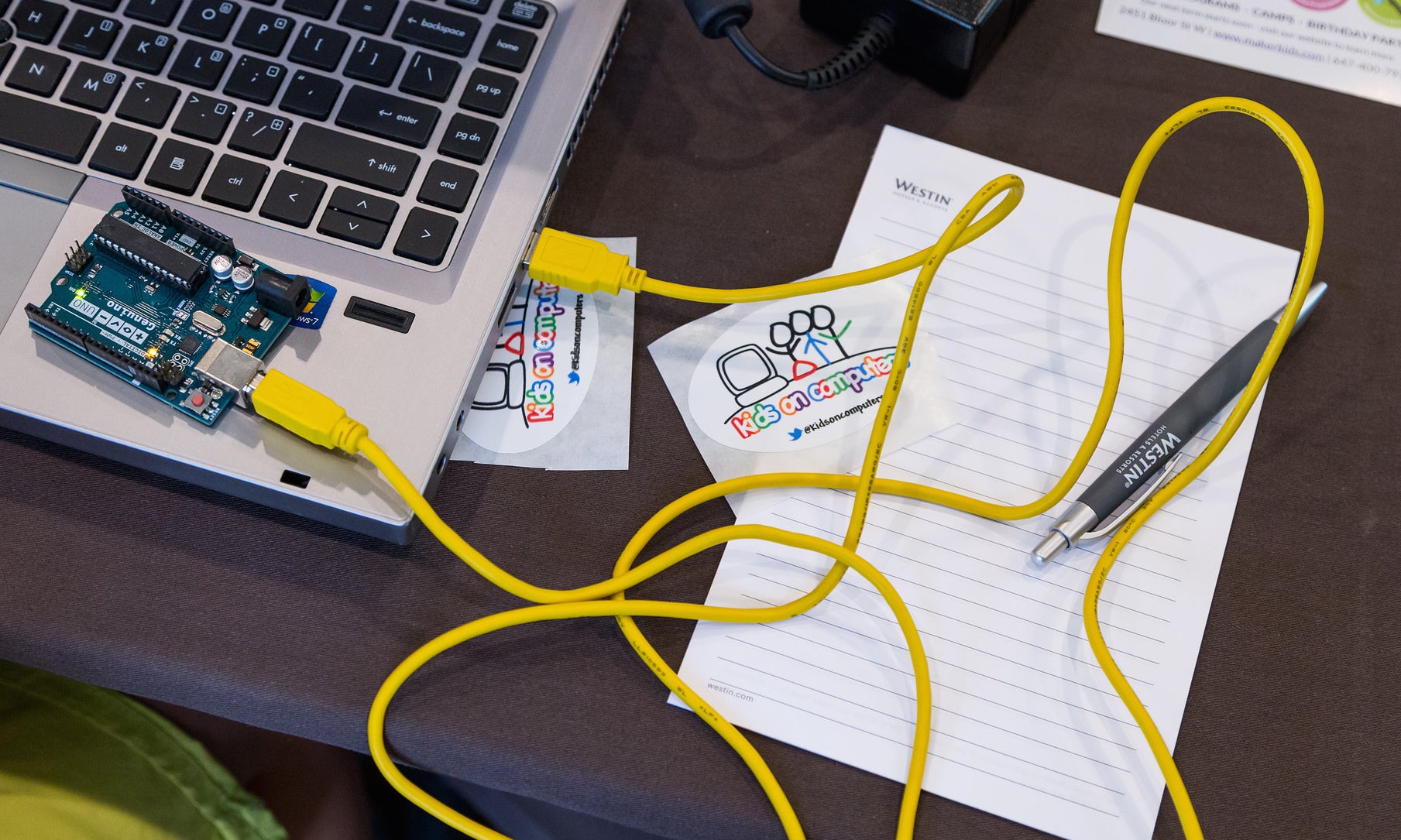
Kids Day Out: From Curiosity to Creativity

This year at LinuxCon North America in Toronto, The Linux Foundation partnered with MakerKids and Kids on Computers to organize a day-long event focused on getting school-aged children interested in learning more about computer programming. The Kids Day workshops included projects around Linux, Arduino, robots, and more.

“Kids on Computers has participated at SCALE and OSCON in years past, but this was our first time at LinuxCon. We do lot of hands-on training with students, teachers, and communities where we install computer labs (we have 12 in Mexico!), but this was our very first conference-based workshop. We are excited to see our Linux Foundation partnership grow and very much appreciated the opportunity to be at LinuxCon and conduct this workshop,” said  Avni Khatri, President of Kids on Computers.

Kid’s talk: The future is open

I talked to some of the children and their parents participating in the event. Here, I am using only their first names to protect their privacy.

“It was a great opportunity for me to bring my daughter to work and expose her a little with what I do. It’s an excellent workshop that the Linux Foundation has come up along with LinuxCon,” said Bryan, an engineer with EMC.

His 9-year-old daughter, Adele, said that she has been using a computer forever. And she uses Linux, specifically Gentoo Linux. She uses it for playing games, researching for school, and for finding games, she told me. Adele and her dad also enjoy playing games that involve some coding.

Bryan said that, in his opinion, you should expose your kids to all kinds of things and find out what they like, and as soon as they can read, allow them to program or type on the keyboard. And if they like it, they like it. Adele was certainly excited about the workshop and said she had a lot fun.

Sean was also attending the event and brought his two kids, Matthias (11) and Naomi (13). Matthias uses his computer at home to play games, and he has done some programming in the school library and has participated in the Hour Of Code program. Naomi is a Chromebook and Android user and has done the Genius Hour program. Compared to her brother, she was much more excited about the workshop.

Sean said that he brought his children so they could enjoy the wider world of Linux and open source ecosystem and see what the nature of collaboration development is all about. He added that during the workshop, they would mostly be doing very basic, low-level stuff and get initial exposure to Linux. “I am hoping they will have some fun with Arduino and some of the whole maker culture stuff,” said Sean.

Kaden is 11 and uses a computer at home to do research for school projects and to play games. He hasn’t done any programming yet, but he came to the workshop to learn more about computers and learn how they work. His dad is a software engineer at IBM, who saw a great opportunity in bringing his son to the event. However, he doesn’t believe in pushing his son to learn anything about computers. “I think it’s a natural thing because he already has a lot of video games at home, so it’s up to him how he likes the programming and Linux or open source. All these concepts are new to him, so we will see.”

Khatri said 13 kids registered and 19 kids showed up for the workshop. “It was exciting to see so much enthusiasm around LinuxCon’s first ever Kids Day, the workshop, and to see kids with engaged parents and older siblings working on the workshop activities,” said Khatri.

It’s not child’s play

It was a busy day for children. During the workshop kids learned how to do a Linux install where they tried Ubermix that’s a fork of Ubuntu with a turn-key 5 minute installation.

They also learned how to install software on Linux using Arduino IDE + Ardublock in preparation for the afternoon workshop with MakerKids. Graham from MakerKids brought over the Arduinos in the morning so the kids could test them.

The children also learned about networking. Tim Moody of Unleash Kids brought an Intel NUC with Internet in a Box (IIAB) installed and taught this portion. “The kids connected to the IIAB access point, accessed content and then used the local network to ping each other, SSH into each other’s machines and SCP files,” said Khatri.

The children also did some scratch programming where they learned to use Scratch (for beginners) and write their name (for folks who already knew how to use Scratch).

According to Khatri, “The participants who attended the workshop were much more experienced than the kids we usually work with in Kids on Computers. They knew how to use a computer and some of them had used Scratch before as well. From what I could tell, none of them had installed Linux on a computer before or were very familiar with networking. Many were also new to Arduino and Arduino programming.”

Do we need such workshops?

These days kids are exposed to computers at a very early age. That’s a good and bad situation. It’s good in the sense that the next generation is getting comfortable with technologies that will be at the core of their lives, but most of these products are dumbed down closed source technologies that erect a wall between how things work and curious minds, locking them out of the immense knowledge of how things work. Thus, projects like Kids on Computers become even more important: These efforts can transform kids from consumers to creators.

“Many kids today have access to an immense amount of technology and we hope our efforts will help them begin their journey to create their own products and building upon technology they use,” said Khatri. “I feel like this workshop was on opportunity for the participants to learn what an Operating System is, how to install an OS, and learn a little bit about programming and networking. We also discussed free and open source software (FOSS) with the participants, how GNU/Linux is FOSS, and I hope something they began to understand from the workshop is the flexibility and power provided when code is easily accessible and modifiable.”

In the end, it turned out to be a really exciting experience. Khatri said the feedback from parents and kids was extremely positive. The parents were excited about what the kids were learning. “I especially loved seeing the kids’ reactions as we taught them how to use SSH and they were able to connect to each other’s machines and send messages over a local network we had in the room,” said Khatri.

That is kind of future we need, where we have complete access to the technologies that we use, and organizations like Kids on Computers and MakerKids help lay the foundation for that future. Let’s build a generation of dreamers and creators.

To learn more about Linux basics, check out the Introduction to Linux, Open Source Development, and GIT course from The Linux Foundation. 

Cloud Native: Service-driven Operations that Save Money, Increase IT Flexibility

I obsess about operations. I think it started when I was a department IT manager at a financial services institute. It was appallingly difficult to get changes deployed into production and the cost of change was spectacularly high. It felt like there had to be a better way, and most every decision I have made professionally since 2008 has led me to work on technology that makes that guy or gal’s life easier….

The Systems Administrator stands between the business and chaos. Though we have seen some changes in the philosophy of automation and configuration this remains true in many places today.

With the SysAdmin the ticket is the atom of work, and a human being is the operator.

Read more at The New Stack

How to Fix the Cryptsetup Vulnerability in Linux

A new vulnerability has been found to affect encrypted Debian and Ubuntu systems. Here’s how to put a temporary fix on the Cryptsetup issue.

Linux enjoys a level of security that most platforms cannot touch. That does not, in any way, mean it is perfect. In fact, over the last couple of years a number of really ugly vulnerabilities have been found — and very quickly patched. Enough time has passed since Heartbleed for those that do to find yet another security issue.

And this one’s a doozy. …

Before I hand you the band aid for this issue, know that by the time you read this, the fix might already be in place. Linux vulnerabilities get patched very quickly.

Read more at TechRepublic

5 Common Myths about Containers

Containers are faster. Containers work only on Linux. Containers are insecure. These are all examples of myths about Docker and other container platforms that continue to persist.

Some of these misconceptions reflect popular misunderstandings of containers. Others are based on information that was once accurate, but is no longer true. Either way, these myths are important to clear up if you want to deploy containers effectively.

Read more at ContainerJournal

OpenSUSE 42.2 Merges Best Features of Enterprise, Community Models

In the world of Linux distributions, users are often faced with the option of choosing an enterprise-grade distribution or a community distribution. With the openSUSE Leap approach, SUSE is attempting to merge the best of both the enterprise and community models into a new type of Linux distribution. In the pure community-first model the upstream open-source code is packaged in a distribution, which can then be further hardened to eventually produce an enterprise-grade Linux product. The open-source openSUSE Leap 42.2 Linux distribution became generally available on Nov. 16 and takes a different approach.

Read more at eWeek

Code Review Essentials

Let’s say, hypothetically, that you have just started working for a new company. Finally, a perfect job you have always dreamed about…or at least, that’s what it seems to be before you’ve taken a first look at the code. That’s when first crisis comes along. After you give it some deep thought, you realize that you can face it. You’re not giving up so easily. After all, it’s you who will be working there and you can (and should) make it better (and I mean here much, much better). You have to come up with a plan.

What can you do to both improve how things are right now and gain some knowledge about the project, which for certain will be useful in the further steps of your brilliant plan? The obvious answer comes to your mind: code reviews! Just think about it; it means that no more code that doesn’t meet good coding standards will be created (or at least merged). You, of course, still have to deal somehow with the code that already exists, but at least it won’t keep getting worse. 

Read more at DZone

Open Source Summit 2017 Combines LinuxCon and Three Other Events

The Linux Foundation today announced it will combine LinuxCon with two other events and a brand new Community Leadership Conference in 2017.

Now called Open Source Summit, the event will bring LinuxCon, CloudOpen, and ContainerCon together under one umbrella and in three locations: North America, Europe, and Japan.

The Community Leadership Conference, led by community-building expert and consultant Jono Bacon, will also join the Open Source Summit in North America and Europe.

“As open source continues to grow and expand into new areas such as hardware, data, IoT, standards, and beyond, having an accessible, productive community strategy is critical for success,” Bacon said. “I am excited to launch the Community Leadership Conference as part of the Open Source Summit to support the continued evolution of community leadership and the success of those who practice it.”

The Linux Foundation organizes hundreds of open source community events each year, and LinuxCon has always been its largest one. In recent years the conference has grown along with the role of open source in business to include co-located events such as CloudOpen, ContainerCon, Xen Project Summit, CloudNativeDay, and others.

“In recent years, open source has expanded to be the default software in virtually every area of technology, so it is important that the broad community have a place to gather and exchange ideas,” said Linux Foundation Executive Director Jim Zemlin. “The Linux Foundation Open Source Summit will gather the best and brightest from every corner of open source technology together for an event where they can collaborate and share best practices.”

Each of the four conference areas will bring a different part of the open source community to the table, providing a holistic overview of the industry for attendees of the new Open Source Summit.

LinuxCon

This is the event where leading maintainers, developers and project leads in the Linux community and from around the world gather together for updates, education, collaboration and problem-solving to further the Linux ecosystem.

ContainerCon

Leading experts in both the development and operations communities will come together to share ideas and best practices for container technologies with a focus on DevOps culture, automation, portability and efficiency. The goal of the event is to bring companies on the leading edge together with users and developers to continue to innovate on the delivery of open source infrastructure.

CloudOpen

The open source projects, products, technologies, and companies driving the cloud, big data and networking ecosystems of today and tomorrow gather at this event. They discuss cloud platforms, automation and management tools, DevOps, virtualization, containers, software-defined networking, storage and filesystems, big data tools and platforms, open source best practices, and much more.

Community Leadership Conference (North America and Europe only)

Leading practitioners who are building empowered and productive open source communities come together to share their expertise. Whether its focus is on collaborative workflow, licensing, governance, outreach, messaging, social media, or anything else, there is sure to be content and conversation that will bring value to any organization or project.

Registration for The Linux Foundation Open Source Summit Japan, North America and Europe will open in December. Organizations interested in sponsoring these events can download a prospectus from http://events.linuxfoundation.org/sponsor.

The events will take place at the following dates and locations:

4 Notable Trends in Open Source Cloud Computing

Some of the most successful public companies today are built around cloud-native applications — a fashionable term that simply means they’re designed to run in the cloud. Netflix, Facebook, LinkedIn, Twitter, and Amazon have all leveraged open source components within a distributed, microservices-based architecture to quickly deliver new products and services that are cost-effective and responsive to market demands and changes.

By breaking applications up into microservices, or distinct, single-purpose services that are loosely coupled with dependencies and explicitly described through service endpoints, they have significantly increased the overall agility and maintainability of applications and used that to gain competitive advantage.

The rest of the market has scrambled to replicate this architecture and approach, cobbling together their own solutions using custom scripts and open source software — often using the open source versions of these web giants’ own infrastructure (i.e., Google’s Borg, which became Kubernetes; Twitter’s Mesos project, VMware’s Cloud Foundry, etc.).

This experimentation has set off a chain of innovation with four notable trends, still playing out today:

1. Increasing consumption of public cloud resources

2. Adoption of container technologies like Docker and others (Fifty-three percent of organizations are either investigating or using containers in development or in production, according to a recent Cloud Foundry report)

3. The rise of DevOps as the most effective method for application delivery in the cloud

4. An explosion in available open source tooling as user companies like Walmart and Capital One release their management software under open source licenses.

From banking and finance to automotive and healthcare, companies are facing the reality that they’re now in the technology business. In this new reality, cloud strategies can make or break an organization’s market success. And successful cloud strategies are built on Linux and open source software.

As cloud adoption grows, open source technologies will continue to be the source of innovation and the foundation for new markets and ecosystems. For each of the trends, above, there are open source projects actively involved in creating the future of IT infrastructure on which companies will deliver their products and services, in the coming year and beyond.

Organizations that wish to succeed should become familiar with these projects, the categories of technology in which they are influential, and the ways in which they can help companies remain competitive in this age of digital transformation.

In our next installment in this cloud series, we’ll discuss the trend toward microservices architectures and public cloud usage.

Learn more about trends in open source cloud computing and see a list of the top open source cloud computing projects. Download The Linux Foundation’s Guide to the Open Cloud report today!

Read the other articles in this series:

Trends in the Open Source Cloud: A Shift to Microservices and the Public Cloud

3 Emerging Cloud Technologies You Should Know

Why the Open Source Cloud Is Important

Enterprise Linux Showdown: SUSE Linux

SUSE has always been a strong player in the Linux arena. Both the commercial server and desktop versions are solid and enterprise ready, while openSUSE — the SUSE developed for and with the community — has become increasingly popular over the years. And, despite some rocky times in the past, the company and its distribution are thriving.

A Brief History of SUSE

SUSE is one of the older Linux distributions and predates both Red Hat and, of course, Ubuntu. In fact, SUSE is the third oldest surviving distribution. Only Debian and Slackware are older.

SUSE, the company, was founded in Germany in 1992 by Roland Dyroff, Thomas Fehr, Burchard Steinbild, and Hubert Mantel. The original name of the company was Gesellschaft für Software und Systementwicklung mbH (Software and Systems Development Corporation), but soon became Software- und System-Entwicklung (i.e., S.u.S.E.), which means Software and Systems Development. SUSE, the distribution, came into being in 1994 as S.u.S.E. 1.0. as a German extension of Slackware. In fact, Slackware’s own Patrick Volkerding helped Dyroff and company translate Slackware to German.

The first independent version of SUSE Linux came out in 1996 with a 4.2 version number. The version number was a reference to Douglas Adam’s The Hitchhiker’s Guide to the Galaxy — and the creators jokingly peddled the distro as “the answer to life, the universe and everything.“

By 1997, S.u.S.E. had become Germany’s biggest Linux distributor and started its expansion into the United States by setting up an office in Oakland, California. In 1998, the company changed its name officially to SuSE Linux Ag. and continued its expansion in Europe, the States, and Asia. Then the 2001 recession struck. Germany was hit hard, and SuSE was forced to reduce its staff. Around this time, the company also introduced SUSE Linux Enterprise Server to try to boost corporate sales.

The Novell Years

In the early 2000s, Novell was suffering its own particular recession, as the market for its core product, Netware, had been declining for years. Seeking a way to invigorate its product line, in 2003, Novell acquired SUSE for $210 million, and SUSE was incorporated as a subsidiary of Novell. During this time, several actions carried out by Novell’s management angered the community and cast a dark cloud over the distribution. First, several prominent and outstanding core engineers were laid off. But what made the community really flip was the deal Novell struck with Microsoft.

Steve Ballmer was then CEO at Microsoft and, to put it mildly, he was disliked by the Linux community. After Ballmer called Linux a cancer, any deal struck with him would be regarded with suspicion. The deal Novell did make was a non-aggression agreement, in which Novell licensed patents and intellectual property to Microsoft, and, in turn Microsoft promised it would not sue SUSE Linux clients for using infringing IP in Linux. This deal enraged the Linux community because it implied that Linux contained code copied from Microsoft. Although the agreement also brought a windfall of cash to Novell, the company was already doomed, and in 2010, it was acquired by Attachmate. In the process, SUSE was extricated from Novell, and the patent portfolio and IP of the company were either put under GPL licenses or donated to the Open Invention Network.

Not everything was bad while SUSE was part of Novell. On the bright side, it was during that time that the previously proprietary YaST2 system management dashboard was released under a free GPL license and the openSUSE project was started.

Current Ecosystem

What is known nowadays as SUSE Linux is the commercial version of the distribution, with enterprise grade support and paid licenses. SUSE Linux comes in two flavors: SLES, the SUSE Linux Enterprise Server; and SLED, the SUSE Linux Enterprise Desktop.

Apart from running on servers and desktops worldwide, you can also find commercial, but tweaked versions of SUSE Linux powering the London Stock Exchange and used extensively in high performance computing (HPC). The Cray Linux Environment, which powers some of the most powerful supercomputers in the worlds, is a customized SUSE Linux Enterprise Server. IBM’s Watson, which beat Jeopardy! champions Brad Rutter and Ken Jennings in 2011 and is now used to help diagnose and work out treatment for cancer patients, also runs a customized version of SUSE Linux.

However, even more interesting is the ecosystem that has sprouted up around openSUSE. Today, openSUSE is — apart from a free distribution for the community — a test bed for technologies that are later incorporated into the commercial offering, much like what Fedora is to Red Hat.

openSUSE comes in two flavors: Leap is version-based flavor that uses sources from SUSE Linux Enterprise branch and follows the same release cycle. It has minor updates every six months, and a new service pack every year. The first Leap came out in November 2015 and, continuing with the tradition, was given 42.1 as its first release number. Version 42.2 came out on November 15, 2016. Leap is designed to be stable and conservative and is recommended for business and production environments.

openSUSE Tumbleweed, by contrast, is a rolling release. This means Tumbleweed users update incrementally, never having to re-install the system from scratch. openSUSE Tumbleweed evolved from the Factory codebase, which was previously a development platform. Tumbleweed is a stabilized version of Factory and made it into a rolling release distribution.

Although Tumbleweed is mostly very usable, it does tend towards the bleeding edge, and sometimes an update can make the system unstable. Fortunately, the solution usually comes in the next update, which often pops up the next day. Also, thanks to Btrfs’s Snapper tool (openSUSE uses Btrfs as the default filesystem format for the main system), you can roll back changes in… well… a snap, and continue working until the amending update turns up.

Finally, as with Fedora and Ubuntu, there are the derivatives — versions of either Leap or Tumbleweed — some of which are created by the community and others by the openSUSE team itself. Argon (based on Leap) and Krypton (built on Tumbleweed), for example, like Jonathan Riddell’s Neon, taps directly into KDE’s git and development repositories. This means that Argon and Krypton allow developers, early testers, and enthusiast adopters to experience the latest KDE software without having to wait for openSUSE developers to package them.

Online Tools

This brings us to SUSE’s online services. Over the years, SUSE has put a web front end on many of the tools that were used internally to build the distribution. Thanks to this policy, now everybody can use them.

One of the most immediately useful services for end users is the openSUSE Package Search service. This works more or less like Ubuntu’s PPAs: If a package you want to install is not in your default repositories, visit the Package Search website, input the name of the software, and the service will return several options, drawing from alternative repositories. It also makes the process easy, because you can install directly from your web browser. Click on 1 Click Install, and YaST’s software management tool will open up and do its thing.

As with PPAs, this process can be a bit hazardous. It’s a good idea to do some research beforehand and make sure the repository you are using is regularly updated and maintained. You must also be careful that it doesn’t conflict with any of your other repositories. If you explore the Package Search service, you will soon realize there are literally hundreds of repositories, most containing one or two packages or a very specific subset of applications and libraries. This is because of OBS or the openSUSE Build Service.

This service allows developers to compile, package and share any software you can compile or run locally. Although packaging with OBS is not trivial, it is not exactly rocket science either, and a many an itch has been scratched thanks to it. OBS also allows you to create packages for non-SUSE distributions, including Debian, Ubuntu, Red Hat, and Fedora.

But maybe the most fun service of them all is SUSE Studio, which allows you to create a custom SUSE distribution from scratch. By tailoring repositories, configuration files, and settings and using a step-by-step online assistant, Studio helps you find, add, and remove software to your distribution; resolve dependencies; create configuration scripts; and add files to be included in the image.

When you’re done, you can download your derivative as a live ISO that you can burn to a DVD or a USB thumbdrive, create a virtual machine image, or deploy your system to most popular cloud services. You can also share it in the Gallery, which is a good place, by the way, to look for interesting derivatives.

Conclusion

SUSE combines tried and tested tools and build methodologies that make this Linux offering a favorite in corporate environments. At the same time, and thanks to openSUSE and the online services built around it, SUSE Linux can also be daring and exciting. Although it has had low points over its long history, the Linux community is lucky that SUSE Linux is still with us and still going strong.

See the previous articles on Red Hat Enterprise Linux and Ubuntu Linux for more information.

Advance your career in system administration! Check out the Essentials of System Administration course from The Linux Foundation.