
Home Blog Page 666

Re-Imagining the Container Stack to Optimize Space and Speed

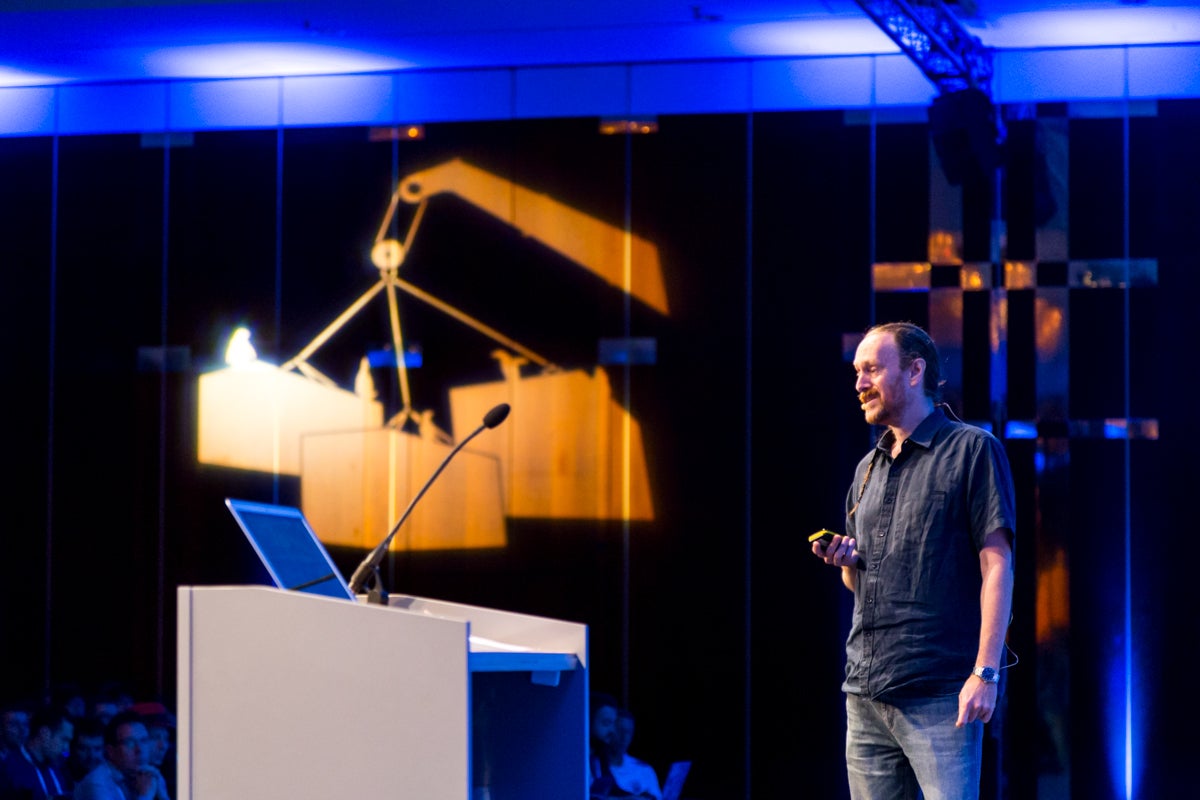
The line between containers and VMs can be thought of as a continuum, according to Graham Whaley, Sr. Software Engineer at Intel. In his keynote at LinuxCon Europe, he talked about the spectrum between fully featured, accelerated, secure, VM features all the way down to the barest minimum lightweight container. He says, “Some people want one end of the spectrum, really time-critical, other people want security. We don’t have that today. What we’d like is a continuous choice of features. … That’s something we’re trying to enable.”

Whaley also talked about two VM myths:

  • VMs don’t have to be big: “I’ve seen embedded systems running hypervisors with tiny amounts of RAM. Admittedly, that VM may not have the features that you want to run a container, but it’s not actually that far off. Containers don’t require that many features at the bottom end.”
  • And they aren’t always slow: “Along with, or parallel with, ‘I’m big,’ comes slow. If you’re not that big, it’s pretty hard to be slow, if you’re very very small. Yeah, VMs don’t have to be this humongous behemoth that you can’t really use in your container space because they’re just too slow. That’s a legacy thing. We can move beyond that.”

Whaley talked about “re-imagining what we can do in the whole container cloud stack” with the goal of making a tenfold improvement in performance. The key to getting this kind of performance improvement is to take a fresh look without assuming that you need something equivalent to a self-contained PC. Their approach is to “throw that away, start again, and pick out the pieces we need from the VM.” By being very selective and only including the bare minimum of what is needed along with also using some new technologies that increase performance, they are getting sub-50-millisecond boot times with around 50MB per container instance overhead.

Whaley wraps it up with more information about next steps and where you can go to participate: “We do continue to optimize space and speed. Really, we want to look for that next tenfold improvement. What’s that next leap of faith, that change of architecture? We are redefining what’s possible. We’re an open project. … The code is available now on GitHub. We have an IRC channel and mailing list. Come to the web site where there’s Clear Linux, Clear Containers and Ciao.”

Watch the entire video to learn more about the Clear Linux project and Intel’s approach to improving performance of containers and VMs.

LinuxCon Europe videos

Keynote: Blurring the Lines: The Continuum Between Containers and VMs

Graham Whaley, Sr. Software Engineer at Intel, says there is a continuum of features and benefits across the container/VM spectrum, and you should be able to choose which point on that continuum best suits you.

Docker and Machine Learning Top the Tech Trends for ‘17

AR, microservices, and autonomous team structures tipped to surge in the coming year.

With 2017 fast approaching, technology trends that will keep gathering steam in the new year range from augmented and virtual reality to machine intelligence, Docker, and microservices, according to technology consulting firm ThoughtWorks.

In its latest semi-annual Technology Radar report, ThoughtWorks calls out four IT themes growing in prominence:

  • Virtual reality (VR) and its cousin, augmented reality (AR)
  • Docker as process, PaaS as machine, microservices architecture as programming model
  • Intelligent empowerment
  • The holistic effect of team structure

Read more at TechCentral

Enabling the Digital Revolution: SDN and Beyond

The promise of software-defined networking and solutions for its wider adoption were explored in depth at VMware’s inaugural future:net event.

To cope with the many challenges of the new digital business, data centers are undergoing a once-in-a-generation architectural shift, from hardware- to software-centric models. Just as virtual machines supplanted physical servers as the fundamental element of modern server applications, software-defined networking (SDN) is now emerging as a more flexible, manageable way to organize a data center’s network needs.

SDN can create far greater manageability by enabling network managers and developers to access network resources at a programmatic level, treating network resources in much the way they treat other computing resources such as central processing units (CPUs) and memory. It can enable networks to become easier to scale up or down, shorten setup time, increase security, and reduce costs. 

Read more at Technology Review

SUSE, Microsoft, Linux and Containers: Open Source Continues Its Enterprise March

Open source has risen to become a truly viable option for enterprises due to the cost savings that can be achieved, the often faster production cycles, and the ability to tap into a growing community of highly skilled workers.

While open source adoption may still face its challenges, it has seen a growing number of companies move to embrace it, such as Microsoft.

Given the growing importance of open source to enterprises, CBR looks at the latest releases from some of the major open source players.

Read more at CBR

GitLab, Consumer Driven Contracts, Helm and Kubernetes

Previously I wrote about the different type of services you can run in a Kubernetes cluster.

This article will focus on building a workflow driven by Continuous Integration and Continuous Delivery for deploying the services on Kubernetes.

We’ll develop and deliver an Application with two different services that communicate with each other. One service is internal and the other will be accessible from the outside world via Traefik. We’ll want to develop, deploy and evolve each service independently of the rest.

Read more at Alberto García L.

Hyperledger Bids to Bridge Blockchain Divide in China Push

If blockchain is done right, borders will begin to disappear. Immutable, shared ledgers of transactions and goods could come to serve as a reminder that everything we grow, build, buy and sell comes from the same tiny planet.

But this future is far from guaranteed, and the various blockchain developer groups competing to bring it to life have so far struggled to involve talent from all over the world in this global vision.

Blockchain consortium Hyperledger, for example, was initially founded with support from companies in almost exclusively Western nations. Yet, the consortium has grown this year to include more than 20 members headquartered in China and 10 from Japan and South Korea, with a spattering of members from other nations represented as well.

With that success, Hyperledger executive director Brian Behlendorf has faced a new challenge, creating a system that allows information to flow between its multilingual members as seamlessly as data on a blockchain.

Read more at CoinDesk

New IBM Platform Brings Watson to IoT

IBM unveiled today an experimental platform that allows developers to embed Watson functions and cognitive technology into various devices. The platform, dubbed Project Intu, can be accessed through the Watson Developer Cloud, Intu Gateway, and GitHub.

More specifically, the goal is to simplify the process for developers that want to create cognitive experiences in robots or other Internet of Things (IoT) devices. These cognitive experiences even extend into the physical world.

Read more at SDx Central

Vagrant Provisioning with Puppet

Automating software installations is an important part of deploying virtual machines with Vagrant. This process is called provisioning and can be integrated with DevOps tools, such as Puppet. Let’s see how to do that.

Vagrantfile Configuration

The configuration for any Vagrant virtual machine is in the Vagrantfile. This is where we will instruct Vagrant to use Puppet to install software or execute commands:

Read complete article at DevX

Apple Is Doubling Down on Open Source

Apple has been getting religion on open source, but more than code the industry needs its voice.  

Apple may be the most secretive tech company on the planet, but it’s finally starting to open up to open source. While the company has yet to issue its own open source report card, Google style, an Apple software engineer recently noted “at Apple we are doubling down on open source.”

That’s progress, and follows on the heels of the company acknowledging its use of Apache Mesos, as well as updating its open source page to proclaim, “Open source software is at the heart of Apple platforms and developer tools.”

Is it enough?

Read more at Tech Republic