Nextcloud, in partnership with Canonical and WDLabs, has released a Raspberry Pi and Ubuntu Linux powered cloud server for your home or office.
The Nextcloud Box is a secure, private, self-hosted cloud and Internet of Things (IoT) platform. It makes hosting a personal cloud simple and cost effective whilst maintaining a secure private environment that can be expanded with additional features via apps.
The Nextcloud Box consists of a WDLabs’s 1 TB USB3 hard drive powered by a Raspberry Pi 2 computer. It uses Snappy Ubuntu Core as its operating system on a microSD card. The mini server comes ready to run with the Apache web server, MySQL, and the latest Nextcloud 10.
For service providers with rigid network resources, physically assigned in metro and wide-area networking (WAN)networks, their complex networking structures aren’t easily manipulated into making dynamic changes. Another challenge is the ability to manage their existing network connections, while at the same time, build new agile platforms with on-demand, multi-tenant services.
The time has come for network operators to also enjoy the benefits that virtualization and programmatic control over network infrastructure can deliver. So today, IXPs and ISPs are ready to forge ahead and deploy software-defined networking (SDN) with at-scale network virtualization and spin up virtual network infrastructure to more flexibly, and cost-efficiently, meet their customer’s demands.
Internet radio and information services will generate approximately 6,000 petabytes of data a year. In just five years, ever more sophisticated in-vehicle infotainment (IVI) systems that stream music and offer real-time navigation will generate up to 98% of mobile-to-mobile (M2M) data traffic, according to a new report.
The Juniper Research report indicates that ever-more popular applications such as Apple CarPlay and Android Auto that mirror your smartphone interface to your car’s IVI will generate massive amounts of cellular M2M data traffic.
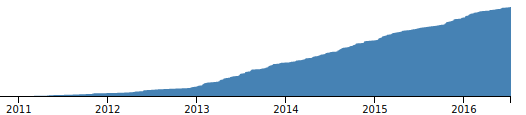
Over the past few years at Strava, server side development has transitioned from our monolithic Ruby on Rails app (The Monorail) to a service oriented architecture with services written in Scala, Ruby, and golang.
Top: Commits to our monolithic rails app. Bottom: Total private repositories at Strava as a proxy for the number of services.
Initially, services at Strava were reserved for things that were simply not possible to implement in Rails (for example, see my previous blog post on Routemaster). It was difficult to bring up a new service, and it required some combination of prior knowledge and trailblazing.
At some point, it became clear that services had become the preferred way of development at Strava. Service oriented architecture (SOA) had triumphed over the Monorail, however, all was not yet well. If done hastily, introducing dozens of services can cause havoc. We had figured out that we liked building services, but we didn’t really have a plan for scaling the number of them.
This post covers the infrastructure that has supported smooth adoption of services at Strava. Today we run over a hundred services deployed by over a dozen engineers. Engineers are able to fully implement and deploy new services quickly and with minimal guidance, having almost no prior infrastructure experience. Services are deployed extremely quickly (< 30 seconds) in a consistent and reliable way. They are monitored, logged, and always kept running.
Unlike some other publications, we did not interpret McKinsey’s recently released ITaaS Cloud Survey findings as a ringing endorsement of the public cloud. Nay, the data doesn’t show that at all. Instead, the data shows that large enterprises have been playing catch-up.
To determine how far along a company is in their cloud migration, McKinsey asked over 800 CIOs and senior IT executives if at least one corporate workload was primarily run on a particular cloud tier. For large enterprises, only 24 percent were using a virtual private cloud in 2015, but that skyrockets to 71 percent in 2018. Ditto public cloud, with large enterprise use going from 10 percent in 2015 to 51 percent in 2018.
I am happy to announce, that the PerfView source code is now open source as a GitHub repository. It is available at
https://github.com/Microsoft/perfview
The readme associated with the GitHub repository has getting started information (how to fetch the repository, how to build, test and deploy the code. We use Visual Studio 2015. You can download a free copy of Visual Studio 2015 Community Edition that has everything you need to clone, build test and deploy PerfView. Thus you can get going with PerfView RIGHT NOW. The instructions on the PerfView repository tell you how to get started even if you know nothing about GIT (although knowing something about GIT and Visual Studio certainly helps).
The readme also talks about how you can log issues as well as contribute to PerfView. You should definitely read the documentation about contributing if you intend to do that (probably best however to just start with learning to build / run / debug and get familiar with the code.
We could definitely use help in both documentation and testing, so this is a great place to contribute, especially to start with.
So there you are, you and your ace tech team, all excited about DevOps. You know that DevOps is the methodology that will move you past “yak shaving” and into building an IT infrastructure that will streamline and move your company forward. But how do you sell this to your bosses, and especially your non-technical bosses? Victoria Blessing, Operations Engineer for the College of Architecture at Texas A&M University, described the basics in her LinuxCon North America 2016 presentation.
To start, Blessing explained the meaning of “yak shaving,” which was coined by Carlin Vieri at MIT. It refers to a series of tasks that must be completed in order for you to be able to do what you were trying to do in the first place. While it can really be applied to any aspect of life, it’s something that we, in IT, constantly fall victim to. Getting caught up in the little details it takes to get things done, and then we’re constantly fighting fires. It’s a part of the culture problem that we have.”
The speed of business is very fast these days, and keeps getting faster, and we can’t afford inefficiencies. But implementing DevOps usually means making a giant cultural shift in your company, and the price of change is often steep. Blessing said, “I’m not going to lie to you. There will be initial technical debt. That often ends up being a stumbling block or a barrier to entry for many organizations. “Oh, we don’t have the time to implement that, or the right tools.” But you have to be willing to take the leap in order to reap the rewards. Yes, there’s initial technical debt, but the rewards are exponential.”
You know the benefits of breaking down the traditional silos, the barriers between the different departments in your company where everyone is doing their own thing, and nobody knows what anyone else is doing, and somehow you’re all supposed to magically coordinate your efforts to develop and release products on time without anyone seeing the big picture. How do you talk to your boss about this? You know that if you start going on about tools like Chef and Puppet, Nagios and Zabbix, Git and Subversion, microservices, orchestration, and all of those good things you risk putting your boss to sleep.
Avoid this trap and follow Blessing’s advice: “The best way to sell something to someone is to show them why it matters to them. Interest is often directly proportional to personal investment. For management, decision drivers are often monetary ones. You’re going to have to show that the benefits outweigh the costs. Ask yourself, “In what ways does this save us money, and in what ways does this make us money?”…Listen to your audience and use their questions to help you adapt your content to make sure that you’re getting your point across.”
Watch Blessing’s presentation below to learn how to persuade your bosses and co-workers to buy in to your DevOps vision.
You won’t want to miss the stellar lineup of keynotes, 185+ sessions and plenty of extracurricular events for networking at LinuxCon + ContainerCon Europe, Oct. 4-6 in Berlin. Secure your spot before it’s too late! Register now.
Do you have an HDMI-enabled dumb TV sitting around that needs a dedicated set-top box or game console to be used? Are you planning to buy a new smart TV? Stop. Here is a tutorial that will turn your current TV into a great Android Linux powered smart TV. At most, you have to spend $30 on it.
What you need
$29 Pine64 (2GB model)
32GB or 64GB micro SD card
Ethernet cable (Bluetooth/Wifi module if you want to play games, or need wireless connectivity)
A 5v power adapter with micro USB (a cellphone charger will work)
HDMI enabled TV
Now download Android from the Pine64 official page. Make sure to download the version for the size of micro SD card that you’re using. Next, unzip the compressed file to extract .img image and use the dd command to write the image to the SD card:
Once the card is ready, plug in the card, connect the HDMI cable to your TV, connect the Ethernet cable, and plug in the keyboard/base. Then, connect the power supply. If everything went well, you will see Pine64 boot screen on your TV, and then the familiar Android 5.x.
First things first
Log into your Gmail Account so that you can manage apps. Then, install Rotation Lock Adaptive app, open the app, and lock the screen in landscape mode. You need to do this because many apps detect Pine64 as a mobile phone and open in portrait mode. This workaround fixes that.
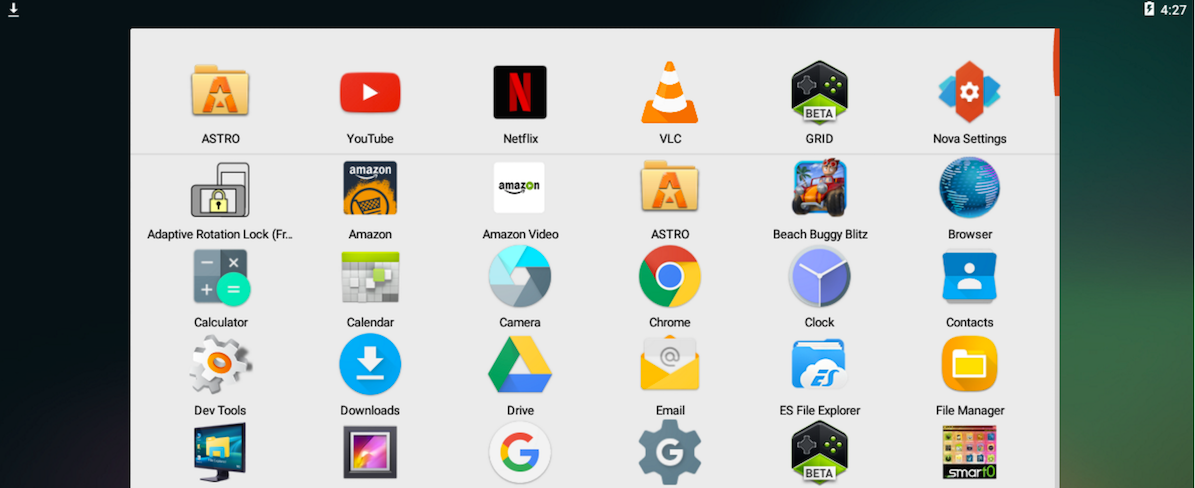
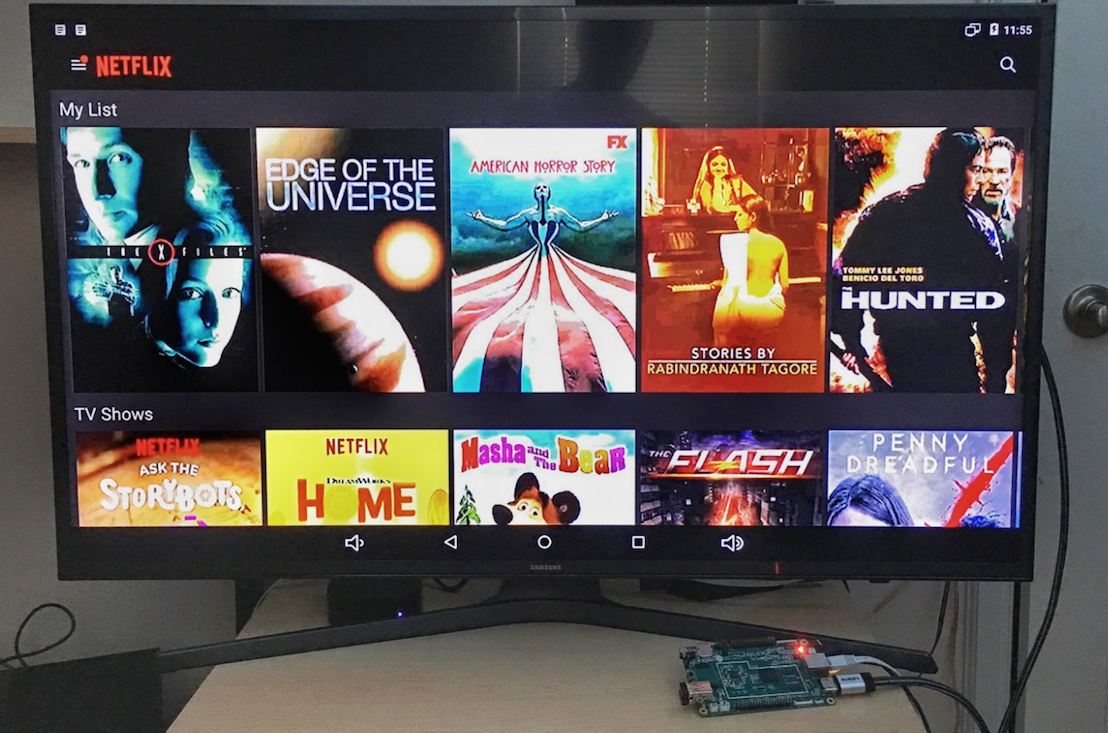
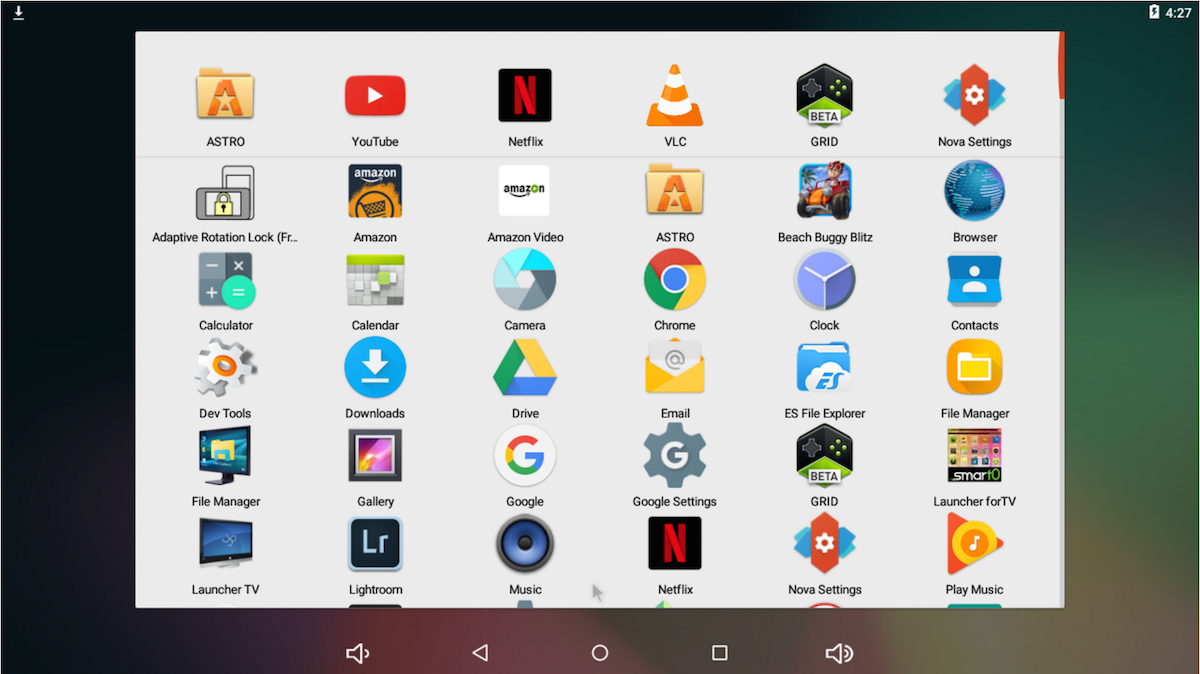
Android for Pine64 doesn’t come with Google apps preloaded so you will have to install a few apps to get things set up. All the apps that are available for Android are at your disposal. I installed YouTube, HBO Go (to complete Game of Thrones), Hulu Plus, Google Play Movies, Amazon Prime, VLC, and Plex.
For music, I installed Amazon Prime Music, YouTube Red (which offers free Google Play Music subscription), Pandora, Spotify, and so on. I am assuming soon Apple Music will also be available.
The good news is that Android also supports USB storage devices, so you can use a powered external hard drive or USB flash drive to watch movies from it, using VLC or file managers like ES File Manager.
If you don’t like the default UI, many launchers are available for Android that you can install from the Play Store. There are also some that also offer a smart TV-like interface.
Why Android?
I used Android rather than a Linux distribution because wanted to add smart TV capabilities to my basic TV and not use it as a desktop PC. Beyond that, Android has a far richer app ecosystem than desktop Linux. Whether you are talking about Netflix, Hulu Plus, Amazon Prime or whatever,…everything is available on Android as an app. And, if you want to use it as a casual gaming system then everything from Angry Birds to Asphalt is available, too. You just need to find a compatible Bluetooth game controller that works with Android.
Although this is a full-fledged smart TV setup with 4K support, it can also support casual web browsing and let you get some work done.
Why not Raspberry Pi?
I love my Raspberry Pi, but there isn’t any official Android port, as far as I am aware. Additionally, 1GB RAM is just not enough to get a decent experience here. On top of that, 4K HDMI output is the killer feature of Pine64.
Why not Chromecast?
As much as I love my Chromecast, I despise its dependence on a smartphone. If you have to take a phone call or leave home, then you leave the program running on your TV in limbo. And, if you are playing a game or something, you can’t use your phone.
Why not just buy a smart TV?
I prefer a dedicated smart TV; but if your TV already has an HDMI input, you don’t need to spend hundreds of dollars buying a smart TV. Smart TVs also have a locked down app ecosystem, so you don’t get access to all the apps and games that you need. Additionally, TV vendors are often quite lazy when it comes to keeping such apps updated. By building your own Smart TV, you are in complete control of what runs on your device.
Conclusion
I own a Samsung smart TV, but I really despise the lack of app and game selection there. I actually prefer my $30 Pine64 smart TV over the expensive alternative. Besides, it’s a cool and fun project to build and run your own Android Linux powered smart TV.
Want to learn how to do more awesome projects with Linux? Learn the basics with the free Intro to Linux course from The Linux Foundation and edX.
The second day at Node Interactive Europe last week had two keynotes that concentrated on specific tools and modules. Kat Marchán talked about the npm packaging tool, and Doug Wilson explored the state of the express module.
Kat Marchán on npm
Kat Marchán gave a comprehensive talk on the state of npm. For those of you new to npm, it may seem that npm is to Node.js what APT is to Debian and Ubuntu, but deep down, it is much more.
Kat reviewed core and basic functionalities of the utility and then moved on to more exotic commands. She explained what was new in the upcoming version 4 and what was being phased out for existing versions. Specifically, npm 2 will go into maintenance mode. This means no updates, just the occasional patch for major vulnerabilities. The current version — npm 3 — will become the long-term support (LTS) version that will go into Node.js 6 (even-numbered Node releases are LTS by default). Becoming LTS implies receiving patches but no new features. Version 4 of npm will probably go into Node.js 7, and npm 5 will probably be part of Node.js 8, another LTS release.
Probably the most surprising moment of Kat’s talk was when she revealed that she is part of a team of only three people, and only two of them actually code. This is, of course, a problem. Feature requests have to be ignored, for example, in favor of patching and stabilizing the code.
This is consistent with what Kat feels is the team’s responsibility with the entire community. Pursuing the development of new features that may have been required by some users, but not others, takes a back seat, she says, to developing a tool that is reliable and consistent and that improves its performance with each release.
Doug Wilson on Express
Doug Wilson talked about what has become the other essential piece to complete the Node.js jigsaw puzzle. Express is the undisputed crown jewel of modules. As Doug modestly puts it: “Express adds a little bit of sugar on top of the core.” Express simplifies building HTTP-enabled servers and provides utilities for routing, low-level HTTP functions, and more.
Express became a part of the Node.js Foundation as an incubated project at the beginning of 2016, and, although this will have little impact on the users of the code, it does help to internally manage the project, said Doug. The developers now have mentors to guide the project and help with the project governance, thus improving its chances of survival and making it more transparent to contributors.
As for the code itself, Doug explained how express is not so much a monolithic piece of code, as much as it is the sum of three projects spread over three GitHub organizations. The expressjs organization is the main entry point where the actual express module is stored and developed.
The pillarjs organization contains what Doug calls the “building blocks” of express. The express module is made up of several pieces, such as the router, how requests to a view engine are handled, error handling, and so on. All these pieces are split out in pillarjs. If you want to use some pieces of express, but not the whole thing, or want to use some of express’s code in your own module, this is where you will find it.
Finally, the jshttp organization contains the low-level code for http-related interactions. After laying out the current state of the project, Doug described what was in store for express 5.0, the next version of express. Version 5.0, among other things, promises support for routing, a better template rendering system which will read templates asynchronously, improved query string and cookie handling, and new route syntax additions.
Doug ended his talk by explaining what the team is doing to get more contributors into the project. As part of the mentoring, they are receiving from the Node.js Foundation, the members of express are working on making their project more transparent by publishing documentation about the internal workings of the organization, by explicitly stating their goals, guides on how to contribute, how the organization is structured, and where their resources are located. They are also publishing what they call “Level up guides” that help users become committers, or even opt to become a member of express’s technical board.
Being understaffed seems to be a common issue even within Node.js’s most popular projects. Hopefully, the strategies they are implementing will pay off.
Oracle barely shows up on the charts of biggest IaaS providers. The vendor is looking to change that.
Larry Ellison, Oracle’s founder and CTO, announced the new services from the opening keynote at Oracle OpenWorld, the company’s big customer conference, which kicked off Sunday.