“Open standards can [ensure] money is invested more efficiently and dramatically accelerate IoT adoption and growth,” said Jeremy Green, Machina analyst and author of the report. Machina provides market research and strategic guidance on M2M and IoT.
Reliance on open standards should seem obvious, but experts said it has been difficult for cities to compare their technology decisions, much less make IoT systems interoperate. Cities will sometimes work with a vendor that offers proprietary technology at low cost or build their own custom solutions.
The cost savings are possible because open standards improve interoperability on networks and limit vendor monopolies that can raise prices; open standards can also reduce integration costs, according to Machina and other research firms.
When smart devices are closed, they’re not smart at all.
Netbeast is an open source platform for developing Internet of Things (IoT) applications for appliances and other devices. It’s an environment-agnostic platform that allows users to ignore details like wireless protocols, brand-specific public APIs, or device detection. One of Netbeast’s main goals is to help foster and develop an open source community in IoT.
EncFS provides an encrypted filesystem in user-space. It runs without any special permissions and uses the FUSE library and Linux kernel module to provide the filesystem interface. It is a pass-through filesystem, not an encrypted block device, which means it is created on top of an existing filesystem. This tutorial shows how you can use EncFS on Ubuntu 16.04 (Xenial Xerus) to encrypt your data.
Microsoft Azure’s programmable, scalable and high-performance network infrastructure is leveraging software-defined networking (SDN) principles as well as open source components to meet the demands of massive cloud-based production environments, said Albert Greenberg, Director of Azure Networking and Distinguished Engineer at Microsoft, at Open Networking Summit 2016.
A major part of Greenberg’s talk was on servicing – updating software in an agile way, fixing bugs, releasing updates, for a production environment of over a million servers.
First, he provided context for the Azure network infrastructure evolution over the last three years:
He summarized what is going on in the v-switch running in the hypervisor and controller, how SDN complex policies in the host are realized and where a server gets smarter about policy, and the network feature set now known as network functions virtualization.
He described how Express Route allows customers to connect enterprise datacenters to the cloud and enables real-time scalability –something that can’t be bought with a router. Eg: 100 million routes can be enabled by express route by hot attaching Azure and deploying as if Azure is part of the network.
He shared how Microsoft builds its scalable controller using a Microsoft open platform called service fabric and how SmartNIC hardware allowed offloading host policy into hardware.
Then he introduced the Virtual Filtering Platform (VFP), Azure’s programmable dataplane, in which the company has scaled up the match action table model to support modern high density servers with >40Gbps of bandwidth, while providing the programmability for its many controllers and SDN applications to create new virtual networking functions.
And finally, he discussed innovations in the data plane, control plane, and physical network in Microsoft Azure network infrastructure.
Data Plane
Packet Direct is the new Windows direct I/O model for accelerating virtual networking and NFV Optimized VFP which offers up to 2x improvement in throughput for heavy VNET workloads, up to 4x PPS improvement in E2E and is supported on major NICs.
Control Plane
Containers play a major role in scaling the private cloud by getting more from VMs. This offers fast provisioning, scalability for hundreds of thousands of containers in the virtual networks, and seamless DevOps for containers. This is accomplished with underlay container management with namespace and VM policies in the VFP so containers can be addressable over the network.
Physical Network
Greenberg introduced Software for Open Networking in the Cloud (SONiC), an open source full routing stack which allows running software on a physical network as a collection of software networking components enabling network devices like switches with rich functionality. SONic enables feature agility, hitless upgrades and restarts with zero customer impact. It runs on top of different switching platforms via the Switch Abstraction Interface (SAI).
SAI is the software abstraction interface that enables logical separation between hardware and software to accommodate a variety of ASICS and enables innovation in both independently.
SONiC lays on top of SAI to unify software running on top of different switches into a cloud-wide network management platform.
He went on the demonstrate how SONiC enables feature agility, hitless upgrades and restarts with zero customer impact.
Watch the full talk, ‘Scaling the S in SDN,’ below.
Machine learning and artificial intelligence have quickly gained traction with the public through applications such as Apple’s Siri and Microsoft’s Cortana. The true promise of these disciplines, though, extends far beyond simple speech recognition performed on our smartphones. New, open source tools are arriving that can run on affordable hardware and allow individuals and small organizations to perform prodigious data crunching and predictive tasks.
Sri Ambati, CEO and co-founder of H2O.ai.
Case in Point: H2O.ai
H2O.ai,formerly known as Oxdata, has carved out a unique niche in the machine learning and artificial intelligence arena because its primary tools are free and open source. You can get the main H2O platform and Sparkling Water, a package that works with Apache Spark, by simply downloading them.
These tools operate under the Apache 2.0 license, one of the most flexible open source licenses available, and you can even run them on clusters powered by Amazon Web Services (AWS) and others for just a few hundred dollars. Never before has this kind of data sifting power been so affordable and easy to deploy.
H2O.ai’s Vinod Iyengar oversees product strategy at the company. In an interview, he discussed how we have reached a tipping point where anyone can wield the same kind of machine learning and artificial intelligence muscle that is used for everything from drug discovery to deep data analytics.
Iyengar emphasizes that hardware trends — not just software development — are making machine learning and artificial intelligence applications accessible for everyone. “In the last five years the cost of storage has come down dramatically, as has the cost of memory,” he said. “Additionally, anyone can leverage an advanced computing cluster on, say, Amazon Web services, for a few hundred dollars. All of this means that organizations or individuals can take a whole lot of data and produce powerful predictions and insights from the large data sets without facing huge costs.”
“We are working to bring the power of AI to businesses,” Iyenger added. “Our machine learning platform features advanced algorithms that can be applied to specialized use cases and the wide variety of problems that organizations face. We really want to enable business transformation for our customers by building smart applications. Smart applications will require a platform that can lubricate the entire data science workflow.”
As an example of how the H2O platform is working in the field, Cisco uses it to analyze its huge data sets that track when customers have bought particular products — such as routers — and when they might logically be due for an upgrade or checkup.
Iyengar noted that H2O.ai is also working on a data science hub called Steam, which will eliminate all the DevOps work required to build and deploy artificial intelligence models. With Steam, developers and data scientists will be encouraged to compare models across teams and take them into production without the need for heavy engineering work on the backend.
Tech Giants are Delivering Free, Open Tools
H2O.ai is definitely not the only company delivering free, open source machine learning and artificial intelligence tools. In fact, both Facebook CEO Mark Zuckerberg and Google CEO Sundar Pichai have been vocal about their recent contributions of open source artificial intelligence and machine learning tools.
In Google’s annual Founders’ Letter to stockholders, Pichai said, “[Artificial Intelligence] can help us in everything from accomplishing our daily tasks and travels to eventually tackling even bigger challenges like climate change and cancer diagnosis.”
Here are a few of the most notable recent open source contributions in this space made by companies including Google and Facebook:
·Facebookhas open sourced its machine learning system designed for artificial intelligence tasks at large scale. It’s a proven platform in use at Facebook.
·Google has open sourced a program called TensorFlow that it has spent years developing to support its AI software and other predictive and analytics programs. You can find out more about TensorFlow at its site, and it is the engine behind several Google tools you may already use, including Google Photos and the speech recognition found in the Google app.
·Yahoo has released its key artificial intelligence software (AI) under an open source license.Its CaffeOnSpark tool is based on deep learning, a branch of artificial intelligence particularly useful in helping machines recognize human speech, or the contents of a photo or video.
·IBM has announced that its proprietary machine learning program known as SystemML is freely available to share and modify through the Apache Software Foundation.
·Microsoft has open sourced the artificial intelligence framework it uses to power speech recognition in its Cortana digital assistant and Skype Translate applications. It released its Computational Network Toolkit (CNTK) as an open source project on GitHub.
“The biggest thing that we’re focused on with artificial intelligence is building computer services that have better perception than people,” said Zuckerberg, on a recentconference call. “I think it’s possible to get to that point in the next five to 10 years.”
To learn more about the promise of machine learning and artificial intelligence, watch a video featuring David Meyer, Chairman of the Board at OpenDaylight, a Collaborative Project at The Linux Foundation.
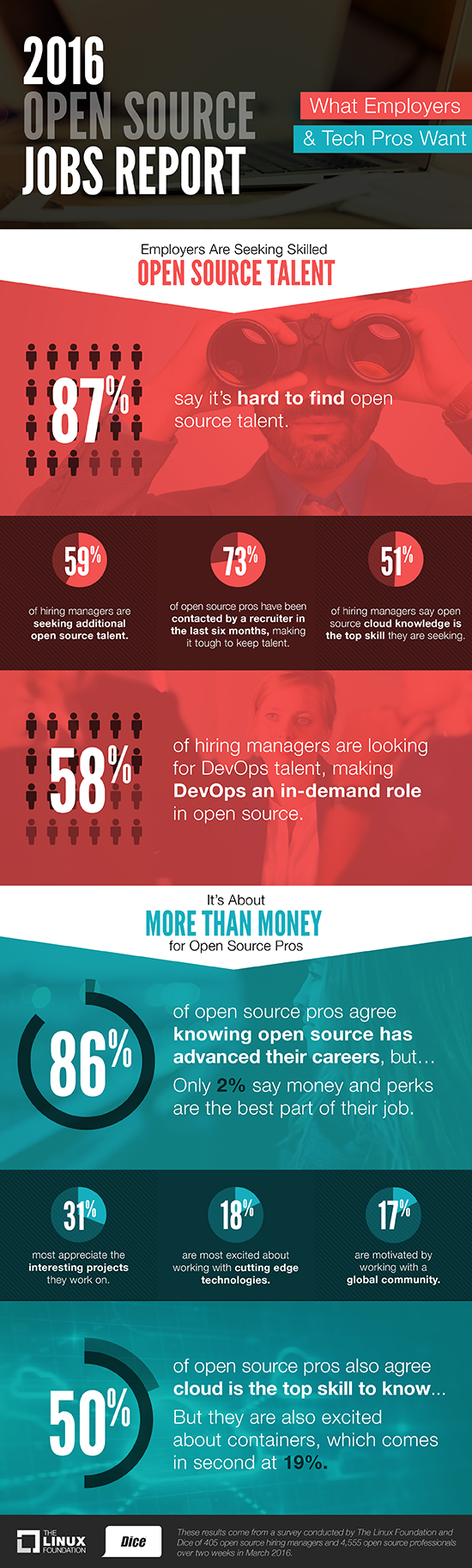
Professionals skilled in open source tools and technologies are now in high demand as open source adoption in the enterprise continues to climb, according to the Open Source Jobs Report released today by The Linux Foundation and Dice.
Fifty-nine percent of hiring managers surveyed said their hiring of open source talent will increase over the next six months. And 65 percent said it will increase more than hiring in other parts of their business, according to the report.
“Demand for open source talent is growing and companies struggle to find experienced professionals to fill open roles,” said Bob Melk, President of Dice. “Rising salaries for open source professionals indicate companies recognize the need to attract, recruit and retain qualified open source professionals on a global scale.”
Benefiting the most from this demand are developers, with 74 percent of hiring managers seeking talent in this role, followed by DevOps practitioners and SysAdmins, with 58 percent and 48 percent (respectively).
A strong economy is driving more open source hiring, managers say, coupled with the continued rise in the strategic importance of open source in business.
Open source software use — largely for application development and production infrastructure — increased in 65 percent of companies included in the 2016 Future of Open Source Survey, released last month by Black Duck Software and North Bridge. Companies use open source for the software quality and competitive features, promise of no vendor lock-in, and customizable code. And they contribute back to open source projects to fix bugs, add features, gain competitive advantage, and cut costs, according to the survey.
The rapid evolution of new technologies, often based on open source, also drives demand for open source professionals. Cloud computing, networking, and security are three hot areas of technology experiencing rapid growth and hiring.
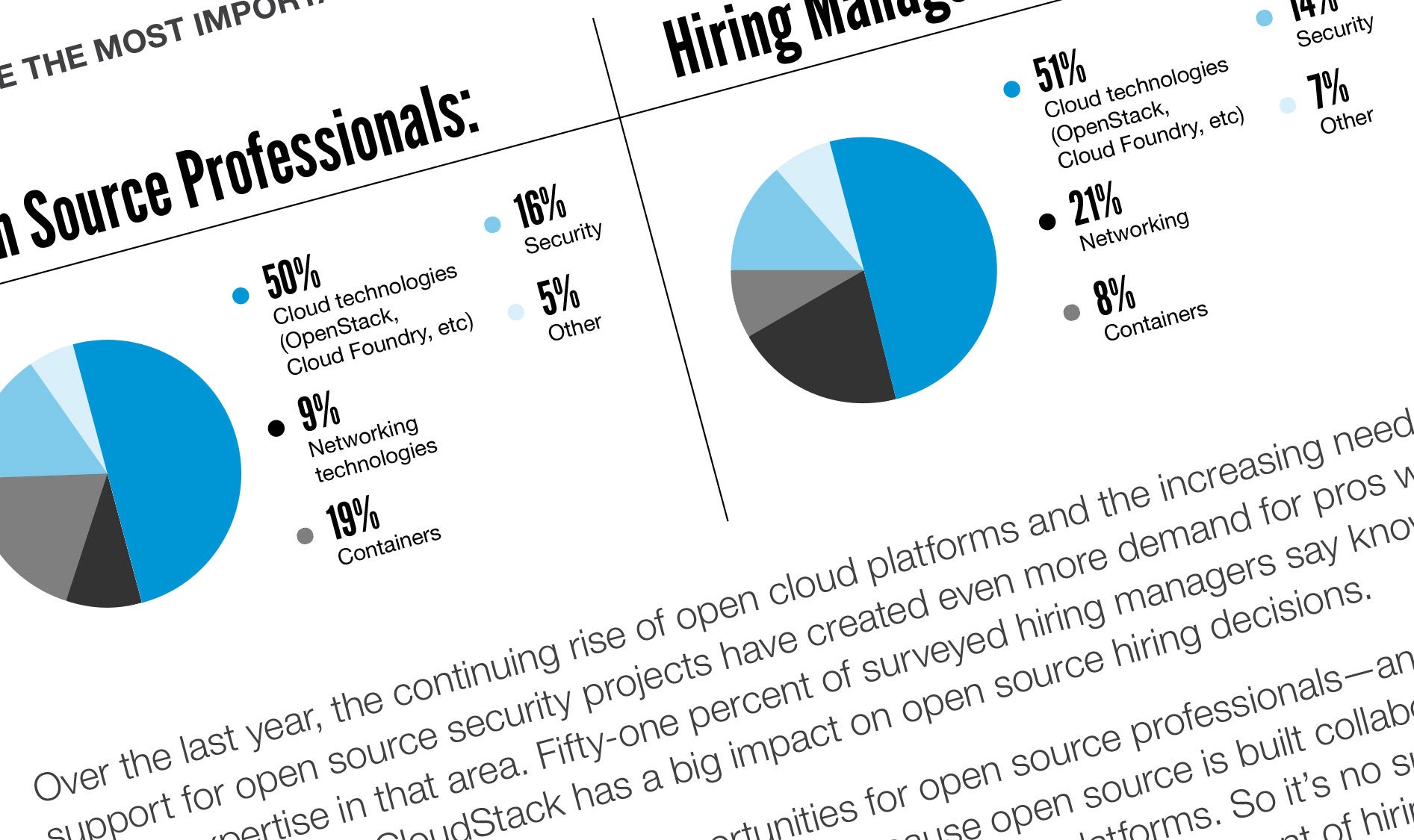
In The Linux Foundation’s Open Source Jobs Survey, 51 percent of hiring managers say experience with or knowledge of OpenStack and CloudStack are driving open source hiring decisions. While 21 percent of hiring managers cited networking and 14 percent cited security experience as having the biggest impact on their hiring decisions.
This year’s Linux Foundation and Dice jobs survey included more than 400 hiring managers at corporations, small and medium businesses (SMBs), government organizations, and staffing agencies worldwide—as well as more than 4,500 open source professionals worldwide.
While there is no question that OpenStack is growing in popularity and is increasingly being used in production settings to orchestrate compute, network, and storage for virtualized servers and sometimes for bare metal and containers, one of the big gripes about OpenStack is that it takes a team of experts to stand up the software and maintain it. …
With Software Defined Networking (SDN), Software Defined Wide Area Networks (SD-WAN), Network Function Virtualization (NFV) and the overall disaggregation of networking from hardware, IDC’s view is that now is an exciting time for networking.
At the 2015 IDC Interop breakfast meeting the analyst firm forecast that the SDN market would reach $8 billion in revenue by 2018.Back in 2012, IDC forecast SDN to generate $3.7 billion by 2016.
From a larger macro perspective, IDC sees the emerging world for the Internet of Things (IoT) to be the largest opportunity on the horizon, generating a staggering $1.46 Trillion in revenues by 2020. IDC is also seeing growth in both private and public cloud networking related revenues which will have an impact on enterprise data centers.
We seem to be hearing about Internet of Things (IOT) and the security challenges related to it everywhere these days…
While there is no denying that IP-based connectivity continues to become more and more pervasive, this is not a fundamentally new thing. What is new is the target audience is changing and connectivity is becoming much more personal. It’s no longer limited to high end technology consumers (watches and drones) but rather, it is showing up in nearly everything from children’s toys to kitchen appliances (yes again) and media devices. The purchasers of these new technology-enabled products are far from security experts, or even security aware. Their primary purchasing requirements are ease of use. …
The emergence of IoT may finally be the technology that brings security from a network afterthought and bolt-on technology to an integral, persistent, omnipresent part of the network. We need secured trustworthy networking as opposed to networking plus security. We need to create even smaller security domains to limit the scope and exposure of an exploited device.
The issue can result in information leaks and local privilege escalation — and it may be impossible to patch all vulnerable devices.
A security flaw affecting Android devices using Qualcomm chips leading to information disclosure and device manipulation has been revealed by researchers. The vulnerability in question is CVE-2016- 2060, a lack of input sanitization of the “interface” parameter of the “netd” daemon, used as part of the Android Open Source Project (AOSP).