
Home Blog Page 842

Lubuntu-Based LXLE 14.04.4 “Posh Paradigm” Linux OS Officially Released

lubuntu-based-lxle-14-04-4On March 24, 2016, the developers of the LXLE distribution of GNU/Linux have been proud to announce the release and immediate availability for download of the final LXLE 14.04.4 operating system.
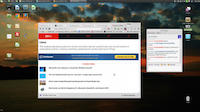
Dubbed Posh Paradigm, LXLE 14.04.4 appears to be based on the long-term supported Lubuntu 14.04.4 LTS (Trusty Tahr) OS and comes with the latest SeaMonkey 2.40 Internet suite that includes web browser, email, and chat components. SeaMonkey is an important part of the user experience offered by the LXLE distro.

As we reported back when the Release Candidate (RC) build of LXLE 14.04.4 was announced, the distribution received a fresh coat of paint on its user interface. This consists of the smoothing of all the rough edges, new artwork, and a new layout that appears to be easy to use…

Weak Links in the Blockchain: We’re Neglecting the Foundations

Premature infatuation with blockchain overlooks security weaknesses in the platform that underlies Bitcoin digital currency. 

In the rush to make bigger and grander claims for the disruptive potential of blockchain, too many commentators are neglecting the foundations. If they think blockchain is important, then it’s all the more important they understand what it does well, and what it just doesn’t do at all.

Blockchain has one very clever, very innovative trick: it polices the order of special events (namely Bitcoin spends) without needing a central authority. The main security aspect that blockchain provides is not tamper resistance or inviolability per se; you can get those any number of ways using standard cryptography. Rather it’s the process for a big network of nodes to reach agreement on the state of a distributed ledger, especially the order of updates to the ledger.

Read more at ZDNet News

Native Docker Comes to Windows and Mac

Docker has launched a beta of Docker for Mac and Docker for Windows, two software packages that represent significant software architecture changes made to optimize Docker for an OS-native experience.

While users could previously use Docker on Windows and Mac, the packages remove additional layers of dependencies and offer native, tightly integrated user experience. Docker can now be installed as a native Windows or native Mac app, launched and utilized from a system toolbar just like any other packaged application. The bottom line is that Mac and Windows users can enjoy faster Docker-driven iteration cycles because their code changes can be tested instantaneously on the laptop without the need to build the Docker application image first.

“Docker for Mac and Windows reflects deep OS system-level work from our Unikernel Systems team and demonstrates how, moving forward, we can leverage native platform capabilities to provide users with the same optimized Docker experience on all platforms,” said Solomon Hykes, Docker founder, chief technology officer and chief product officer. 

Read more at The New Stack

How to Install and Configure MySQL Cluster on CentOS 7

MySQL Cluster is designed to provide a MySQL compatible database with high availability and low latency. The MySQL Cluster technology is implemented through the NDB (Network DataBase) and NDBCLUSTER storage engines and provides shared-nothing clustering and auto-sharding for MySQL database systems. In the shared-nothing architecture, each of nodes has its own memory and disk, the use of shared storage such as NFS, SANs is not recommended and supported.

Read more at HowtoForge

​Linux Best Bets: There’s a Desktop Distro Just Right for You

linux-desktop-2016There are hundreds of Linux desktop distributions. What’s a would-be Linux desktop user to do? Luckily for you, you don’t have to try them all out to find a good fit. 

The key question is: “What do you want to use Linux for?” Once you know that, everything else is easy.

For those of you who haven’t met me before. I’ve been using Linux as a desktop operating system since 1993, two years after Linux was created. Since then I’ve used dozens of different Linux distribution and I used to run a website called Desktop Linux. Today, I use three different Linux desktops on a regular basis. In short, I know the Linux desktop. So, let’s get started shall we?

Read more at ZDNet Linux and Open Source

Oracle Issues Emergency Java Patch for Bug Leading to System Hijack

Users have been warned to patch their systems as soon as possible. Oracle has released an emergency patch for Java which fixes a critical bug leading to remote code execution without the need for user credentials.

In a security alert posted Thursday, the tech giant said the flaw, CVE-2016-0636, is rather potent — having achieved a rating of 9.3 through the Common Vulnerability Scoring System. The bug is considered so severe as the flaw “can impact the availability, integrity, and confidentiality of the user’s system.” Oracle Java SE 7 Update 97, and 8 Update 73 and 74 for Windows, Solaris, Linux, and Mac OS X are affected. 

Read more at ZDNet News

Gorgeous Cub Linux 1.0 (Chromixium OS) Release Candidate Now Available – Gallery

cub-linux-1-0The Cub Linux (previously Chromixium OS) developers have just announced on their Twitter account that the RC (Release Candidate) build of the upcoming 1.0 version of the operating system is available for download.

Before we tell you what goodies have been shipped with the first Release Candidate builds of Cub Linux 1.0, we would like to remind those of you who are not in the loop that, earlier this year, the team announced the rename of the project to Cub Linux from Chromixium OS at the request of Google’s Trademark Enforcement Team.

The Chromixium OS devs were asked, at the point in time, by Google, to cease the use of the name “Chromixium” for their GNU/Linux operating system because of infringement, despite the fact that Google doesn’t yet use that name on any of its projects.

Inside AT&T’s Open Source, Software-Defined Transformation

John Donovan, Chief Strategy Officer and Group President, Technology and Operations at AT&T said during his keynote at Open Networking Summit earlier this month that they are going through a data explosion at AT&T. The has been more than 150,000% growth in data traffic on AT&T’s wireless network from 2007 through 2015. 

To address these changing market dynamics, companies like AT&T need more agile, scalable networks. Donovan told the audience that the “traditional hardware approach is too slow. The only way to stay ahead of that kind of demand curve is software. We are all in in virtualizing our network.â€

AT&T is planning to virtualize 75% of its network by 2020. In 2015 they targeted to virtualize 5% of their network, and that was the hardest part as it was laying the foundation for the future. 

Read more at CIO

Native ZFS for Linux Implementation Now Supports Linux Kernel 4.5 and s390 Arch

native-zfs-The developers behind the ZFS for Linux (ZoL) project were proud to announce yet another stable release of the native ZFS implementation for GNU/Linux operating systems.

ZFS (Z File System) is an advanced file system and volume manager, and the ZFS for Linux project provides a native Linux kernel port for it. The latest stable release, ZFS for Linux 0.6.5.6, appears to bring quite some interesting changes, such as support for Linux kernels 2.6.32 until 4.5, as well as the s390 and s390x hardware architectures. According to the release notes published on the project’s GitHub page, the packaging has been updated, and it no longer contains artificial architecture restrictions,…

Ubuntu Touch OTA-10 to Bring a Major Unity 8 Update with New Dash Navigation

Canonical’s Łukasz Zemczak informed the Ubuntu Touch community today, March 24, 2016, about the latest landings that happened this week for the upcoming OTA-10 software update. As you may well be aware, the Ubuntu Touch OTA-10 update is currently in heavy development, and it should arrive for all supported devices, including the recently unveiled Meizu PRO 5 Ubuntu Edition smartphone and BQ Aquaris M10 Ubuntu Edition tablet, which will be available for pre-order on March 28, in the first days of the next month.

Today’s report of Łukasz Zemczak caught our attention because it mentions the fact that the anticipated out-of-the-box experience for the Unity 8 interface just become reality, bringing dozens of new goodies, such as a new Dash navigation, new side-stage for the Ubuntu tablet, hardware keyboard layouts support, and a desktop mode toggle.