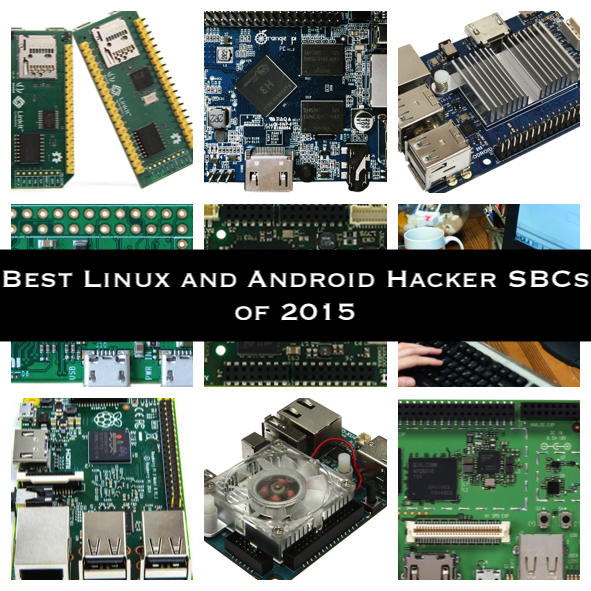
 The world of community-backed SBCs continued to expand in 2015, marked by lower prices and more modular, kit-like Internet of Things boards. Here we take a look at the top 10 most important — and probably the best — under $100 Linux- or Android-based, open-spec hacker SBCs that began shipping in 2015. (Click on the Gallery link below for a slide show.)
Since our Hacker SBC reader survey in May, we have seen some remarkable price/performance breakthroughs on the low end. A few from my top 10 list include open-spec boards like Shenzhen Xunlong’s $15, quad-core Cortex-A7 Orange Pi PC, Next Thing Co.’s $9 to $24, Cortex-A8-based Chip, and the $5-and-up Raspberry Pi Zero.
The under $30 price range was previously inhabited only by barebones, low-powered MIPS (typically Atheros AR9331) SBCs running OpenWrt that were often more like computer-on-modules than workable hacker boards. Yet even these WiFi-equipped MIPS boards have grown more sophisticated, and offer more for the money. For example, one of our winners — MediaTek’s $16, Seeed Studio built LinkIt Smart 7688 Duo, which runs OpenWrt on MediaTek’s 580MHz MT7688AN SoC, offers kit expansion with low-cost options like a $6 Grove sensor breakout and $13 Arduino breakout.
Modular to the Max
The LinkIt is just one of many community-backed single board computers this year that are actually more like multi-board computers. We’re increasingly seeing sandwich-style, COM-with-carrier combo kits — a design borrowed from the traditional commercial embedded board industry – as well as modular boards that ship with multiple add-on options. Many of the IoT focused kits not only support Arduino and/or Raspberry Pi expansion, but also sensor-oriented modules like Seeed’s Grove family, MikroElektronika’s wide range of Click add-on daughterboards, or homegrown module collections.
All this modularity is welcome, but makes it more difficult for direct comparisons. Your Intel Edison or Raspberry Pi Zero kit may look considerably different than mine, depending on what options you choose. It also muddies the waters when it comes to price comparisons. Products such as the Chip and the Zero may start at an unbelievably low price, but those versions are intended primarily for volume buys for small production runs. To turn these into workable hacker boards, you’ll probably end up with something in the $20 to $50 range.
The Chip and the Zero are still great deals, but the quad-core, Cortex-A7 Raspberry Pi 2 Model B is probably a better buy for most hobbyists and prototypers. The $35 Pi 2 was not only the favorite of our readers in last May’s survey, but it leads my list as the most important new SBC of the year. The Zero may offers some interesting new possibilities, but its ARM11 architecture was out of date even when the first Raspberry Pi 1 Model B arrived in April 2012. Meanwhile, the Pi 2’s more up to date, ARMv7 processor supports robust Linux distributions such as Ubuntu MATE.
Here comes 64-bit
The other big trend of 2015 was the arrival of the first 64-bit, ARMv8 hacker SBC, with the 96Boards.org HiKey. For this list, I chose the second 96Boards SBC, Qualcomm’s $75 quad-core, Cortex-A53 DragonBoard 410c. This is the most powerful board on my top 10 list, although Hardkernel’s 32-bit, yet octa-core, Exynos5422 based Odroid-XU4 runs a close second for a dollar less.
In 2016, we can expect more 64-bit boards and at lower prices. Earlier this month, a Kickstarter project launched for a 64-bit Pine A64 SBC that starts at just $15. When it ships in Q2 2016, the quad-core Allwinner A64 based Pine A64 will likely be the new price/performance leader, not only among 64-bit boards but hacker SBCs in general.
Then again, a lot can change in six months. By the time the Chip shipped to backers last month, it seemed less amazing than it did earlier this year in the light of the Orange Pi PC, the Zero, and other low-cost boards.
All our Top 10 boards are ARM-based except for the MIPS-based LinkIt SBC. There are plenty of good low-cost MIPS boards, as well as Imagination’s pricier Creator series, and on the x86 side, Intel has spun the admirable MinnowBoard Max and Edison-with-expansion board products. However, LinkIt was the only major new non ARM product in 2015. Next year, I predict we’ll see at least one intriguing low-cost SBC based on the capable and fairly affordable, 14nm Intel Atom x5 (Cherry Trail).
In addition to the board mentioned above, my top 10 list includes capable upgrades to the popular Odroid-C1 and BeagleBone, as well as the i.MX SoloX based Udoo Neo hacker board for IoT. All 10 of the boards support Linux, and the DragonBoard 410c, BeagleBone Green, Orange Pi PC, Udoo Neo, and the two Odroid boards also run Android
I can’t claim these are necessarily the very best SBC deals on the market, but they’re close. There are also plenty of excellent boards available that launched in 2014, especially since many have cut their prices. To find out what other Linux.com and LinuxGizmos readers think are best tune into our next joint hacker SBC survey slated for Q2 2016.
Here are the top 10 Linux/Android hacker SBCs of 2015, in order of importance, with links to product pages. Click on the Gallery link above to see a slide show in reverse order:
1. Raspberry Pi 2 Model B
2. Raspberry Pi Zero
3. DragonBoard 410c
4. Chip
5. Orange Pi PC
6. BeagleBone Green
7. Odroid-C1+
8. Odroid-XU4
9. Udoo Neo
10. LinkIt Smart 7688 Duo

 The Linux Foundation, the nonprofit organization enabling mass innovation through open source, today announced a new collaborative effort to advance the popular blockchain technology. The project will develop an enterprise grade, open source distributed ledger framework and free developers to focus on building robust, industry-specific applications, platforms and hardware systems to support business transactions.
 Tumbleweed had two snapshot this week and
  Software has been eating the world for
  The developers of the powerful Orca open-source screen reader and magnifier announced the immediate availability for download and testing of the Orca 3.19.3 release.
 A series of platform-as-a-service cloud providers such as IBM, Hewlett Packard Enterprise, Pivotal, CenturyLink and SAP have agreed to certify their Cloud Foundry-based offerings to ensure that the code is portable and won’t lock in customers.
 With this zero-code solution, enterprises write once, and WaveMaker automatically generates a desktop, Google Android and Apple iOS app.
 Late yesterday European institutions