Anytime a new language binding is introduced to syslog-ng, somebody immediately implements an Elasticsearch destination. There is one in Lua, Perl and Python, meaning that there is a very strong interest in getting data from syslog-ng into Elasticsearch. Recently, an official Elasticsearch destination has been developed by the syslog-ng team in Java.
Why do so many people want to send their logs to Elasticsearch? There are many reasons:
it is an easy-to-scale and easy-to-search data store
it is NoSQL: any number of name-value pairs can be stored (Hello PatternDB!)
Kibana: an easy-to-use data explorer and visualization solution for Elasticsearch
And why to use syslog-ng on the sending side? There are also very good reasons for that:
A single, high-performance and reliable log collector for all of your logs, no matter if they are coming from network devices, local system or applications. Therefore, it can greatly simplify your logging architecture.
High speed data processor, parsing both structured (JSON, CSV/click stream) and unstructured log messages (PatternDB). It can also anonymize log messages if required by policies or regulations, and reformat them to be easily digested by analyzers.
Complex filtering, to make sure that only important messages get through and they reach the right destination.
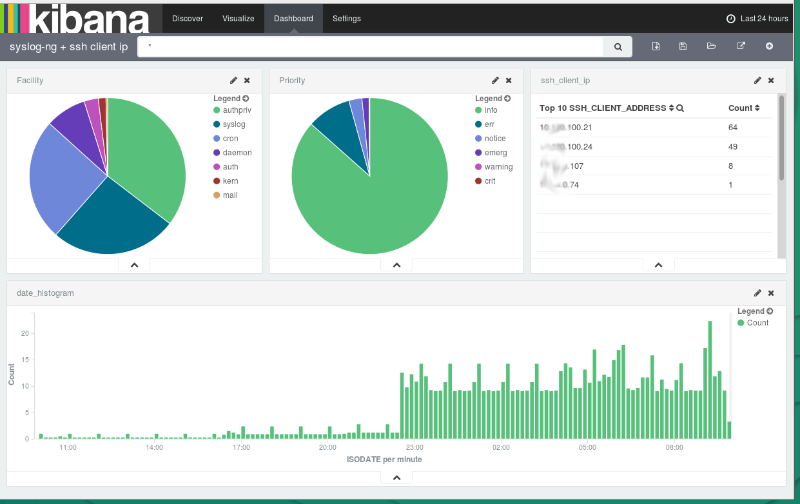
The next screenshot shows a Kibana dashboard, which displays logs collected by syslog-ng, parsed by PatternDB and stored into Elasticsearch by our brand new Java-based driver:
Imagination Technologies this week unveiled a new version of its open source Creator single board computer on Kickstarter, this time with a greater focus on Internet of Things vs. multimedia. Expect to see more IoT-focused boards like the OpenWRT Linux-ready Creator Ci40 that emphasize wireless and peripheral optimization over speed. Like the Ci40, this new wave of IoT boards also features lightweight Linux distributions, support for readymade sensor expansion platforms, and cloud-based IoT endpoint aggregation and control.
Typically, newer generation hacker SBCs have faster processors. Yet, the Creator Ci40 slows down a bit, while at the same time improving the power efficiency and performance of its 802.11ac, Bluetooth 4.1, and the 802.15.4–based 6LoWPAN radios, as well as low-power peripherals.
Compared to last year’s Creator Ci20 SBC, which ran on a MIPS-based, dual-core 1.2GHz JZ4780 SoC from Ingenics, the Creator Ci40 taps a slower, dual-core 550MHz cXT200 system-on-chip developed by MIPS IP license holder Imagination. The cXT200 SoC uses Imagination’s energy-efficient, IoT-focused MIPS InterAptiv architecture, which also supports RTOSes running on microcontroller unit (MCU) processors.
Many open source developers have avoided the original Creator board due to its non-standard MIPS architecture and opaque (although powerful) Imagination PowerVR GPU. (Despite this, the otherwise fully open spec, open source Creator ranked in the middle of our 2015 hacker SBC survey.) The mysterious workings of the PowerVR is no longer a problem since the Creator Ci40’s cXT200 is a headless design that lacks a graphics processor entirely.
What the cXT200 does have is Imagination’s Ensigma MACSec connectivity engine for accelerating wireless performance. It also offers a separate, dedicated 802.15.4 chip, and the SoC is closely connected with the Ci40’s onboard TPM chip, reflecting the importance of security for IoT devices.
Android out – OpenWRT and Brillo in
The low-power nature of the cXT200 SoC is also reflected in a change in supported distributions. While the Creator ci20 highlighted Debian and Android support, the Ci40 defaults to OpenWRT Linux, the increasingly popular, lightweight Linux distro typically found on Qualcomm’s popular, MIPS-based Atheros AR9331 SoC. The Ci40 still supports Debian, as well as Buildroot, but OpenWRT is the fully optimized distro here. Android support is gone entirely, but instead you can find support for Google’s lightweight, Android-based Brillo OS.
The 106 x 100mm Creator Ci40 board ships with 256MB of DDR3 RAM and 512MB NAND flash. With all the wireless radios — and no need for video ports — real-world connections are limited to a microSD slot, a 10/100 Ethernet port, audio jacks, and a micro-USB 2.0 OTG port.
Like many new Linux-oriented, community-backed SBCs, the latest Creator board sports a Raspberry Pi compatible expansion interface. This should make it easier to port add-in boards to the platform, despite the ARM to MIPS transition.
Clicking into sensors
In addition, the basic kit, which starts at 70 Pounds ($106) includes two of MikroElektronika’s MCU-based Clicker micro-carrier boards and three Click expansion modules: a temperature sensor, a motion sensor, and a relay switch. Buyers can then choose from a catalog of more than 100 Click options ranging from sensors to stepper motors to wireless extensions. The Click modules click directly onto the MikroBus connectors found on the Creator board or the MikroBus sockets found on the Clicker carriers, which have ZigBee-like 6LoWPAN radios and AAA batteries. The Click adoption both follows — and leads — a trend among hacker projects opting for ready-made expansion systems for IoT sensors. SolidRun uses Click in its HummingBoard SBCs and new ClearFog networking SBC.
Other projects, such as Intel’s Edison, Amazon’s AWS IoT platform, and BeagleBoard.org, have aligned with Seeed’s catalog of Grove sensor boards. In fact, Seeed manufactures the BeagleBone Green, which features a Grove sensor interface and add-ons.
While many other boards offer Arduino interfaces to enable similar add-ons, alternatives like Grove and Click are gaining ground. This may be partially due to the uncertainty about the future of Arduino, due to the continuing rift between the two rival Arduino camps. However, it primarily reflects the convenience of one-stop shopping, guaranteed compatibility, and the greater focus on wireless and sensor modules rather than motor control.
The Creator Ci40 also demonstrates the trend toward hacker boards and IoT gateways sold with readymade cloud-based aggregation and control platforms. Like the Creator Ci20, the Ci40 ships with a limited subscription to Imagination’s FlowCloud, which streamlines device connections to the Internet, “enabling easy product registration and updates as well as access to partner-enabled services,” says Imagination. FlowCloud includes a centralized dashboard to monitor usage, as well as open source APIs.
Somewhat similar cloud-based IoT management platforms have appeared in products like Amazon’s AWS IoT, Mentor Graphics’ SysDK, and Wind River’s Wind River Helix Cloud.
With its MIPS architecture, the Creator Ci40 will have an uphill battle against ARM giants like the Raspberry Pi. Yet, Imagination has clued into many of the key components developers are looking for in an IoT-focused hacker board. We can expect to see more of the same by the time of the upcoming 2016 edition of our hacker SBC survey.
As I review one Linux distribution or another, I find myself uttering phrases like “This is pretty good! Almost makes me want to switch my system to this,” over and over again. So many distributions of Linux are truly fantastic – but usually with a caveat. Something that stops me from making them my primary system.
Which begs the question… What does the perfect Linux distribution (or Linux-based operating system) look like for me?
In an attempt to streamline remote support, Dell installed a self-signed root certificateand corresponding private key on its customers’ computers, apparently without realizing that this exposes users’ encrypted communications to potential spying.
Even more surprising is that the company did this while being fully aware of a very similar security blunder by one of its competitors, Lenovo, that came to light in February.
Some time ago, I was a development manager with 23 reports spread over four teams.
When I joined the company, they had already made the transition from “smart people in a room,” to having a repeatable process. And they had been able to grow from a pair of Waterloo graduates to about forty engineers, half of whom were in my group. After a series of embarrassing schedule SNAFUs, the company had doubled down on process, instituting rigid Big Design Up Front and scheduling weekly reviews of the ubiquitous waterfall GANTT charts. This had helped, but the schedule kept slipping.
I had joined to lead a small team, and I brought a different tool, Agile, to the table. After my small team had hit several targets in a row, I was promoted to manage four teams, and with the new approach, the group hit its ship date for the very first time.
I was well-regarded within the company, and happy. However, a friend worked for a startup with excellent prospects, and he convinced me that I ought to fly down to Cupertino and interview for the VP of Engineering role. They were growing like crazy, and needed to go beyond “a bunch of smart people in a room.” I’d be the most senior non-founder, and it would mean a chance to build the engineering organization.
Big Internet companies like Amazon, Facebook, and Google keep up with the growing demand for their services through massive parallelism, with their data centers routinely housing tens of thousands of individual computers, many of which might be working to serve just one end user. Supercomputer facilities are about as big and, if anything, run their equipment even more intensively.
In computing systems built on such huge scales, even low-probability failures take place relatively frequently. If an individual computer can be expected to crash, say, three times a year, in a data center with 10,000 computers, there will be nearly 100 crashes a day.
Our group at the University of Toronto has been investigating ways to prevent that. We started with the simple premise that before we could hope to make these computers work more reliably, we needed to fully understand how real systems fail. While it didn’t surprise us that DRAM errors are a big part of the problem, exactly how those memory chips were malfunctioning proved a great surprise.
The new Radeon Software Crimson Driver from AMD has been released for the Linux platform as well, but it looks like the Linux users will have to wait a little bit more for the new UI or other features.
Numerous users, including myself, were excited to see that AMD was paying proper attention to the Linux drivers, and there was a special slide in their official communique about Linux gaming. In fact, they were saying that, with the help of the new drivers, Linux players shou… (read more)
At SC15, Intel talked about some transformational high-performance computing (HPC) technologies and the architecture—Intel® Scalable System Framework (Intel® SSF). Intel describes Intel SSF as “an advanced architectural approach for simplifying the procurement, deployment, and management of HPC systems, while broadening the accessibility of HPC to more industries and workloads.” Intel SSF is designed to eliminate the traditional bottlenecks; the so called power, memory, storage, and I/O walls that system builders and operators have run into over the years.
Is there anything special that you do to praise or reward good work within your IT organization? We asked eight IT leaders what they do to recognize outstanding contributions within thier teams.
1. Keep things loose
By Andy Knauf, Director of IT and Vice President and Principal, Mead & Hunt
“You’ve got to keep things loose and do fun things to keep them interested. It’s not just working; you’ve got to be able to go out and have fun and do silly stuff and keep them engaged. Not everyone is always looking for the paycheck; especially I’ve noticed with younger guys it’s more about having good time than necessarily about the money.”

 The new Radeon Software Crimson Driver from AMD has been released for the Linux platform as well, but it looks like the Linux users will have to wait a little bit more for the new UI or other features.