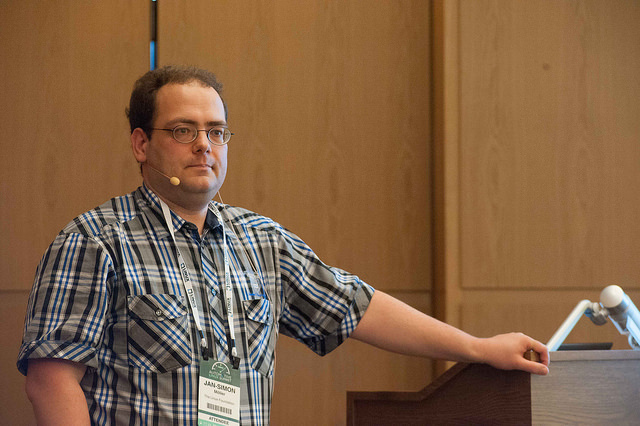
Jan-Simon Möller is a consultant and trainer for the Linux Foundation’s training program and holds an electrical engineering degree. But he started out as a home Linux user tinkering with different distributions before moving on to systems administration.
He now teaches a range of Linux Foundation courses, from writing Linux kernel drivers, to embedded Linux development, and system administration. His expertise lies in embedded Linux, Realtime Linux, SELinux, power management, and integration of new compilers.
Here Möller tells us more about how he learned Linux, his career path, the projects he’s currently involved in, and his ham radio hobby.
Linux.com: What courses do you teach at the LF?
Jan-Simon Möller: I teach courses from the developer curriculum. Especially the classes on Linux Kernel Internals,Developing Linux Device Drivers (LFD320, LFD331) as well as the Embedded Linux Development classes (LFD405/LFD411) are my favorites. I also maintain the class on Embedded Linux Development with the Yocto Project. Another area are the sysadmin courses from where I, among others, teach Linux System Administration and Performance Tuning.
How long have you been teaching? How long at the LF?
I started teaching in the middle of my studies towards the diploma in electrical engineering doing technical trainings. For the LF I’m teaching now for about four years.
How did you get started with Linux?
I started early in my time at the university to use Linux at home. I experimented a lot during that time – openSUSE, Debian, Gentoo, Linux-from-Scratch. Later on I worked as sysadmin keeping a mix of SUN/Sparc workstations and plenty of Linux desktops up and running.
How did you learn?
At the beginning I learned a lot by doing. Linux-From-Scratch and Gentoo were really educational for my userspace knowledge back then – albeit, “the hard way.” (Remember how long Gentoo compiled on an i486?) Today Arch has really good documentation IMHO.
What is your area of expertise now?
My expertise is in the areas of Embedded Linux, Linux Kernel Drivers, Linux Build Systems, Systems Engineering and Networks.
How did you develop that? What has your career path been?
Diploma (masters) in Electrical Engineering; programming Embedded Systems as trainee; Realtime Linux & SELinux research; working on Build Systems, that led to Systems/Platform Engineering, then deeper into Linux kernel and training.
What projects are you involved in currently? What are you working on?
The projects I’m involved in are LLVMLinux, the Yocto Project, Automotive Grade Linux and OpenDaylight. Right now I’m designing a new class on software-defined networking with OpenDaylight (there’s also a two-day SDN course already available).
Anything else you’d like us to know?
I like to travel and see foreign countries and cultures. The reason might be my hobby – ham radio – which I started at the age of 14 by listening to short-wave radio stations all over the world. Also, when I’m teaching you will recognize me as I have always my own box of whiteboard-markers with me.
Learn more about Linux Foundation Training courses and certification at http://training.linuxfoundation.org/.
Read about more Linux Foundation Training instructors:
Learn OpenStack with Linux Foundation Instructor Tim Serewicz
Learn KVM and Linux App Development with Linux Foundation Instructor Mike Day
Learn Cloud Administration With Linux Foundation Instructor Michael Clarkson
Learn Linux Performance and Scripting with Linux Foundation Instructor Frank Edwards

 After reporting earlier the summary of the Ubuntu Desktop Team meeting that took place on June 2, we’re now informing you about the decisions made by the Ubuntu Kernel Team on the same day.
 The Ubuntu Touch platform already received a few major updates in the past few months, but the developers are preparing so much more with the next releases. This information was revealed during the latest Ubuntu insider hangout.
 Blackhole is a beautifully rendered 2D sci-fi hardcore platformer developed and published on Steam by FiolaSoft Studio. The game has been ported to the Linux platform along with the just-released DLC.