 Time was, if you had a hankering for a nice Raspberry Pi, you had but one choice: the Raspberry Pi Model B. You plunked down your $35, and like millions of other Pi-heads, you liked it. Then came the stripped-down $25 Model A, followed this year by the Raspberry Pi Compute Module. Now they’ve got this gussied up Raspberry Pi Model B+ with four USB ports and a backward-compatible 40-pin expansion connector. What’s the world coming to?
Those are just the Pi models available from the Raspberry Pi Foundation. There are also third-party clones like the Banana Pi or value-added, Pi-based computers like the Modberry automation computer, the Sherlybox NAS device, and TinyGreenPC’s new Pi Media Player digital signage computer. Other products like Geekroo’s Fairywren extend the Pi into a more feature-rich SBC.
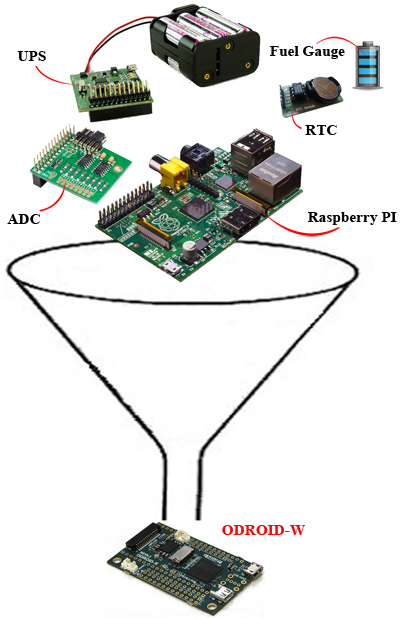
The latest product to extend, clone, or mimic the RPi is an open source wearables platform called the Odroid-W from Hardkernel’s Odroid project. Announced earlier this week for $30, the 60 x 36mm Odroid-W mimics aspects of both the Pi Model B and the RPi Compute Module, falling somewhere between a single board computer and a computer-on-module.
When the Odroid project looked into developing a wearables platform, it considered adapting its quad-core Odroid-U3 board, which was voted the third most popular Linux hacker SBC in our recent survey after the Pi and the BeagleBone Black. Yet the Pi’s lower power consumption and ready-made compatibility with a huge library of applications and add-on boards won the day.
Since Odroid is one of the more popular open source board providers around, the adoption of the Pi design is fairly significant. Does this mean that other board projects will soon be downgrading from their faster dual- and quad-core boards for an aging ARM11 platform? Not exactly — nothing lasts forever, and even the Pi Foundation will likely advance to a Cortex platform next year. Yet, the Pi’s growing ecosystem of software and add-ons has taken on a life of its own, and many more Pi-like creations are no doubt on the way.
6 Raspberry Pi-Like Computers
Here’s a quick look at some of the more commercial Pi-like and Pi- based boards and computers available for sale today, starting with the most recently announced:
- Odroid-W— This tiny, COM-like near Pi clone has already been demonstrated in a smartwatch prototype, and is designed for a variety of wearable and lightweight Internet of Things applications. The $30 Odroid-W adopts the Pi’s 700MHz, ARM11 Broadcom BCM2835 system-on-chip, 512MB of RAM, and microSD slot. It also duplicates the Model B’s 26-pin expansion connector and 15-pin camera connector, promising full compatibility on both counts. The board jettisons features like the Ethernet port and MIPI-DSI interface, however, and if you want a real-world USB port, which you’ll need to add WiFi or Bluetooth, you’ll have to solder it on yourself.
Like the new Pi Model B+, the Odroid-W switches from HDMI to micro-HDMI. It also adds support for eMMC flash, and provides wearables-oriented features like a battery charger and fuel gauge, real-time clock, ADC inputs, and DC/DC step converters, among other enhancements.
- Pi Media Player— AndersDX subsidiary TinyGreenPC last week announced a Raspberry Pi-based digital signage player that consumes only 7 Watts. The Pi Media Player adopts Silver Curve’s “Aperture” graphics engine, which has tweaked the VideoCore IV GPU on the RPi’s Broadcom SoC for signage. This helps make it compatible with signage content management systems like SignageLive, Instore Media (INSM), and Gemasi Italy. The device adds a serial port, WiFi, and up to 256GB of storage to the RPi’s usual complement of features. It’s also available in an optional Open Pluggable Specification version. Prices start at about 280 UK Pounds (about $476).
- ModBerry— Techbase’s ModBerry automation computer is built around the Raspberry Pi Compute Module. The flexible device can act as a protocol converter, data logger, telemetry module, server, PLC device, MODBUS router, or SNMP agent. The ModBerry integrates the Polish startup’s cloud-based iMod, iModCloud, and iModWizard Software-as-a-Service (SaaS), allowing data storage and control of various iMod compatible computers. In addition to the usual RPi ports, it adds a SIM slot, dual serial ports, a CAN port, and a 1-Wire bus, among other industrial I/O. One or two PCI-Express expansion slots are also available.
- Sherlybox— Like Techbase, Sherlybox vendor Sher.ly is a startup from Poland. The RPi-based network attached storage device creates a private cloud network that lets invited visitors share public data or add their own synced files. The privacy-oriented NAS system uses a peer-to-peer VPN, and offers a zippy file-sharing protocol. The Sherlybox supports mobile device access, and provides streaming capability. It’s available for $149, or $199 with 1TB of built-in storage.
- HummingBoard — When SolidRun announced the HummingBoard in April, it was billed as a quasi RPi clone. Yet by the time it shipped in July, starting at $45, there was no mention of RPi compatibility. Nevertheless, the HummingBoard has a layout and 26-pin connector that are very similar to that of the RPi, making it an easier leap for existing RPi users. The modular design is far more powerful, however, as it features a COM with a quad-core Freescale i.MX6 SoC.
- Banana Pi— Lemaker’s near clone mimics the Pi’s 26-pin connector and overall layout, and offers RPi software compatibility. The roughly $60 open spec SBC advances to dual-core, Cortex-A7-based Allwinner A20 SoC, and doubles the RAM to 1GB. Compared to the Pi Model B, it also upgrades to gigabit Ethernet, and adds a SATA port and a micro-USB OTG port.
A recent review on LinuxUser gives the Banana Pi four out of five stars, praising it for its performance and storage enhancements, while noting various incompatibilities. For example, Pi cases and camera modules are not compatible, and a shift in placement of the expansion connector causes “larger piggyback boards to foul on the composite video output,” says the review. There were also some wiring issues related to GPIO interfaces. Yet, “Lemaker has worked hard to overcome these issues to the extent that most projects based around Raspbian and the Wiring Pi or RPi.GPIO libraries work absolutely fine on the Banana Pi,” says LinuxUser.
- Fairywren — Australia-based Geekroo achieved Kickstarter funding for the Fairywren a year ago. The Mini-ITX board sells for $103 without the Raspberry Pi itself, which acts as the board’s COM. It extends the RPi with features like a 2.5-inch SATA drive, extra USB ports, a serial port, an IR remote module, and an ATX 24-pin power socket. An acrylic case is also available, along with optional Arduino Uno and XBee add-ons.
 Hey my name is Christian and I’m a student currently in the third year of the Bachelor of Science course with information systems and management major in Nuremberg, Germany. During my time at university I already was interested in developing web applications and gained first experience. Google Summer of Code at openSUSE was a great opportunity for me to improve my knowledge and work together with other excellent developers. There are only two weeks left which makes now the perfect time to summarize what I have achieved and learned so far.