Home Blog Page 1781

Samsung to Introduce ‘Curved Display Smartphone’ in October

At an event today in Seoul, Korea dedicated mainly to showing off the Galaxy Gear and Galaxy Note 3, Samsung executives said that the company plans to “introduce a curved display smartphone in October,” but declined to give any further details — including price, exact release date, or even what operating system it would be using. Samsung has technically released curved-screen phones before — the Nexus S had a gentle curve on it, but in that case it was the glass, not the screen itself that was curved. The company also applied for a recent patent for a smartphone that is curved along its vertical axis. However, presumably this upcoming smartphone would include something more dramatic than what it offered with the Nexus S or Galaxy…

Continue reading…

Read more at The Verge

Three Trends in Business App Development You Need to be Aware Of

Disruption! Transformation! The future is upon us, application architects.

Oracle Eyes OpenStack API Integration, New Cloud Services

Oracle supports OpenStack as the interface to manage cloud infrastructure and launches a bevy of new services primarily aimed at HR and CRM.

Hybrid Cloud: The ‘Prius’ of Computing Architectures

RedMonk’s James Governor looks at the Prius as a metaphor for on-premises-to-cloud transformation.

Mini-PCs Gain Customized I/O and a Headless Hack

CompuLab announced four customized versions of its fanless, Linux-ready mini-PCs based on plug-in LAN, serial/CAN, USB/mSATA, and mini-PCIe personality modules. The company also introduced a signage and communication oriented mini-PC, as well as a $15 HDMI dongle that enables high-res VNC-based remote display from headless PCs by tricking video drivers into thinking an HDMI display […]

Read more at LinuxGizmos

openSUSE Summit 2013: Registration Opened!

openSUSE Summit 2013 logo
It has already been a year since the first iteration of the openSUSE Summit held in Orlando Florida. Our guests and organizers agreed that tying this community event at the end of SUSEcon is a very good idea and it was set to be repeated in 2013 as well. If you live in the Northern part of the U.S.A. then you know that November can be very cold, therefore, our organizers decided to go back to Florida this year and have everyone warm up to the never-ending summer in the peach state. Our event website is up and running and registrations are open!

Read more at openSUSE News

Paranoid Android Team Will Rewrite The ROM For KitKat Focusing On Fewer Devices, Googley Design, And Accessibility

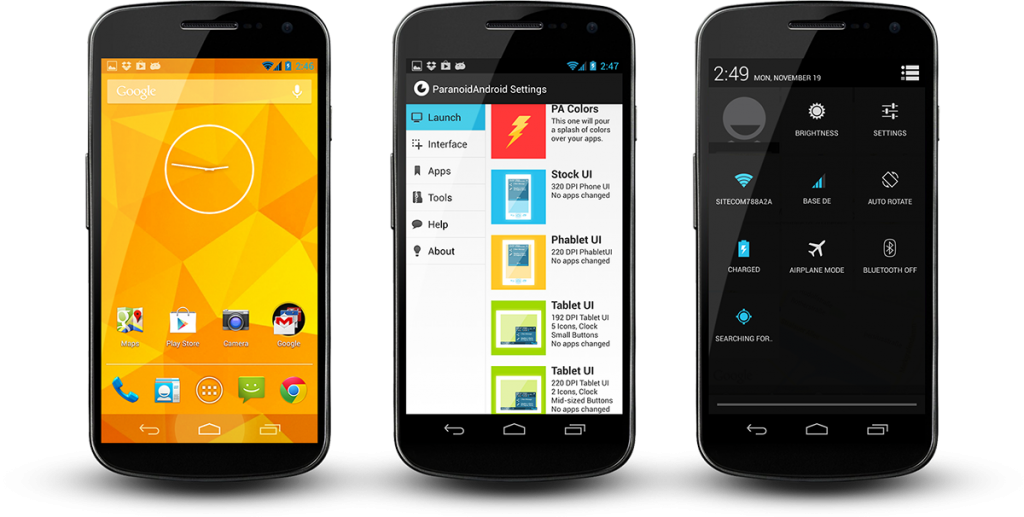
bubAs the announcement of Android 4.4 KitKat (presumably) draws closer, the Paranoid Android team has decide to make some changes to the way the popular ROM is managed. On the agenda is a complete rewrite of Paranoid Android with a focus on making a highly stable ROM targeted at fewer devices. That doesn’t necessarily mean it won’t run on your device, but things are about to change.

pa-1024x517

According to the G+ post, the core team has decided to move away from the model of having everyone support individual devices.


Done With This Post? You Might Also Like These:

Paranoid Android Team Will Rewrite The ROM For KitKat Focusing On Fewer Devices, Googley Design, And Accessibility was written by the awesome team at Android Police.

Read more at Android Police

BeagleBone and Raspberry Pi Gain FPGA Add-Ons

At the Maker Faire in New York City, ValentFX showed off two open source FPGA boards that stack with BeagleBone and Raspberry Pi SBCs, and also unveiled BBot, a BeagleBone-based drink serving robot built with an earlier FPGA board version. The FPGA add-on boards use Xilinx Spartan 6 LX9 FPGAs, offer Arduino and PMOD expansion, […]

Read more at LinuxGizmos

An introduction to Linux Deepin’s way of innovation

Author: Andy Stewart, co-founder and leader of the Linux Deepin team

Note: This article is translated from this page.


When Linux Deepin team was organized two years ago, we already have a clear idea of what a perfect deskop operating system would be like. Over the last two years, our team has grown from several people to more than 30 members. We’ve always had a clear-cut goal, that is, to make a Linux operating system with the best interactive user experience.


Our view about interactive experience

In our opinion, the criteria for good interactive experience are as follows:

1. It’s not the users’ job to work out the details

There are lots of things to learn about Linux. Programmers can examine underlying algorithms. Designers can do visual studies. Experts in other subjects can do research in their fields. However, ordinary users will basically need to listen to the music, watch movies or the like.

Traditionally, Linux users, especially Chinese users, have to spend days to get fonts, character encodings and codecs working properly. Sometimes they go to extremes to get bleeding-edge versions of underlying libraries. I am a geek myself. I never use a mouse when coding and I use Emacs to get everything done. I also lived the days when I was full of enthusiasm and spend days and nights playing with my system. However, as time goes by, I would rather see that things *JUST* work and do not need configuration after installation.

So We have put the idea into practice. The arduous and daunting configurations are already done by Deepin. All users need to do is enjoy.

2. Good interactive design is not just about themes.

Analysis: Can SteamOS Drag the PC Game Industry Over to Linux?

Right after I wrote up today’s news regarding Valve’s announcement of a Linux-based SteamOS as central to its living room PC gaming efforts, I tweeted the following instant analysis: “If anyone has the clout to drag the gaming industry towards Linux, it’s Valve.” After thinking about it for a bit, I think Valve has a better than decent shot of actually pulling the transition off, especially if it wisely utilizes its position as what amounts to the biggest first-party developer in PC gaming.

The history of Windows’ current near-hegemony in the PC gaming space is well known. Windows (and MS-DOS before it) had the most users, so developers coded their games primarily (or exclusively) for Windows. This attracted more gaming-focused users to Windows, which gave developers even more reasons to focus on Windows. It’s a cycle that led to a widespread lock-in effect for both PC gamers and game developers, and it’s been incredibly hard for other operating systems to break over the years.

Read more at ArsTechnica.