
Sphirewall 0.9.9.5 has been released this weekend. Sphirewall is an open-source Linux firewall/router with advanced management capabilities, analytics, and other advanced features…
Read more at Phoronix
Last time around we took a look at the new $45 Beagle Bone Black (BBB) board which has a 1GHz ARM Cortex-A8 CPU with 512Mb of RAM and 2Gb of eMMC flash memory. This time we’ll see how fast that little machine is.
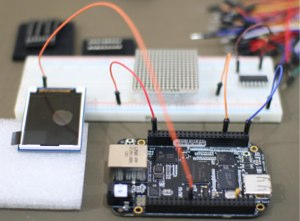 First, to the eMMC flash. This 2Gb of storage is one of the differences between the BBB and the Raspberry Pi machine. Bonnie wants to create files which are twice the size of the available memory on the system to avoid disk caches from interfering with the benchmark. Unfortunately, the BBB has 512Mb of RAM and with a default Angstrom installation. I only had about 500Mb of free space on the eMMC. So I had to use the second set of parameters to force files only up to 200Mb in size to be created.
user@bbb:~/test$ /sbin/bonnie++ -f -m bbb-emmc -d `pwd`
Writing intelligently...Can't write block.
Bonnie: drastic I/O error (write(2)): No such file or directory
user@bbb:~/test$ /sbin/bonnie++ -f -m bbb-emmc -s 200 -r 100 -d `pwd`
Sequential output was about 4.2Mb/s, rewrite at about 4.5Mb/s, and sequential input at 206Mb/s. The input figure is very likely to be incorrect because the entire file could be cached in memory. For comparison, the ODroid-U2 quad core ARM machinegot around 16Mb/s for sequential output and 12Mb/s for rewrite on it’s eMMC flash. Random create and delete on the BBB came to 10k and 6k files/s respectively. This was on an ext4 filesystem using the mount options: rw,relatime,data=ordered.
I compiled openssl 1.0.1e on the BBB which took 21.5 minutes to complete. The ODroid-U2 quad core ARM can compile the same code in 4 minutes using all of its cores and a desktop Intel 2600K in slightly less than 1 minute. Unfortunately I was using different versions of gcc on both platforms.
      BBB: gcc version 4.7.3 20130205 (prerelease) (Linaro GCC 4.7-2013.02-01)
ODroid-U2: gcc (Ubuntu/Linaro 4.6.3-1ubuntu5) 4.6.3
Fedora-18: gcc (GCC) 4.7.2 20121109 (Red Hat 4.7.2-8)
The openssl speed test only uses a single core on a machine. This doesn’t matter for the BBB, but on the ODroid-U2 there were three cores effectively going to waste during the test. Comparing the BBB to the ODroid-U2 openssl speed benchmarks we can see a range of 50 to 75 percent the speed of one core.
77%  1024 byte aes-256 cbc
73%  1024 byte md5
67%  1024 byte sha1
50%  1024 bit RSA sign
52%  1024 bit RSA verify
To test 2d graphics performance I used version 1.0.1 of the Cairo Performance Demos. The gears test runs three turning gears; the chart runs four line graphs; the fish is a simulated fish tank with many fish swimming around; gradient is a filled curved edged path what moves around the screen; and flowers renders rotating flowers that move up and down the screen. For comparison I used a desktop machine running an Intel 2600K CPU with an NVidia GTX 570 card which drives two screens, one at 2560×1440 and the other at 1080p.
           BBB fps    desktop 2600k/nv570
           at 720p    two screns.
  gears      26          140
  chart       2           16
   fish       4          188
gradient     10          117
flowers       1          170
For testing Web browsing performance, I used Firefox on both machines and ran the Octane Javascript benchmark. The Intel 2600K sets the top performance as expected with 9667 overall. Next up the ODroid-U2 came in at 1411 and the BBB at 367 which is 26 percent the performance of ODroid-U2. For most of the individual tests the BBB was 30 percent the speed of the ODroid-U2. Exceptions such as EarleyBoyer, NavierStokes, and Raytrace saw the BBB back in the 13 to 14 percent the performance of the ODroid-U2.
The Beagle Bone Black is a great little machine for anyone who wants to tinker with hardware. The collection of ports on offer to connect with other hardware is wonderful and you get to interface with the hardware you are tinkering with from a full Linux system. Having a full Linux system running the show means you can hook up very cheap small LCD screens and make them available as a normal frame buffer. Or run cron jobs to prod some hardware at intervals of your choosing, saving images or collected data right to the BBB eMMC and making it available over the Web.
Using some cheap LCD panels might take a bit more tinkering to get going with the BBB than on Arduino. Using a LCD from Arduino usually involves including a library to drive that hardware and compiling a program to upload to the Arduino. Your program uses whatever API the library that drives the LCD offers to show information. On the other hand, for Linux you might want the kernel itself to expose the screen as a normal frame buffer which might require you to recompile your kernel and possibly merge patches into your kernel source.
However on the BBB once you have the framebuffer setup, all of the lower level details like communicating over the Serial Peripheral Interface Bus (SPI) bus are abstracted from your application. You can then concentrate on making your Qt/QML, EFL, GTK, or Cairo application. As long as your application targets the resolution of your chosen display there shouldn’t be much porting of the user interface code from a Desktop Linux display to the LCD display which runs over SPI on the BBB.
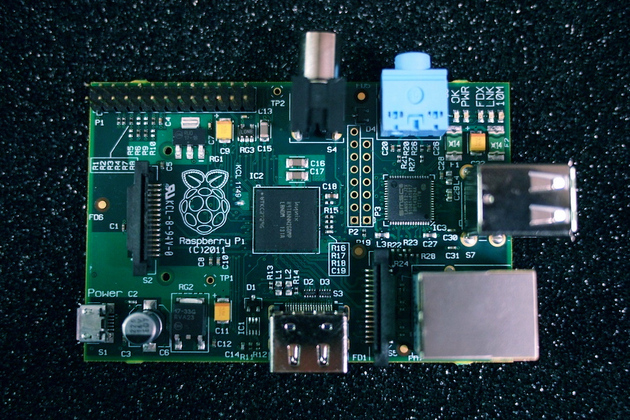
The Raspberry Pi has grown well beyond the founder’s original plans for an inexpensive student computer, and is now a staple in almost every hardware hacker’s toolkit. Wired tells the story of the Raspberry Pi Foundation, the British computer company that has become the face of a new wave of highly affordable computing. But the success of the Raspberry Pi Foundation wasn’t always a sure bet, and the initial loan request was denied due to an apparent lack of perceived market. Demand for the product turned out to be even bigger than original estimates, growing beyond the classroom and becoming a product adored by adult hardware hobbyists. Despite its broad success, the company is still focused on getting the Raspberry Pi into the hands…
Over at NewScientist, Sophie Hebden writes that a quantum computing now has its first practical, high-level programming language. And while today’s devices are not ready for most practical applications, the new Quipper language could guide the design of future machines and make them easier to program when they do arrive.

Now Peter Selinger of Dalhousie University in Halifax, Canada, and colleagues have brought the field up to speed by creating Quipper, the first high-level quantum programming language. Quipper is designed to express instructions in terms of bigger concepts, and to make it easy to bring together multiple algorithms in a modular way. High-level languages for classical computers such as Java do most of the heavy lifting in modern computation. Quipper is based on a classical programming language called Haskell, which is particularly suited to programming for physics applications. What Selinger’s team has done is to customise it to deal with qubits.
Quipper does not support the only quantum computer in the market today, the D-wave system. It uses a novel approach called adiabatic quantum computing and so is not currently compatible with Quipper.
Read the Full Story or download the paper on Quipper (PDF).
Related posts:
The post New Quipper Language is Like Java for Quantum Computers appeared first on insideHPC.
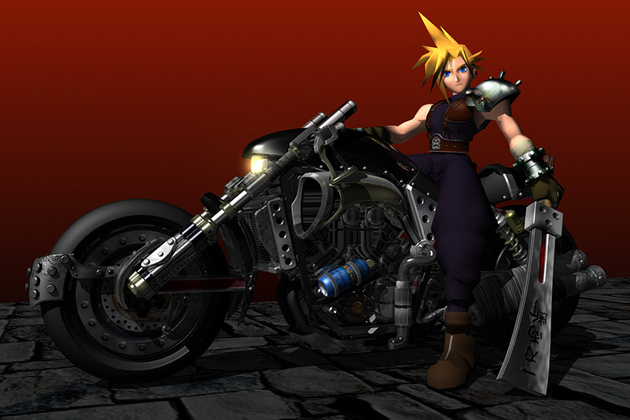
One of the biggest role playing games of all time is now available through Steam. Square Enix has just launched Final Fantasy VII on the service, almost a year after re-releasing the Windows version on its own site. The Steam version appears to be identical to that edition, which means it includes both achievements and cloud saving, in addition to the convenience of purchasing through Valve’s digital store. The seminal RPG, originally released on PlayStation back in 1997, will cost you $11.99. The news comes just days after Square Enix revealed a special pre-order bonus for the upcoming Lightning Returns: FInal Fantasy XIII, which will let players dress Lightning up as Cloud, FF VII‘s spiky haired, giant sword-wielding hero.
 Over at Professional Engineering, Lee Hibbert writes that Jaguar Land Rover is playing a leading role in a £10 million virtual engineering research program with EPSRC and four leading UK universities. The aim of the work is to the research is intended to improve the quality and capabilities of its simulation activities, from finite element analysis of individual component and subsystem design, through to whole-car visualization.
From JLR’s point of view, it wants to produce better cars and bring them to market in a shorter timeframe,” said Dr Mark Claydon-Smith at EPSRC. “But as models become more complex, there is a limit to what can be achieved from physical testing. So these projects will build on JLR’s existing knowledge, improving its capability in the medium term. From the academic side, the research will focus on systems engineering and new design methods and tools. It’s the sort of work that is hard to do in a laboratory. JLR has been generous in opening up its practices to provide real-world problems and information.”
Read the Full Story.
Related posts:
The post Jaguar Land Rover Looks to Digital Modeling to Improve Designs appeared first on insideHPC.

Samsung today released guidance for its latest financial quarter, and to the average eye they’re very positive. The company’s early figures reveal an operating profit of 9.5 trillion won (around $8.3 billion) from 57 trillion won ($49.9 billion) revenue. Those are the highest revenue and profits Samsung Electronics has ever posted, but despite the record-breaking figures, investors aren’t happy.