The Mobile World Congress (MWC) in Barcelona may be an Android-driven show, but several emerging open source mobile Linux projects also showed up to pitch their alternative visions. Canonical got the ball rolling last week by releasing preview versions of Ubuntu for Phones and Ubuntu for Tablets, and Samsung confirmed plans to fold Bada into Tizen. LG announced it was buying HP’s WebOS assets for use in new smart TV products — a transition that heaps even greater uncertainty on a mobile future for Open WebOS.
 The most substantial news came from Mozilla. Early supporters ZTE and Alcatel unveiled the first two commercial Firefox OS phones, and Mozilla announced new partners in LG and Huawei, which will also ship handsets this year. Meanwhile, Sony Mobile tipped a partnership with Spanish mobile provider Telefonica to explore the potential development of a Firefox OS handset expected in 2014.
Firefox OS launches are scheduled this year for Brazil, Colombia, Hungary, Mexico, Montenegro, Poland, Serbia, Spain, and Venezuela, says Mozilla. Additional markets, primarily in emerging nations, will be announced later, and Sprint users in the U.S, should see availability in 2014, says the company.
Carrier Friendly
Like the Samsung-backed Tizen project, which incorporates code from the earlier carrier-driven LiMo (Linux Mobile), Firefox OS has gained considerable backing from mobile operators. Telefonica was the first to vow Firefox OS support last year, and was later joined by Deutsche Telecom, Telecom Italia, and lone U.S. carrier Sprint. In Barcelona this week, Mozilla tipped more than a dozen new mobile providers, including China Unicom and KDDI, bringing the total number of partners to 17. América Móvil (Latin America) and Telenor (Europe) will join Telefonica and Deutsche Telecom in shipping Firefox OS phones this summer.
Wireless carriers are growing increasingly wary of Google’s domination of the mobile world, and they are intrigued by the greater branding and customization freedom promised by open source projects like Firefox OS and the Linux Foundation’s Tizen. The latter, which was released in a final 2.0 version earlier this month, has a similar open policy toward carriers, and even Canonical now appears to be open to third-party branding for Ubuntu for Phones.
Backing up its carrier-friendly claims, Mozilla announced that a new Firefox Marketplace for its HTML5-based apps will appear later this year, letting users buy apps directly from a mobile operator. The appstore, which will feature web-based apps like Facebook and Twitter, as well as games from EA and Disney, is notable for letting users try out apps before they buy. It can be previewed via Firefox for Android Aurora.
Not So Smartphones
It’s all very exciting news until one gets down the handsets themselves, which look more like smartphones from 2009 instead of 2013. For example, the Alcatel One Touch Fire, which Deutsche Telekom will launch in Poland in June prior to expanding elsewhere, runs on a modest, albeit Firefox OS optimized, 1GHz, Cortex-A5 Qualcomm Snapdragon. The 3G-only phone sports a prehistoric 3.5-inch HVGA display, and offers 256MB RAM, 512MB NAND, and a 3.2-megapixel camera.
The ZTE Open has similar specs, but with even pokier clock rates of either 600MHz or 800MHz. Aimed at Telefonica’s Latin American and European customers, the handset will have a bill of materials of less than $100, according to TechCrunch.
Low pricing will be crucial. Mozilla and its partners believe they have found an untapped segment between cheap, primarily Symbian-based, feature phones that still dominate in most low-income nations, and a new wave of increasingly low-cost Android smartphones. It could be a thin needle to thread, and one that could require carriers to initially subsidize and heavily promote Firefox phones.
Although cheap Android phones are now common in more developed emerging markets like China and India, there are many other nations where smartphones are only beginning to be introduced, giving Firefox OS a better chance. The good news for Mozilla is that Microsoft, BlackBerry, and Apple are farther behind in targeting consumers in emerging markets.
Open APIs and New Developer Phones
Despite the limited hardware, Firefox OS has attracted considerable developer support. The open source Firefox OS starts with a Linux kernel, but is largely built around Mozilla’s browser-oriented Gecko rendering engine, and is unlocked with web technologies led by HTML5. With its exclusive focus on web-based apps, it needs very little middleware, which Mozilla says leads to greater performance on relatively slow processors.
Given this web focus and simple design, developers who have used Android or other native app-oriented mobile Linux platforms are in for a new experience. By comparison, Tizen and Ubuntu for Phones provide more familiar native app development frameworks in addition to HTML5 APIs, and Jolla’s MeeGo-based Sailfish focuses primarily on native apps. Still, native app developers moving to Firefox OS should find it much easier going than for web developers learning a new native app framework.
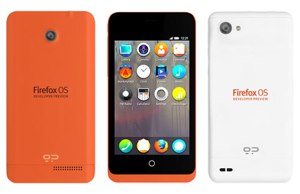
Firefox OS APIs and documentation are already available at the Firefox Marketplace Developer Hub, and starting next month, developers will be able to dig into the first of two developer reference phones. Announced last month and sold by Spanish online phone seller and Telefonica partner Geeksphone, the low-end Keon phone was demonstrated at MWC, according to Engadget.
A higher-end Peak model from Geeksphone will follow. It moves up to a 1.2GHz, dual-core Snapdragon S4, and features a 4.3-inch qHD display and dual cameras, including an 8-megapixel device. Those specs should give it a fighting chance in the U.S. next year when Sprint tips its Firefox OS hand.

