
The Lumias are here. What’s Redmond got to show?
Analysis It’s two years since the “Elopocalypse”. This week in 2011 Nokia’s new CEO Stephen Elop set Europe’s biggest technology company off in a radical new direction.…
Read more at The Register

Chances are you know about the digital divide, but not about the Kramden Institute’s work to help hardworking students in grades 3 – 12 who don’t have a computer in their home cross it. You also might be shocked to learn that while information technology seems to be ubiquitous, a full 23% of U.S. households still don’t have a computer.
Cloud storage may be on the move, but local network-attached storage (NAS) systems continue to be in hot demand, especially as they integrate cloud backup and mobile access. In the enterprise NAS, unified storage, and SAN (storage area network) world, Linux shares the pie with Unix and Windows. But in the faster-growing small and medium business (SMB), small office and home office (SoHo), and consumer NAS segments, Linux is clearly dominant.
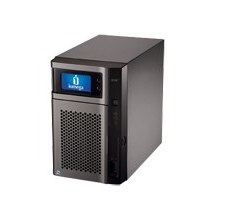 The NAS market grew 21.5 percent to $4.5 billion year-over-year in 2011, according to a Gartner study. Recently, TechNavio projected the SMB NAS market alone would grow 51.1 percent from 2011 to 2015.
The major vendors in the under-$5,000 NAS segment all sell Linux-based devices: Netgear, Qnap, Synology, and Buffalo Technology. Although listed here in descending order of market share, according to Gartner, none own more than 20 percent. Not surprisingly, this booming, wide-open market has attracted some newer players like LG and Lenovo, which recently invested 51 percent in a new LenovoEMC joint venture for NAS. LenovoEMC is built upon EMC’s Iomega NAS division, which has a strong presence in Linux SMB and SoHo NAS devices. EMC — the market leader in enterprise storage along with NetApp — partnered with Lenovo to replace longtime PC/server partner Dell, which is now developing its own storage products.
NAS vendors are drawn to Linux for its stability, security, and low cost. Linux rarely requires patching, is relatively immune to virus attacks, and can usually run in flash memory for even greater security. Lack of licensing fees is also a draw of course, although at least one NAS vendor — Buffalo — pays Microsoft via a patent covenant for the privilege of using Linux.
The following slide show of top 10 Linux-based NAS devices for SoHo users includes a range of $200 to $1,000 desktop boxes that support 2 to 4TB of built-in networked storage. All these devices run on embedded Linux, and support attached Linux desktop PCs in addition to other platforms. (Brother’s LinkStations are not included here in part due to the fact that while they’re Linux-compatible, they do not come with Linux support.)
Software is becoming increasingly important in NAS reviews at sites like CNET, PCMag, and PCWorld. The robust suites of utilities available with even the lowliest Synology and Qnap devices are especially praised, with Synology’s DSM software singled out for its ease of use. Both vendors, as well as Netgear, Iomega, and a few others, freely share their open source code and provide development tools and resources that attract developers to write utilities and add-ons. As a result, NAS devices continue to move into new applications, from media serving to video surveillance.
These days, even low-cost consumer NAS devices provide software with a wide variety of built-in servers, including web, print, BitTorrent, FTP, and iTunes. Increasingly, many offer remote mobile access and sync, cloud-based backup, video storage, and advanced RAID and iSCSI support.
Higher-end devices in the SoHo segment — or low-end SMB systems — tend to have dual-core Intel Atom D510 processors. Most consumer/SoHo devices instead run on slower, but less power-hungry Marvell ARM processors. More RAM also improves performance, as well as other components involved in data transfer, including the hard drives themselves.
In the slide show, I list the lowest available prices for diskless models unless they are unavailable. Sometimes, built-in storage can be cheaper (and easier) than spending $75 to $100 per 1TB drive, but in other cases, buying your own drives is more affordable. Higher-end models can also require specific drives to get full functionality and performance.
More and more systems now offer WiFi, typically via a USB dongle. However, WiFi’s lower bandwidth tends to negate any performance edge a faster system might provide. All NAS devices have a gigabit Ethernet port, but some double up on Ethernet for load balancing and port trunking. Many systems offer at least two, if not three USB ports, and may add an eSATA port or two. Other features to look for include K-lock security, hot-swappable drives, and LCD displays.
Our slide show omits low-cost consumer NAS devices that lack built-in storage, and instead depend solely on USB drives. These are led by Marvell SheevaPlug-based Linux devices like the under-$100 PogoPlug or TonidoPlug. Like a growing number of SATA-based NAS systems, they often support streaming media server duty and remote access from mobile devices. Addonics’ NAS 3.0 Adapter is another notable contender here.
Taking the DIY approach one step further, you can always build your own NAS device using a Linux PC. There are numerous open source Linux software options available including NASLite, CryptoNAS, and OpenMediaVault. Last week Amahi and Splashtop announced a partnership by which the open source Amahi NAS software can be extended with Splashtop’s VPN-like remote access software to enable streaming of NAS content to mobile devices.
Click on the gallery link below to see a slideshow of 10 solid bets in Linux-ready NAS systems under $1,000, listed in ascending order of price, with lowest current prices listed.
If the arrival of Windows 8 opened new doors for Linux in the world of desktop operating systems last fall, then it seems fair to say that the recent arrival of Microsoft Office 2013 and Office 365 has surely done something similar for free and open source office suites.
 After all, much the way Windows 8 imposed a whole new mobile-inspired paradigm on desktop users who weren’t necessarily willing to buy into it, so the newest Office generation has brought big changes in everything from the format to the pricing plan.
So, as the world mulls the significance of President Obama’s recent State of the Union address, there could hardly be a better time to look at the current state of open source office software—particularly given that several of the key players just got big updates.
Read on, then, for some of the highlights of where things stand in the world of free and open Office alternatives.
Clearly leading the pack of free and open source office suites is LibreOffice, the fork of OpenOffice.org that was created back in 2010. Widely held up as a shining example of FOSS success, LibreOffice has flourished since its founding, steadily gaining stability and performance improvements as well as exciting new features along the way.
Hard on the heels of the software’s second birthday last fall, the Document Foundation recently released version 4.0 to considerable fanfare. The software offers six feature-rich applications and is included by most leading Linux distributions. Particularly notable about this latest release are all the many improvements made to interoperability.
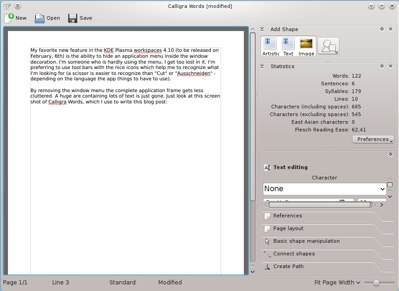 Even more recently, the Calligra Suite that grew out of the KDE project’s KOffice in 2010 reached a significant milestone as well with the appearance of version 2.6. With versions for desktop PCs, tablets, and smartphones, this package brings numerous improvements across its eight applications. Surely most noteworthy among them, however, is the addition of Calligra Author targeting both novelists and textbook authors.
While they may not have seen updates as recently, there are also several other key players in the world of open source office software, of course, including also Apache OpenOffice.
Now under the purview of the Apache Software Foundation, it’s this suite that was forked to create LibreOffice, so the two definitely share many similarities. The current version 3.4 of Apache OpenOffice has been downloaded more than 30 million times, the project says.
Also worth mentioning are OxygenOffice Professional—an enhanced version of OpenOffice—and Feng Office Community Edition, a free and open source online project management and collaboration tool. The popular Google Docs, of course, is not open source software.
In any case, there’s no doubt these and other open contenders are increasingly offering a viable alternative to business users.
“The open source office software alternatives still represent a minority of users, but the good news is that conversion to and from other office software suites, particularly Microsoft’s, makes it possible to function in today’s business world with these open source options,” Jay Lyman, a senior analyst with 451 Research, told Linux.com.
“In terms of capabilities and features, the main open source options such as LibreOffice and OpenOffice have also come a long way in this regard, matching most of the functionality provided by their proprietary counterparts, Lyman added.