

Home Blog Page 604

Growing Your Open Source Community With Twitter

Engagement in an open source community leads to collaboration, says Jason Hibbets, community evangelist at Red Hat. And social media is one good tool that projects can use to help increase engagement in their communities, he adds, “because you can reach a broad audience at pretty much no-to-low costs.”

Hibbets will discuss how Red Hat has increased engagement with one such social media tool, Twitter chats, in his talk at Open Source Leadership Summit in Lake Tahoe on Feb. 16, 2017. Here, he shares with us some of his reasoning behind why engagement is important, some best practices for increasing engagement, and a few lessons learned from Red Hat’s Twitter chats.

Linux.com: Why should an open source project be concerned with building engagement?

Jason Hibbets: Let’s first start with why have a community in the first place? A community is a group of people who come together with a common vision, collective passion, and shared purpose. Communities bring together a diverse group of people to share work and can accomplish more than individuals can alone.

Many open source projects exemplify these qualities and come together to form a community. Typically, an individual wants to solve a problem (scratch their own itch) and it just so happens that other people are trying to solve a similar problem. When communities collaborate to solve these problems together, it leads to better outcomes and results.

So, why should leaders be concerned with engagement? Engagement leads to collaboration. And if communities can collaborate, then work gets done and they can achieve something together. As an individual, your knowledge is limited. There will be a point when you want feedback, need advice, or get stuck. If you have an engaged community, you are building in a human-powered support system.

Linux.com: What are some of the best practices, in general, for increasing engagement and gaining more active followers?

HIbbets: I’ll share two best practices, but believe me there are a lot more. The first is to provide a safe environment. The second is to create value.

Having a well-written Code of Conduct and enforcing those rules is a foundation for having a safe and inviting environment. This can ultimately lead to increased participation from a more diverse group of contributors and creative problem-solving with faster, more innovative solutions.

A second best practice is to provide value. In the community programs I’ve built, you need to think about why a person would volunteer their precious time to contribute–this is commonly referred to as the “what’s in it for me?” question.

When contributors are finding value in the community, they are more likely to be engaged. And if they are more engaged, they can become your advocate. Which can lead to the best type of marketing for your community, word-of-mouth recommendations.

For more best practices about community building, I recommend reading The Art of Community by Jono Bacon.

Linux.com: Why is social media, and Twitter in particular, a good place for open source projects to do outreach?

Hibbets: In general, social media is a good place for outreach and amplification because you can reach a broad audience at pretty much no-to-low costs (other than your time). The challenge, of course, is putting in the investment and time to build a following, a content strategy, and determine the right way to fit into each social media community.

Twitter is a great platform for open source projects because of ease-of-use and, for now, unfiltered streams. Engagement levels can be higher, and people follow specific hashtags. Once you filter through all the noise, there is a lot of valuable information that can be found for open source communities.

And bonus, there’s a lot of open source behind each Tweet.

Linux.com: What is a Twitter chat?

Hibbets: I like to describe a Twitter chat as a public-facing conversation at a set time, using Twitter as the platform and a hashtag as the way to follow. It’s the equivalent of using a chat room in IRC (Internet relay chat) or similar chat functionality, but instead, you’re using and following a hashtag on Twitter. What it boils down to for our Open Organization community on Opensource.com is to have focused discussions on topics with several source matters experts invited to participate and help lead the discussion. For example, last October, we talked about the intersection of DevOps and Open Organizations.

There are several different formats Twitter chats can take. We chose to do more of a live event where we are actively Tweeting questions for an hour and watching the responses come in. My team leads the conversation, monitors the responses, and learns from our community. Participants learn from other participants and make valuable connections that enhance their network.

Linux.com: How do you measure progress and what’s the goal?

Hibbets: My talk at the Open Source Leadership Conference will be on building a community using Twitter chats for our Open Organization community. The examples I will use come from my experience doing this for the Open Organization community, so  I’ll focus on my response on that aspect.

First off, the goal is two-fold: to build awareness of our community and attract new people to join the conversation.

By hosting a Twitter chat, we are able to have an amazing conversation with our community. Seeing the engagement, responses, and interactions really makes me proud as a community manager. We are having a conversation that is engaging to people with vastly different roles–from solutions architects to consultants, and open source project leaders to people managers outside of open source. We have a diverse audience of participants.

So, how do we measure success? There are two main metrics we are concerned with: the number of unique participants and how many Tweets they generate. From there, we can calculate more impressive numbers like total reach and total timeline exposures. These numbers can impress managers, which is helpful, but the more meaningful metrics are really around the number of active participants as well as how many new people continue to join.

To give you some context, on average, we have about 30-50 unique participants generating about 300-400 tweets in about an hour.

Linux.com: What did you learn from hosting regular Twitter chats with your community?

Hibbets: There are three things we learned I’d like to share. First, there are people out there who not only want to have this conversation in the first place, but want to continue the conversation. The number of repeat participants that come back to our Twitter chats is high for the Open Organizations community. .

Second, being prepared makes our “live” events successful. We did a number of things (which I cover in extreme detail in my talk) that makes our event run smoothly. A few examples include promoting your Twitter chat in advance, preparing your questions ahead of time, and sharing your questions with invited guests in advance.

Third, having guest hosts and source matter experts is critical. Nothing draws a crowd more than a crowd, right? We found that inviting experts to join us and putting them in the spotlight worked really well for our community building efforts.

Join us for a future #OpenOrgChat Twitter chat to see what it’s all about.

Want to learn more about what it takes to grow an open source project? Tune in for the free live video of Open Source Leadership Summit. Sign up now!
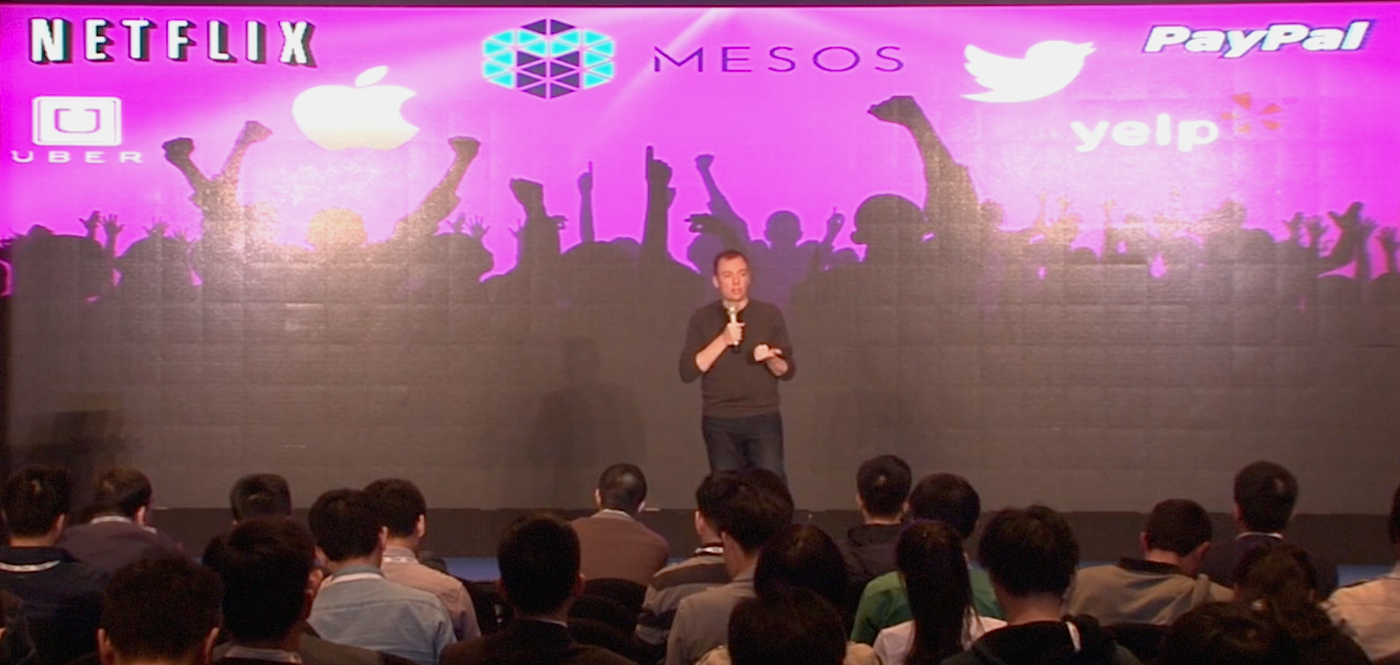
Taming the Mesos Bleeding Edge with DC/OS

Satya Nadella, the CEO of Microsoft, famously said: “Every business will become a software business, build applications, use advanced analytics and provide Saas services.” That’s a bold prediction. Aaron Williams, Head of Advocacy and DC/OS at Mesosphere, believes it’s true and that DC/OS is the bridge to this new world. He tells us why at MesosCon Asia 2016.

There has to be a business case for all of this upheaval. For early adopters such as Adobe, Twitter, IBM, and many other industry bigwigs, it’s about doing things nobody could do before, and they have the resources to experiment.

But what do you if you’re not an industry titan with vast resources? Containers, microservices, Apache Mesos, these are all massive change-movers, upending datacenters and remaking them in completely different ways, and changing how business operate. Everything is different. “It’s really a story of increased complexity,” says Williams, “Going from a single mainframe to multiple servers to virtual machines to containers inside virtual machines. You increase the sophistication of your data center. You increase the complexity of your data center.”

All of this requires much more than just Mesos. It’s a constellation of all different kinds of software: data analytics engines, containers, container orchestrators, service discovery, monitoring and alerting…the good news all of this is open source software. It’s freely available, freely shared, and supported by large communities of skilled motivated users. This is one of the most startling changes — competitors in all industries cooperating on building and sharing core software stacks.

The bad news is the complexity: you just want to build your apps and services and not have to invest large resources in building the supporting framework. This where DC/OS comes in. Williams says, “I think what you’ll find is that the DC/OS project does a good job of bringing together the core components that are needed, makes it easy for you to install, easy to get started… We’ve got a GUI and a CLI… You can install your favorite frameworks, analytics, big data, fast data, etc. Then we have what’s called the Universe, which gives you an easy one-click or one-command way to install these frameworks into your data center.”

In a short amount of time, we’ve gone from having to painfully piece everything together and do a lot of custom coding to having a nice ready-to-use platform in DC/OS.

Watch Williams’ complete talk (below) to learn more about the key DC/OS components, and how large vendors like Autodesk use DC/OS to streamline their datacenter and invest more resources in microservices and applications that move their businesses forward.

https://www.youtube.com/watch?v=vtIMmstNtvQ?list=PLbzoR-pLrL6pLSHrXSg7IYgzSlkOh132K

Interested in speaking at MesosCon Asia on June 21 – 22? Submit your proposal by March 25, 2017. Submit now>>
Not interested in speaking but want to attend? Linux.com readers can register now with the discount code, LINUXRD5, for 5% off the attendee registration price. Register now to save over $125!

It’s Complicated, Okay (or Let’s Talk Openly about Mesos’ OSS Neighbors, Friends, and Rivals)

https://www.youtube.com/watch?v=vtIMmstNtvQ?list=PLbzoR-pLrL6pLSHrXSg7IYgzSlkOh132K

Aaron Williams, Head of Advocacy and DC/OS at Mesosphere, discusses the characteristics of what makes some solutions work well with Mesos and calls out the projects that don’t meet the standard.


Postmortem of GitLab Database Outage of January 31

On January 31st 2017, we experienced a major service outage for one of our products, the online service GitLab.com. The outage was caused by an accidental removal of data from our primary database server.

This incident caused the GitLab.com service to be unavailable for many hours. We also lost some production data that we were eventually unable to recover. Specifically, we lost modifications to database data such as projects, comments, user accounts, issues and snippets, that took place between 17:20 and 00:00 UTC on January 31. Our best estimate is that it affected roughly 5,000 projects, 5,000 comments and 700 new user accounts. Code repositories or wikis hosted on GitLab.com were unavailable during the outage, but were not affected by the data loss. GitLab Enterprise customers, GitHost customers, and self-hosted GitLab CE users were not affected by the outage, or the data loss.

Losing production data is unacceptable. To ensure this does not happen again we’re working on multiple improvements to our operations & recovery procedures for GitLab.com. In this article we’ll look at what went wrong, what we did to recover, and what we’ll do to prevent this from happening in the future.

Read more at GitLab

PHP vs. Node.js: An Epic Battle for Developer Mind Share

…PHP and JavaScript, two partners who once ruled the internet together but now duke it out for the mind share of developers.

In the old days, the partnership was simple. JavaScript handled little details on the browser, while PHP managed all the server-side tasks between port 80 and MySQL. It was a happy union that continues to support many crucial parts of the internet. Between WordPress, Drupal, and Facebook, people can hardly go a minute on the web without running into PHP. 

Then some clever kid discovered he could get JavaScript running on the server. Suddenly, there was no need to use PHP to build the next generation of server stacks. One language was all it took to build Node.js and the frameworks running on the client. “JavaScript everywhere” became the mantra for some.

Read more at Network World

Practical Approaches to IoT Test Challenges

For engineers working on wireless-enabled IoT system designs, a variety of design challenges and tradeoffs transpire from start to finish. Moving efficiently through the process requires a good test-and-measurement strategy and proper instrumentation to ensure that you make timely and correct design decisions and can overcome potential roadblocks. Not only that, you need to deliver your project on time and on budget. IoT designers face six key challenges where test and measurement is a critical part of the project’s ultimate success:

Read more at Electronic Design

Linux Enhanced BPF (eBPF) Tracing Tools

This page shows examples of performance analysis tools using enhancements to BPF (Berkeley Packet Filter) which were added to the Linux 4.x series kernels, allowing BPF to do much more than just filtering packets. These enhancements allow custom analysis programs to be executed on Linux dynamic tracing, static tracing, and profiling events.

Read more at Brendan Gregg

Python Programming Basics With Examples

Python is a popular and a powerful scripting language that can do everything — web crawling, networking tools, scientific tools, Raspberry PI programming, web development, video games, and much more. With Python programming, you can do even do system programming regardless of the platform you are using.

We will discuss basic Python programming in this post. In future posts, we will build tools and see Python programming in action.

If you find the content of this post is a little tricky, tell me so that I can start from the bottom level of Python programming in the upcoming posts.

Read more at DZone

Zorin OS 12 Review | LinuxAndUbuntu Distro Review Of The Week

Zorin OS is an Ubuntu-based Linux distro that seeks to stand out amongst the many Linux distros around. It is touted as “a replacement for Windows and MacOS, designed to make your computer faster, more powerful and secure”. So what’s the deal with Zorin? Is it worth your attention in the sea of distros? Let us take a look at what makes this distro stand apart.
 

Read More At LinuxAndUbuntu

OPNFV Nearing Commercial Deployment

The somewhat long-awaited report on OPNFV’s December Plugfest emerged this morning, revealing no major surprises but taking some steps forward on integration with other open source projects, namely the Open Compute Project and Open Orchestrator.

It also signals a stage where the OPNFV Project’s software platform could be ready for commercial deployment — dates for which the organization is not setting directly. “We’ll defer to the vendors on that,” says Heather Kirksey, OPNFV director. But she expects to start collecting deployment data this year. Queries to a couple of the involved vendors have not yet produced responses, but stay tuned.

Read more at LightReading