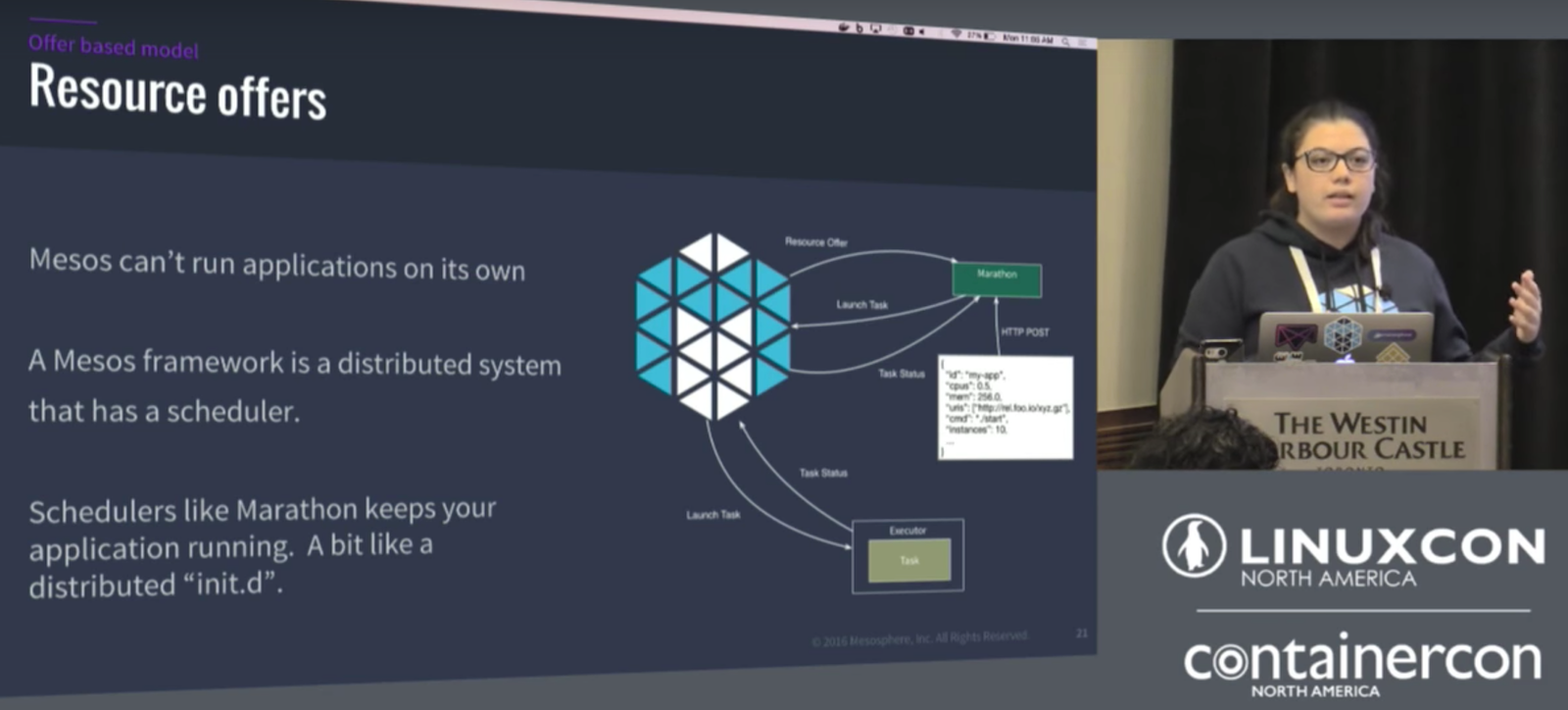
Current most popular container orchestration tools do not offer a failover mechanism for stateful Applications. In this talk from LinuxCon, Apache Mesophere’s Isabel Jimenez and Kapil Arya demonstrate container migration on an Apache Mesos cluster and a more enjoyable way to schedule your Containers.
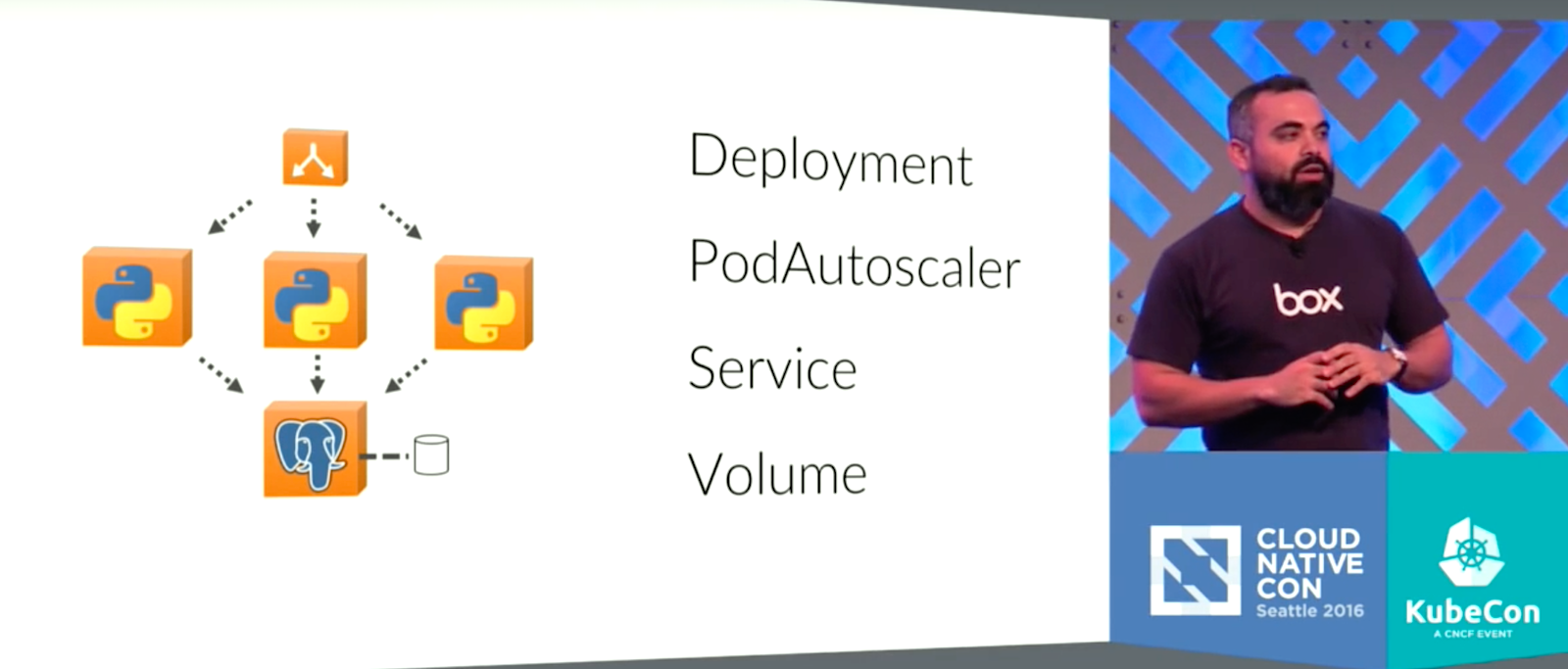
The Kubernetes community is building a platform that will make application development completely cloud infrastructure agnostic. Sam Ghods, co-founder of Box, said Kubernetes’ combination of portability and extensibility put it in a class of its own for cloud application development, during his CloudNativeCon keynote in November.
This year (2016) I accepted as much incident response work as I could. I spent about 300 hours responding to security incidents and data breaches this year as a consultant or volunteer.
This included hands on work with an in-progress breach, or coordinating a response with victim engineering teams and incident responders.
These lessons come from my consolidated notes of those incidents. I mostly work with tech companies, though not exclusively, and you’ll see a bias in these lessons as a result.
Interview with Björn Rabenstein, Production Engineer at SoundCloud
A lot of companies and organizations have adopted Prometheus and the project quickly gained an active developer and user community. It is currently a standalone open source project maintained independently of any company. In 2016, Prometheus joined the Cloud Native Computing Foundation as the second hosted project after Kubernetes. We talked to Björn Rabenstein, engineer at SoundCloud and Prometheus core developer, about how Prometheus can help companies adopt DevOps.
JAXenter: Would you call Prometheus a DevOps tool?
Björn Rabenstein: Absolutely. I mean, there are so many different understandings of what DevOps actually means, but I dare to say that Prometheus fits most of them….
Patent trolls were down but certainly not out in 2016. After a massive burst of litigation at the end of last year, we saw a noticeable drop in patent troll lawsuits at the start of this one. But trolls began returning to court as the year continued and 2016 will likely end with a relatively small overall decline. Consistent with recent trends, troll cases clustered in the Eastern District of Texas. Approximately one in three patent suits were filed in that remote, troll-friendly district, and these suits were almost all filed by companies with no business other than suing for patent infringement.
With many of the worst patent suits clustering in Texas, recent reform efforts have focused on requiring that patent suits be brought in forums that have meaningful ties to the dispute.
A common rap against OpenStack is that the platform hasn’t caught on with public clouds. But that’s too U.S.-centric of a viewpoint, according to findings published by Forrester Research this week.
In his LinuxCon Europe keynote, Dan Kohn, Executive Director of the Cloud Native Computing Foundation (CNCF), provided with a brief history of the cloud and how CNCF fits with where we are now
How we use computing infrastructure has changed drastically over the past two decades, moving from buying physical servers to having tools and technologies that make it easy for companies and individual developers to deploy software in the cloud. In his LinuxCon Europe keynote, Dan Kohn, Executive Director of the Cloud Native Computing Foundation (CNCF), provided us with a brief history of the cloud and how CNCF fits with where we are now.
Kohn starts with the year 2000, when you had to buy physical servers before you could deploy a new application, and if you needed more capacity, you bought more servers. In 2001, VMware “had the relatively brilliant idea of virtualizing that server so that each application could have it’s own virtual environment and you could have multiple different applications sharing the same physical server,” Kohn said. Moving on to 2006, Amazon popularized the idea that you could rent your servers by the hour, instead of buying them, and you don’t need to buy more capacity until you actually need it, which can save companies quite a bit of money. In 2009, Heroku made it easy for developers to deploy applications “without having to think of all the details about operating systems and versioning and keeping things up to date, and you didn’t necessarily need to hire the ops staff,” Kohn says.
Next, Kohn shifts from talking about proprietary technologies that shaped the history of the cloud and on to open source solutions, starting with OpenStack in 2010, which provides open source Infrastructure as a Service (IaaS) solutions based on VMs that compete with AWS and VMware. Cloud Foundry came along in 2011 to compete with Heroku to provide an open source Platform as a Service (PaaS) using containers. Jumping to 2013, Docker emerged to take technologies that have been around for years and combine them with better user interfaces and marketing, thus bringing containers to the masses.
This brings us up to the present with the 2015 formation of the Cloud Native Computing Foundation (CNCF). Kohn says that “cloud native computing uses an open source software stack to segment applications into microservices, packaging each part into its own container and dynamically orchestrating those containers to optimize resource utilization.” The value propositions from cloud native computing include isolation, no lock-in, unlimited scalability, agility and maintainability, improved efficiency and resource utilization, and resiliency.
To learn more about how you can host your project at CNCF or get more involved in the project, you can visit the CNCF website and watch the video of Kohn’s entire keynote presentation.
Interested in speaking at Open Source Summit North America on September 11 – 13? Submit your proposal by May 6, 2017. Submit now>>
Not interested in speaking but want to attend? Linux.com readers can register now with the discount code, LINUXRD5, for 5% off the all-access attendee registration price. Register now to save over $300!
Conky is a system monitor that can display information about your CPU, memory, swap, disk space, temperature, top, upload, download, system messages… the list goes on and on.
Microsoft announced support for the Unix Bash shell on Windows, providing developers and administrators with an important tool for managing Unix and Linux servers.
Secondly, where there had been a void in the area of management and network orchestration (MANO), suddenly there was a glut. Two competing groups established MANO open source projects. And a service provider, AT&T, even jumped into the open source MANO fray.