The cloud continues to be a significant force in enterprise computing and technology adoption. Enterprises that have adopted cloud have seen slashes capital expenses, increased agility, centralized information management, and scaled their businesses quickly.
The 2015 RightScale State of the Cloud Survey estimates that 93% of respondents are adopting cloud – 88% are using public cloud, 63% using private cloud, and 58% using both.
In May, we reported on an Embedded Linux Conference talk by Open Connectivity Foundation (OCF) Executive Director Mike Richmond on the potential for interoperability between the OCF’s IoTivity IoT framework and the AllSeen Alliance’s AllJoynspec. We also looked at how the OCF has evolved from the earlier Open Interconnect Consortium (OIC) and acquired the assets of the Universal Plug and Play (UPnP) Forum. Here, we examine another ELC 2016 talk about the specifics of those integrations, as well as other changes planned for the IoTivity 2.0 release due later this year.
The Iotivity 2.0 talk (see full video below) was presented by Vijay Kesavan, a Senior Member of Technical Staff in the Communication and Devices Group at Intel Corp. Kesavan is a seed contributor to the core IoTivity library, and currently serves as the Business Development Task Group chair for OCF.
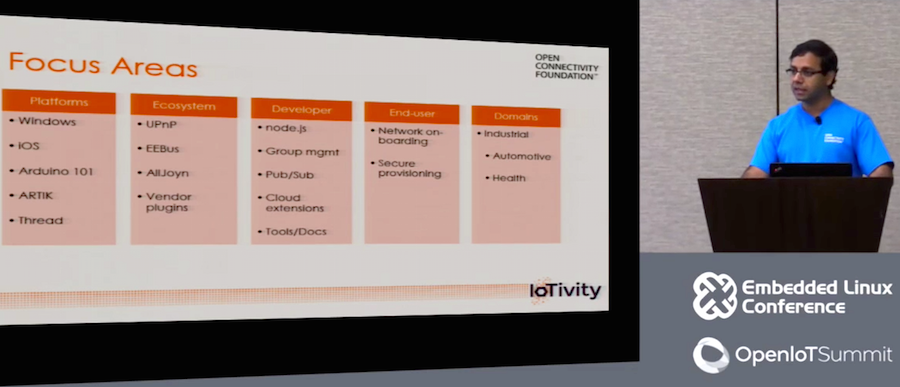
Speaking shortly after the release of IoTivity 1.1, Kesavan told the ELC audience about plans to support new platforms and IoT ecosystems in v2.0. He also explained how the OCF is exploring usage profiles beyond home automation in domains like automotive and industrial.
Joining the IoTivity Party: iOS, Windows, UPnP, and Arduino 101
IoTivity currently supports Linux, including specific Ubuntu and Android support, as well as Arduino. Version 2.0 will expand that to Windows and iOS. For iOS, the OCF is essentially doing what it did for Android: adding support in the “upper stack built on C++” rather than the lower C-based stack, in order to expose IoTivity to the iOS API, said Kesavan. The Windows integration will be more substantial. “We’re porting IoTivity to Windows so it can build upon Visual Studio 2013,” he said.
New hardware targets will include Intel’s Arduino 101 board. Arduino 101 runs the Arduino IDE on the Intel-developed, open source Zephyr OS, which itself runs on an Intel Curie module based on an Intel Quark SE chip. “Zephyr and IoTivity have the same data model, but the APIs are not yet compatible,” said Kesavan. IoTivity 2.0 will also support Samsung’s Linux-ready Artik embedded modules.
Integrating IoT ecosystems is a more challenging problem. Much of v2.0 is about supporting legacy UPnP devices. “We’re doing a lot of work in protocol translations, exposing UPnP devices using a plugin mechanism,” said Kesavan. “A UPnP device will essentially be discovered and seen as an OCF device.”
In the future, the OCF will translate IoTivity’s REST APIs to UPnP’s SOAP/XML representations, he added. There are also plans to integrate the UPnP AV data model directly to IoTivity to support audio and video.
IoTivity 2.0 will also include “some work” in interoperability with AllJoyn, although in v2.0, this work will not be as comprehensive as the UPnP integration. “There will be an AllJoyn plugin that maps AllJoyn into the OCF model and talks to AllJoyn routers, and maybe talk to some of the thinner devices like lightbulbs,” said Kesavan.
Additionally, IoTivity 2.0 will include the beginnings of interoperability with EEBus, a European IoT spec for energy management in homes and smart buildings. Specific device integration will also be provided for IoT device families like Nest, LIFX, and Hue. Presumably, the Nest support would include some integration with Nest’s Weave IoT protocol, but Kesavan did not go into specifics.
NodeJS and Group Management
The big news for developers in v2.0 is the support for NodeJS at the API level. There will also be better group management features, making it easier to create and manage conceptual groups of IoT devices, and detailing “how you add and remove devices and add security,” said Kesavan.
Other new developer-focused features will include Pub/Sub integration, more cloud extensions, and better tools and documentation. When asked whether IoTivity would expand to different transport protocols beyond its Constrained Application Protocol (CoAP) to support HTTP, Kesavan said there were “no plans for 2.0 but we’re looking into it.”
Finally, IotTvity 2.0 will feature end user improvements including better support for “network onboarding” of tools. “This will make it easier for end users to add a device to a WiFi or BLE network,” said Kesavan.
New Industrial Domains: Supply Chain, Automotive, and More
For future release, the OCF is beginning to look beyond the smart home to new industrial domains with very specific usage requirements. In the shipping business, for example, there are considerable questions about how IoTivity could be modified to support asset tracking and smart logistics in the supply chain. “The industry wants to move beyond bar codes to add smart sensors that continuously monitor shipments,” said Kesavan.
Sensors are being implemented first for high value goods and perishables like vaccines and food that need to maintain consistent temperature and other conditions. “Today, you don’t know about the quality of the goods until you open the box,” said Kesavan. “But if you knew the temperature threshold was being breached closer to the time it happened, you could take action earlier. We’ll see coin-cell driven sensors attached to boxes and pallets to measure things like temperature, shock, and humidity. At each step, that data can be read and aggregated through a gateway to the cloud.”
Industrial supply chains present challenges like scale, density, and quality of service that are less common in the home. “If you have all these boxes all transmitting status over BLE or ZigBee, how do manage interference?” said Kesavan. “We can have gateways coordinate with each other on load balancing, handoffs, and channel allocations.”
The OCF is looking into how to integrate DDS for quality of service, and how to operate on highly constrained devices. “We’ll also need to look at better security at both the device and hierarchical level,” he added.
Other domains under evaluation include medical and automotive. In automotive, the OCF is working with both the Automotive Grade Linux (AGL) and GENIVI standards organizations. “The next step will be creating an automotive profile for IoTivity,” said Kesavan. “We’ll look at how you integrate wearables, and communicate between the car and a home gateway, including scheduling smart charging. We’ll look at how we talk to various automotive buses, as well as other cars or infrastructure using V2V or V2I.”
As the OCF’s industrial workgroups pull together requirements for these and other domains, they need more participants with domain experience. “Please join the OCF,” said Kesavan. “We need your expertise.”
Need a tiny, $5 computer to build a robot that will bring you your slippers, initiate a massage chair session, and pour out your daily dose of bourbon?
This tiny board is Arduino-compatible but also runs Linux natively. This means you can plug it in and get a command line or access the system via a desktop-like web interface. It has Wi-Fi built in and can be expanded to support cellular, Bluebooth, and GPS connections.
“Omega2 is a Linux computer designed for hardware projects. It does a few things. First it allows software developers to develop hardware using high-level programming languages and familiar developer tools. …”
Google has started building a new open-source operating system that doesn’t rely on the Linux kernel.
While Android and Chrome OS have Linux at their heart, Google’s new OS, dubbed Fuchsia, opts for a different kernel to create a lightweight but capable OS, suitable for running all Internet of Things devices, from embedded systems to higher-powered phones and PCs.
Instead of the Linux kernel, Google’s new OS uses Magenta, which itself is based on LittleKernel, a rival to commercial OSes for embedded systems such as FreeRTOS and ThreadX. According to Android Police, Magenta can target smartphones and PCs thanks to user-mode support and a capability-based security model not unlike Android 6.0’s permissions framework.
Data scientists have a lot of tools at their disposal, but not all of them are equally accessible. Aiming to put IBM’s Watson AI within closer reach, analytics firm Columbus Collaboratory on Thursday released a new open-source R extension called CognizeR.
R is an open-source language that’s widely used by data scientists for statistical and analytics applications. Previously, data scientists would have had to exit R to tap Watson’s capabilities, coding the calls to Watson’s APIs in another language, such as Java or Python.
As DevOps has come into its own, IT automation companies such as Chef have made automating and managing release pipelines simpler. At ChefConf 2016, Chef announced new tools which include Chef Automate, which pulls together all of Chef’s IT automation tools in one package. How DevOps teams communicate with others in their business has also changed with the rise of tools such as Slack, HipChat, and processes such as ChatOps.
In this episode of The New Stack Makers podcast embedded below, we explore how Chef Automate and ChatOps enable DevOps teams to work more efficiently, the ways in which agile development practices have shaped DevOps, and how the culture of DevOps has evolved as the ways in which businesses use software has changed. Electric Cloud Chief Technology Officer Anders Wallgren and ChatOps software provider VictorOps DevOps evangelist Jason Hand spoke with TNS consulting engineer Lee Calcote and TNS managing editor Joab Jackson at ChefConf 2016 for this podcast.
In the previous six articles in this series we learned how to manage version control on text files with Git. But what about binary files? Git has extensions for handling binary blobs such as multimedia files, so today we will learn how to manage binary assets with Git.
One thing everyone seems to agree on is Git is not great for big binary blobs. Keep in mind that a binary blob is different from a large text file; you can use Git on large text files without a problem, but Git can’t do much with an impervious binary file except treat it as one big solid black box and commit it as-is.
One of the major reasons why Linux usage has lagged behind in comparison to Windows and Mac OS X operating systems has been it’s minimal support for gaming. Before some of the powerful and exciting desktop environments came to existence on Linux, when all a user would utilize was the command line to control a Linux system, users were restricted to playing text based games which did not offer convenient features comparable to graphical games of today.
However, with the recent progressive development and immense advancement in the Linux desktop, several distributions have come into the limelight, offering users great gaming platforms with reliable GUI applications and features.
[[ This is a content summary only. Visit my website for full links, other content, and more! ]]
This article is about compilation and installation of PSAD (Port Scan Attack Detector) for IPFire (Linux based firewall). However, a development environment for the IPFire will be setup for the compilation of new plugin (PSAD in this case).
Sshuttle may be installed on Fedora 24 via straight forward `dnf -y install sshutle` [1]. So, when F24 has been set up as WKS for TripleO QuickStart deployment to VIRTHOST , there is no need to install add-on FoxyProxy and tune it on firefox as well as connect from ansible wks to undercloud via $ ssh -F ~/.quickstart/ssh.config.ansible undercloud -D 9090
Sshuttle creates a transparent proxy server on your local machine for all IP addresses that match 10.0.0.0/24 in particular case. Any TCP session you initiate to one of the proxied IP addresses will be captured by sshuttle and sent over an ssh session to the remote copy of sshuttle, which will then regenerate the connection on that end, and funnel the data back and forth through ssh. There is no need to install sshuttle on the remote server; the remote server just needs to have python available. sshuttle will automatically upload and run its source code to the remote python.
Complete text may be seen here http://bderzhavets.blogspot.com/2016/08/access-to-tripleo-quickstart-overcloud.html