Home Blog Page 784

Running Puppet Inside Docker Containers: Useful Tool or Cool Trick?

On Thursday, Puppet announced it will become possible to run the Puppet automation service as a set of containerized services. Container images for the portable Puppet agent, Puppet Server, and the PuppetDB data warehouse will be made available beginning Thursday on Docker Hub.

With these containerized versions of components, Puppet can itself be hosted by Docker or by CoreOS, orchestrated by Kubernetes or by DC/OS, and perhaps automated by… well, by Puppet.

But as Puppet Senior Software Engineer Gareth Rushgrove in an interview with The New Stack, microservices architecture is making it feasible for infrastructure services to materialize effectively into existence, from within the very containers whose infrastructure these services would seek to automate.

Read more at The New Stack

Microservices vs. SOA

These days, there are a lot of discussions about Microservices at the workplace or in tech talks. And if you have worked with SOA before, you might wonder what is the difference between SOA and Microservices. Here I have explained both architectures and compared them in details.

SOA

Service Oriented Architecture is a software architecture pattern, which application components provide services to other components via a communications protocol over a network. The communication can involve either simple data passing or it could involve two or more services coordinating connecting services to each other. Services (such as RESTful Web services) carry out some small functions, such as validating an order, activating account, or providing shopping cart services.

Read more at DZone

Endless Computer Makes Their GNOME-Focused Linux OS Available To Everyone

Over the past year or two you’ve likely heard of Endless Computers for their work on building a $79 PC for the “offline world” as a Linux PC for developing countries. Or you may have also heard of Endless Computers due to their upstream contributions to GNOME, since their “Endless OS” is based upon the GNOME desktop environment. Up to now their Linux distribution has just been available for their low-cost PCs, but now they are making it available for free…

Install Latest Nodejs and NPM Version in Linux Systems

In this guide, we shall take a look at how you can install the latest version of Nodejs and NPM in RHEL/CentOS and Fedora distributions.

Nodejs is a lightweight and efficient JavaScript platform which is built based on Chrome’s V8 JavaScriptengine and NPM is a default NodeJS package manager. You can use it to build scalable network applications.

Step 1: Adding NodeSource Repository

The latest version of Node.js and NPM is available from the official NodeSource Enterprise LinuxFedora,Debian and Ubuntu binary distributions repository, which is maintained by the Nodejs website and you will need to add it to your system to be able to install the latest Nodejs and NPM packages.

[[ This is a content summary only. Visit my website for full links, other content, and more! ]]

Introducing the new superheroes of the networking world…no, not me!

SDN and NFV may look like the new superheroes of the networking world, but they are only foundation members of an orchestra now playing a dynamic network symphony.

Hybrid WAN’s are one thing, but software defined or “SD-WAN’s” are another. The key difference in my opinion; centralised control delivering a more agile model via automation. Add to this, the ability to unify previously disparate domains within a service orchestration model and we are now starting to do something really exciting.

Previous paragraph given you a headache? Here’s the upshot. Next generation software-oriented models are changing the nature of networks.

In simple terms, customers want dynamic network services that deliver business outcomes on-demand and the agility to succeed in their markets, all charged on consumption.

Read more at ZDNet.


​OwnCloud Founder Forks Popular Open-Source Cloud

Frank Karlitschek, co-founder and former CTO of ownCloud, announced he’s forking the popular IaaS cloud program into “Nextcloud.”

OwnCloud, a very popular, open-source Infrastructure-as-a-Service (IaaS) cloud program, has been forked by its founder Frank Karlitschek. The fork, Nextcloud, will be available in early July. 

For this new project Karlitschek’s philosophy is for Nextcloud to give you “full control over your data. We will help you achieve a safe home for all your data. Secure, under your control and developed in an open, transparent and trustworthy way.”

Read more at ZDNet

The Rise of the Open Source Professional

Whether you realize it or not, open source software affects just about everyone around the world, every single day. It’s used by almost any industry you can think of, including telecommunications, finance, healthcare, automotive, retail, entertainment and more. In the coming months and years, society will run even more on software built and maintained collaboratively by hundreds of thousands of people all over the world.

Companies and organizations need to help to establish, build and sustain open source projects for the long term to accelerate innovation while reducing their R&D costs. To be successful, though, open source projects must possess a level of sophistication that solicits support from companies and developers. This is why the professionalization of open source is progressing at such a rapid pace.

Professionalizing and scaling the open source space requires specialized tools, licensing regimes, project governance, expert training, credible certifications and events that enable collaboration. In other words, a similar support ecosystem to that which has long been the standard for proprietary software, but operating on open source principles such as collaboration and open governance. Open source professionals are the individuals who make this happen. They include not only the Administrators and Engineers who deploy and manage systems and the developers who write the code, but also attorneys that ensure compliance with open source licenses, educators who teach new and existing professionals how to use the tools available to them, management teams that evaluate which projects to both invest in and implement and so many more.

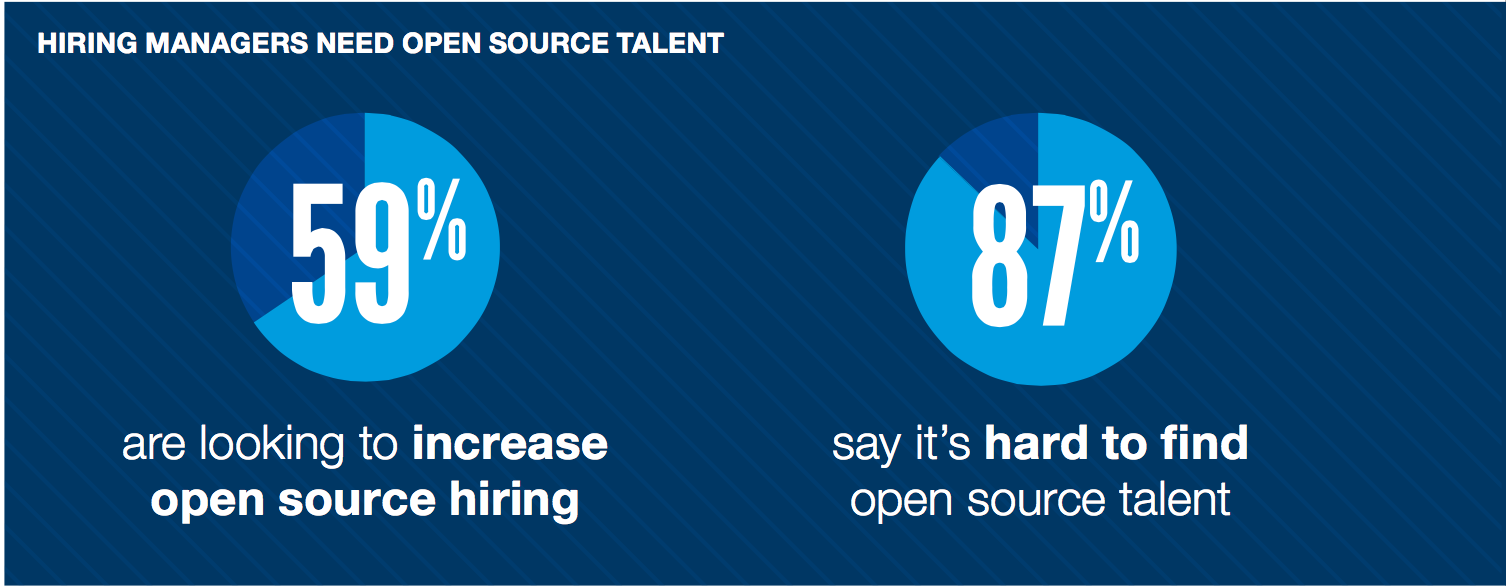
The recent Linux Foundation and Dice Open Source Jobs Report found that identifying open source talent is not easy – 87 percent of hiring managers reported difficulty finding qualified individuals for these positions – while demand continues to be high, with 65 percent reporting they are expanding open source hiring more than other parts of their businesses. And it’s important to understand that open source professionals may be different than other employees, with only 2 percent stating money and perks to be the best part of their job – instead they like working on interesting projects (31 percent) and with the most cutting edge technologies (18 percent) in a global, collaborative community (17 percent).


The Linux Foundation is the organization of choice for the world’s top engineers, developers and companies, working with the worldwide open source community to solve the hardest technology problems by creating the largest shared technology investment in history, which together deliver an economic impact never seen before. We encourage more organizations to think about their open source strategy, hire individuals with the skills necessary to meet these challenges and train current staff in the latest, cutting-edge open source technologies. Those who do will reap the rewards of more effective technology at a lower cost, while helping to affect the lives of countless people in a positive way.

Learn more about open source training and certification options at https://training.linuxfoundation.org/.


linux-com_ctas_may2016_v2_opensource.jpg?itok=Hdu0RIJn

IBM Launches System for Building and Managing Data Lakes

The growing interest in so-called data center operating systems such as OpenStack and Mesosphere Inc.’s DCOS has spurred IBM Corp. to join the fray today with its own automation platform. Dubbed Spectrum Conductor, the software promises to do away with much of the duplicate componentry and expenses that burden IT departments.

According to the vendor, this feat is made possible by a homegrown access mechanism that provides the ability to share information among the applications that need it instead of having to make a separate copy for each. Much of the credit goes to File Placement Optimizer, a set of low-level data management features included in Spectrum Conductor that accelerate read and write operations. IBM says that the benefits become especially pronounced in environments with multiple Spark instances, where its software can move infrastructure resources around as usage patterns change.

Read more at SiliconAngle

Containers 101: Docker Fundamentals

Understand Docker images, containers, and registries and how they deliver the benefits of immutable infrastructure and software reuse.

Docker started out in 2012 as an open source project, originally named dotcloud, to build single-application Linux containers. Since then, Docker has become an immensely popular development tool, increasingly used as a runtime environment. Few — if any — technologies have caught on with developers as quickly as Docker.

One reason Docker is so popular is that it delivers the promise of “develop once, run anywhere.” Docker offers a simple way to package an application and its runtime dependencies into a single container; it also provides a runtime abstraction that enables the container to run across different versions of the Linux kernel.

Read more at InfoWorld

Price Is Not the Driving Factor in the Cloud Services Biz

According to 451 Research’s latest Cloud Price Index (CPI), the cloud services sector is a long way from being a commodity market. Price, the CPI indicates, barely affects market share, while value-added services comprise the real driver in the sector.

Amazon Web Services (AWS) and Google have been cutting virtual machine (VM) prices relentlessly for a while now, spurring some to refer to this tactic as a “race to the bottom.” And although 451 Research finds that VM pricing has dropped 12 percent on average over the past 18 months, it conversely found that the price of storage, load balancing, bandwidth, and other services has remained stable and continues to provide margins.

Read more at SDx Central