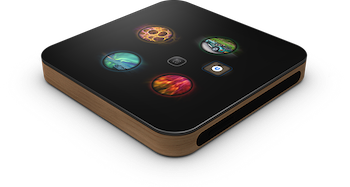
 A Finnish startup called Solu Machines is closing in on its Kickstarter funding for a smartphone-like mini-PC with a Linux-based, cloud-oriented operating system and a novel UI stack. Funding packages start at $388 for the Solu, which would join a fairly short list of mini-PCs with pre-installed Linux, and an even smaller group of ARM-based Linux mini-PCs. Solu is much more singular than that, however, in that it’s a battery-powered touchscreen device that can also drive a 4K display. It is not only replacing standard PC and phone paradigms with a fully cloud-based platform, but is also reinventing the user interface.
Solu’s SoluOS, which was confirmed by Softpedia to be built around Linux, aims to help users “share documents and applications and work co-cooperatively,” says Solu. The cloud-oriented platform provides unlimited access to SoluOS apps, as well as encrypted storage, with automatic maintenance and backup, and “without any annoying in-app purchases or advertisements.” The device, which also works offline, will support “legacy” Android apps as well, says Solu Machines.
The intriguing SoluOS interface is based around network diagrams linked to various projects. Instead of looking for specific apps and documents, you zoom in on content based on projects. The design has an organic look and feel, while at the same time looking like something you might see on the bridge of an alien spaceship.
The Solu runs SoluOS on a “4-Plus-1” Nvidia chip, which would appear to be the Tegra K1. The 2.3GHz, quad-core, Cortex-A15 SoC features Nvidia Kepler graphics with 192 CUDA cores. The 102x102x13mm device has a wooden exterior except for the square, 1440×1440-pixel, 450ppi, edge-to-edge touchscreen. There’s no mention of a display port, so it would appear Solu uses the sole USB Type C port to plug into a monitor and drive a 4K display. The 1200mAh battery powered Solu ships with 4GB of LPDDR3 RAM and 32GB of local storage, and provides dual-band WiFi (802.11a/b/g/n) and Bluetooth 4.0.
Early bird Kickstarter packages for the Solu are available through Nov. 14 for 349 Euros ($388), a discount from the eventual retail price of 449€, with shipments starting in May 2016. The price includes three free months of access to Solu’s cloud platform, which will normally cost 20€ (about $22) per month. A 749€ package gets you an early version in January.
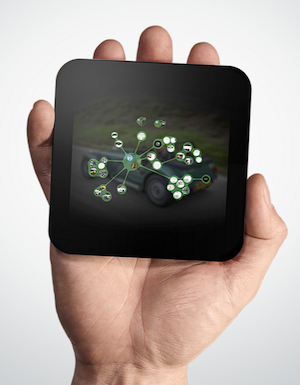
Reinventing the Interface
It takes courage to attempt a completely novel UI like SoluOS. The fact that innovative interfaces rarely succeed doesn’t mean we shouldn’t keep trying to reimagine the way we interact with computers. Maybe it’s just a Finnish thing, as the Linux-based Sailfish OS from Finland-based Jolla also pushes the limits of our mobile UI expectations, although not as dramatically.
With its rounded, square-shaped, wooden exterior, and novel Linux-based UI, Solu seems a bit like Monohm’s Firefox OS-based Runcible, but without the cellular telephony and round display. With its support for large-screen displays, Solu is also somewhat similar to Canonical’s vision for its Ubuntu Phones, and its cloud-based approach, meanwhile, reminds one of Chrome OS.
The fluid, spider web-like UI brings to mind other unusual interfaces that have popped up from time to time. One of the weirdest was a fan-like UI that appeared on the LiMo (Linux Mobile) based Else phone. The Else wowed the media in demos back in 2009 but never shipped. (LiMo, meanwhile, went on to form a good chunk of Tizen.)
It’s certainly not a coincidence that all of the above listed products run Linux. Open source projects have a way of making the impossible seem possible. As for open source, however, Solu Machines says only that “We are looking into possibilities to open source part or all of the work.” The app development model is also unclear. “We are providing talented developers with the opportunity to make a living out of their great apps by sharing a portion of the monthly fee with them,” says Solu.
Without great assurances of open source licensing and governance, or at least a clearer path to profits, Solu may have trouble attracting developers. Beyond the considerable challenges of launching a new computing ecosystem, Solu faces some more specific obstacles. The starting price is fairly high for a device with minimal features and without cellular support, and the $22 a month subscription may also give potential users pause. Solu also faces the same user expectation gaps that Google had with Chrome OS. The Solu FAQ concedes that there will initially be limited support for printers and scanners, with support improving over time.
The Kickstarter page text and videos provide plenty of inspiring talk about changing the world, including a stirring video from Finnish rapper Paleface defying the inevitable critics to howl. Yet, there are relatively few details on how the software works, or how users will collaborate on documents. The company cannot specify how it will achieve Android compatibility except to say that for now it is using the adb command-line interface.
Still, with 17 days to go, Solu seems likely to make its goal of $227,812.00, and it already has $1.3 million in seed investments. Assuming the collaboration tools are there, along with the rest of the technology, one can conceive of startups or highly mobile corporate teams buying a bunch of Solus for its team members to keep them focused on projects with limited distractions.
In any case, close to 500 Kickstarter backers have either acquired an inside track on the new computing paradigm or an interesting, wooden-backed conversation piece they can someday donate to the Computer History Museum. Changing the face of computing is not without a little risk.

 The new rules for exemptions to copyright’s DRM-circumvention laws were issued today, and the Librarian of Congress has granted much of what EFF asked for over the course of months of extensive briefs and hearings. The exemptions we requested—ripping DVDs and Blurays for making fair use remixes and analysis; preserving video games and running multiplayer servers after publishers have abandoned them; jailbreaking cell phones, tablets, and other portable computing devices to run third party software; and security research and modification and repairs on cars—have each been accepted, subject to some important caveats. The exemptions are needed thanks to a fundamentally flawed law that forbids users from breaking DRM, even if the purpose is a clearly lawful fair use….
 Rausch Netzwerktechnik
 The founder was Bernd Rausch in 1998. He sold the company in 2008. In 2015, I made a management buyout and now, with a friend, hold 100% of the shares. Since the beginning, we have been selling hardware for the data center, especially for Internet Service Providers. Most of them were standard server systems, then later more and more customized systems. The most important point was to increase the density and/or the efficiency. Power consumption is a big problem of data centers, and we always try to optimize our systems. In the meantime, we are selling to data centers all over the world, most of them are service providers or in the HPC sector.
 Based on OpenStack Liberty, delivers high availability and non-disruptive upgrades plus Docker and IBM z/VM mainframe virtualization support to ease transition of enterprise workloads to the cloud.