I believe this idea is one of my more interesting ones. Inspired by those advanced AI chat bots or assistants. Would it not be interesting if there were a free and open source educational chat bot that would know the contents of your university textbooks. I mean the idea is simple. We remember better if we are engaged. So I thought. If the students would chat with the software bot they would remember much better. I think this would work much better than if they were just given steps to follow.
This could also work for smartphones. Maybe also in refugee educational situations. Here you want a better way to get the information than to read the whole thing on a small screen. Then why not use text to speech and text chat. Voice recognition if it works would be awesome . Just place the phone next to the pen and paper.
So the idea is for an educational chat bot for math, physics and other subjects. Let the bot read or present the theory to you while at the same time you can interrupt it and ask questions. Even if they are standard questions to begin with. It will be quite powerful. // peroglyfer.se
So, Ubuntu 16.04 LTS is finally here and many of us are already getting our hands dirty with the final version of the most popular distribution that is using the X window system. While this long-term support release does look good, the upcoming major changes planned for Ubuntu 16.10 have generated great excitement.
Technology has had a profound impact on all of our lives, yet the stories of many of the people behind it are rarely told. So John Shewchuk, a Microsoft Technical Fellow, put together the Decoded video series on YouTube to tell these stories. The series focuses on non-Microsoft technologies used by Open Source developers. In the first two episodes we focused on responsive user interfaces with Jacob Thornton, a co-inventor of Bootstrap and the inventor of NPM (watch the first episode, below).
With such a great stories to tell why leave it to just a YouTube series? We’re not!
We are going to have our first Decoded conference. Linux and OSS are already increasingly becoming a larger part of Microsoft’s developer story (Linux on Azure and Bash in Windows are great examples) and this trend is something that we continue to support. With these developments there will be a lot of great content for Linux and OSS developers.
Come join us at the Decoded conference where you can learn more about what Microsoft is doing with Open Source and Linux and meet some of John’s team that is focused on leveraging the best available technologies to help you solve your hardest problems!
Who: John Shewchuk (and his Merry Band of Engineers)
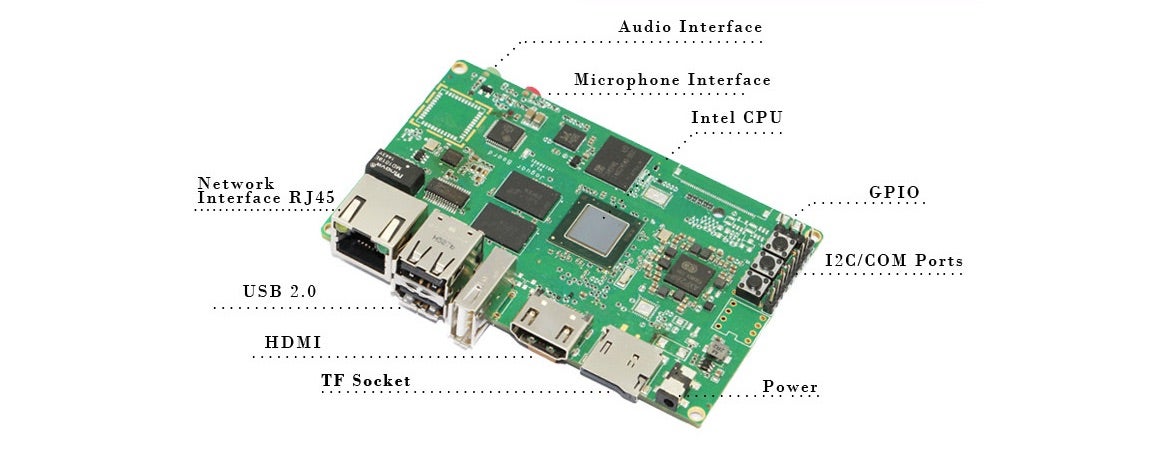
The first x86-based community-backed hacker SBCs not backed by Intel or AMD have reached market, offering higher prices than most ARM SBCs, but with faster processors and competitive power consumption. The Kickstarter-backed newcomers, all of which run Linux or Android, include the now-shipping JaguarBoard, the soon to ship UP board, and the Udoo X86, due in November.
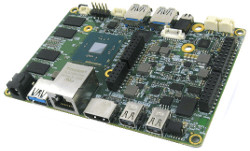
Udoo X86 board
The Udoo X86 is the only one of the trio to match the fully open source claims of the hacker boards offered by the two major x86 chipmakers, but they’re all aimed at the maker market and offer community services. AMD already sells a Gizmo 2 board, and Intel has the Atom-based MinnowBoard Max and Intel Edison for Arduino Kit, as well as its Quark-based Galileo. Yet, none of these open-spec boards are configured with chips as powerful as those driving the three newcomers, especially the 14nm Atom driven UP and Udoo X86.
The arrival of x86 hacker boards has been slowed by the high power consumption of x86 SoCs compared to ARM, as well as higher prices. The first hurdle has largely been overcome, with the UP’s Atom x5-Z8300 running at 2W and the Udoo X86’s Braswell-based Atom x5-E8000 and faster Celeron N3160 SoCs offering 5W and 6W TDPs, respectively.
Pricing, however, is still a challenge. While these $80 to $100 boards are still in the hacker board ballpark, most of the ARM action is now happening at $35 or under, as with the Raspberry Pi 3, and several boards are selling for well under $20.
Still the new entries compete better with higher-end ARM boards, few of which offer quite the same CPU horsepower. And the Udoo X86 in particular provides features that are still rarely seen on the ARM side, including DisplayPort, SATA, and M.2 expansion.
Intel just tipped a lower-cost Apollo Lake Atom system-on-chip expected to arrive later this year in 2-in-1s, tablets, and budget mini-PCs. Apollo Lake will debut 14nm “Goldmont” cores as well as Gen9 graphics similar to that found on Intel’s 6th-Gen “Skylake” Core CPUs.
Although embedded is not the main focus, price and the power consumption will be lower than with Braswell Atoms. In addition, Apollo Lake is loaded with interfaces like GPIO, I2C, SPI, and PWM, that would be welcome on a hacker SBC.
Here’s a quick look at the new JaguarBoard, UP board, and Udoo X86:
JaguarBoard — Jaguar Electronic HK’s JaguarBoard launched in January, and has already shipped to backers. The 101.9 x 64.5mm SBC is the most affordable of the three newcomers, offered at $65 to Kickstarter backers, and now available for $79.
The JaguarBoard’s lower price reflects the fact that it runs on Intel’s older, 22nm, “Bay Trail” Atom Z3735G, and offers only 1GB of RAM and 16GB flash, The SBC ships with an SD slot, HDMI, 10/100 Ethernet, and three USB 2,0 ports, among other I/O. Total consumption is said to be under 7.5W. There are no claims for open hardware, but there’s a forum and other community resources.
UP board — Asus-backed Aaeon Europe’s UP board will begin shipping to Kickstarter backers in early May. Based on a 14nm “Cherry Trail” Atom x5-Z8300, the UP has a Raspberry Pi-compatible 40-pin connector, and offers a similar, 85.6×56.5mm size and port layout.
The quad-core Atom x5-Z8350 is clocked at 1.44GHz (1.92GHz burst) and provides 4K-ready Intel HD 400 Graphics. You can choose between 1GB ($89) or 2GB ($99) DDR3L-1600 RAM, each with 16GB flash, expandable to 32GB, and there’s a new 4GB version with 32GB of flash that goes for $149. Intel is using the latter configuration for a $250, Ubuntu-driven Intel RealSense Robotic Development Kit, which includes an external RealSense depth-sensing camera.
The UP board ships with DSI and eDP display interfaces, and offers CSI camera and I2S audio ports. Other features include a Gigabit Ethernet port, three USB 3.0 ports, and six onboard USB interfaces. Aaeon just launched its UP Community website, which features a new Yocto Project build, but there’s currently no forum, and no schematics or other open spec resources.
Udoo X86 — Last week, Seco’s Udoo project, known for open-spec SBCs like the i.MX6-based Udoo Quad, surpassed its Kickstarter goal for its $89 and up Udoo X86. With its quad-core, 14nm Braswell-based Atom and Celeron processors, the open-spec Udoo X86 is billed, somewhat justifiably, as “the most powerful maker board ever.” Then again, it won’t ship until November, by which time we can expect several more x86 hacker SBCs to break cover.
Kickstarter funding is available through June 6 for the $89 Udoo X86 Basic (1.04GHz with 2.00GHz burst) with 2GB of RAM and an Atom x5-E8000 SoC. There’s also the $129 Udoo X86 Advanced with 4GB RAM and a faster Celeron N3160 (1.60GHz with 2.24GHz burst). Both options can drive three simultaneous 4K displays.
The 120x85mm Udoo X86 is equipped with 8GB of eMMC, as well as a microSD slot and a SATA connector with optional solid state drives. The SBC features HDMI and dual DisplayPort++ ports, plus S/PDIF and analog audio outputs. Other features include a GbE port, three USB 3.0 ports, an IR interface, and 20 GPIOs. An M.2 Key B slot supports an optional 802.11ac and Bluetooth 4.0 module.
The Udoo X86 is the first hacker SBC to integrate the tiny Intel Curie module, which incorporates a Bluetooth Low Energy radio, and a Quark SE MCU. The Quark enables Arduino 101 IDE compatibility, as well as support for Arduino shields, sensors, and actuators.
IT vendors and telecos are heaviest users of open source cloud software.
One thing that’s clear is that interest in OpenStack continues to grow rapidly. The project is made up of 20 million lines of code; more than 585 companies have supported OpenStack in some way, and the OpenStack Foundation counts almost 40,000 people actively engaged in the community.
The April 2016 version of the OpenStack Foundation’s survey (read the full report here) queried 1,603 members from 1,111 organizations who oversee 405 OpenStack clouds.
In this part of our Linux Awk command series, we shall have a look at one of the most important features of Awk, which is field editing.
It is good to know that Awk automatically divides input lines provided to it into fields, and a field can be defined as a set of characters that are separated from other fields by an internal field separator.
New tech and innovative business models are changing the shape of tech employment. That role of the IT professional is changing, thanks to new technology and new business models. Rather than simply employing experts in coding and testing, businesses are keen to tap into the skills of business-focused specialists who can manage projects and deliver value.
It all means technology professionals must think very carefully about career development, says independent consultant and author Ade McCormack. He believes we are about to enter into the ‘gig economy’, where most people contract their expertise on a freelance basis.
Digital archivists have been worried about the ephemeral nature of digital storage for some time now. How can you trust vital documents to any storage technology, which will most likely be obsolete within a decade or two? Now some researchers are investigating the use of nature’s own digital storage mechanism, DNA (deoxyribonucleic acid) for long-term data retention.
At the Linux Foundation’s Vault storage conference, held last week in Raleigh, North Carolina, European Bioinformatics Institute (EBI)researcher Nick Goldman talked about the feasibility of using DNA as a long-term storage format, a talk timely not only because it was at a storage conference, but also because Monday is DNA Day.
This blog post is the first in a regular tech series from the Yell engineering team looking at challenges they face and problems they solve across Yell’s various digital solutions.
Here, Yell’s Head of Web Engineering, Steve Workman, looks back over Yell.com‘s seven-month transition to HTTPS, (a secure version of the HTTP protocol – which sends data between a browser and a website) to raise awareness of the issues with the move in the industry and to make the adoption process easier for other engineering teams.
Gone are the days of scientists processing data by hand. Scientific tools are rapidly scaling to meet the increasing demands of their users, both in terms of complexity and sheer volumes of data.
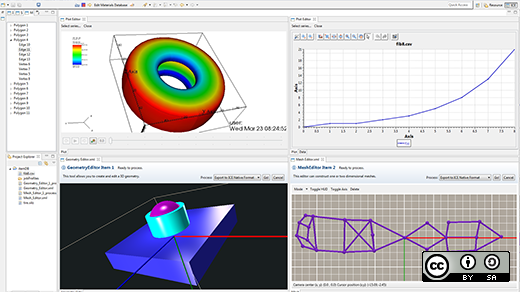
In various domains, highly sophisticated scientific workbenches have been developed to enable scientists and researchers to quickly make sense of their data in a reproducible way. Here are five great scientific workbenches from members of the Eclipse Science Group. Every one of them is open source and built on Java and Eclipse RCP.